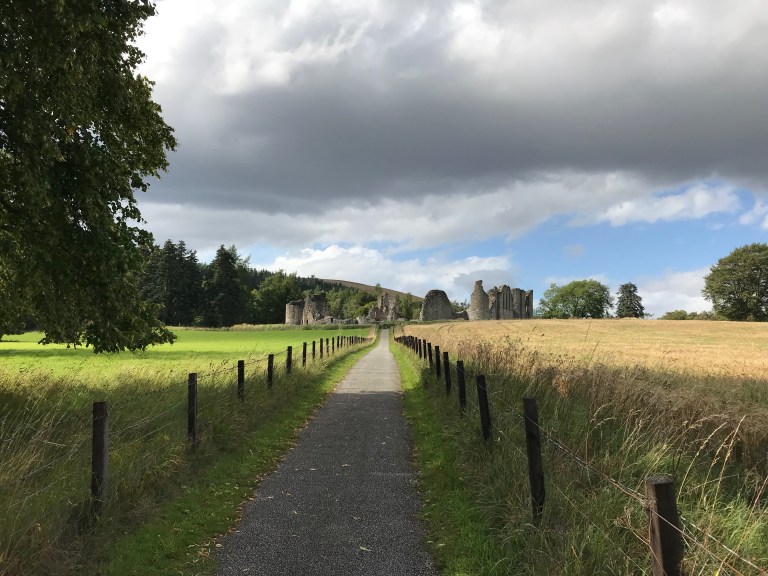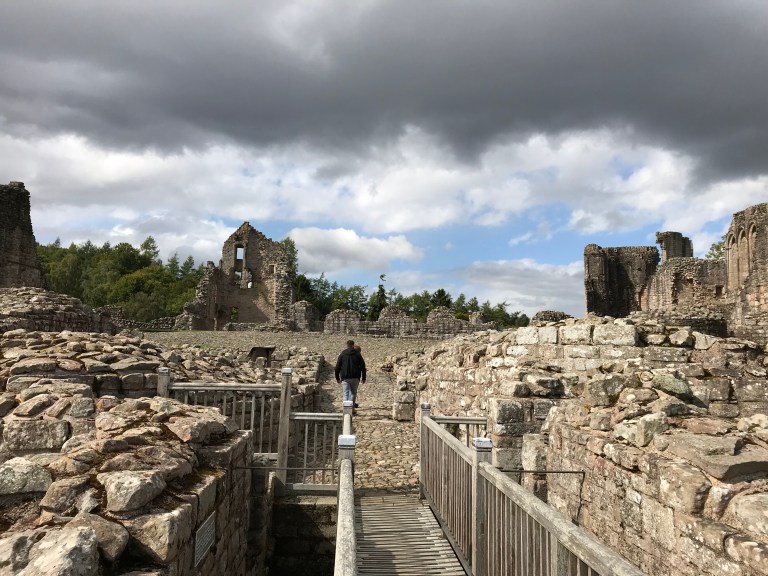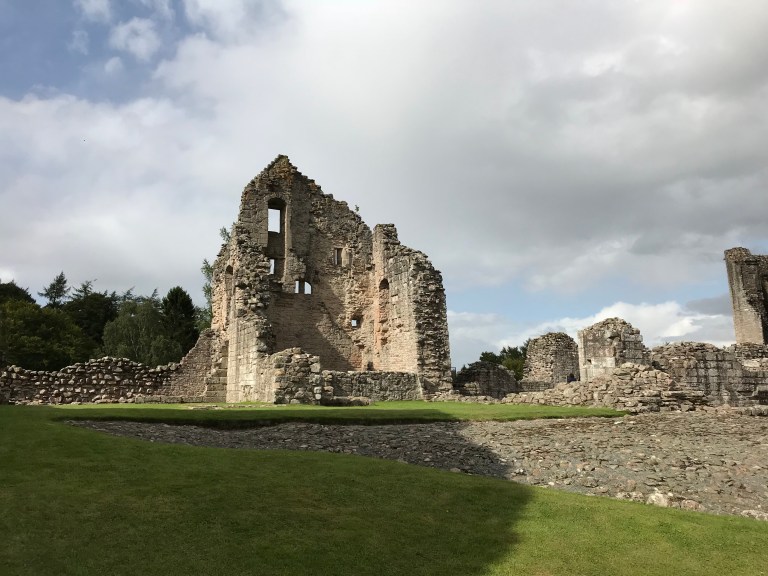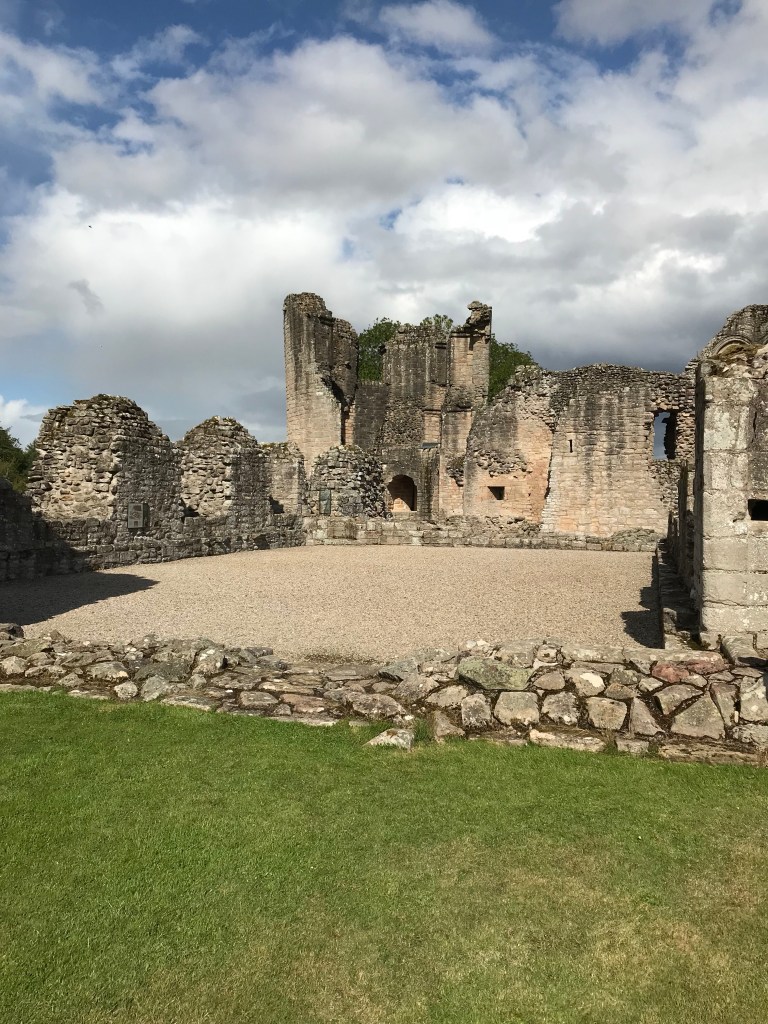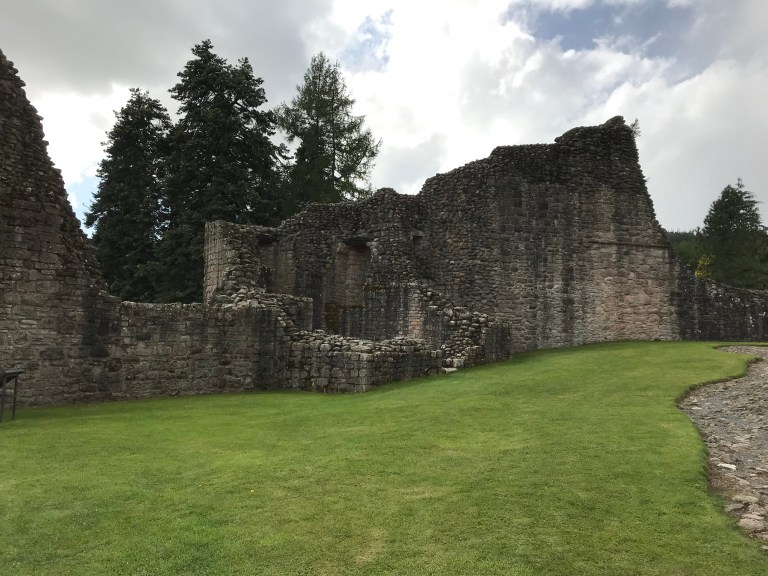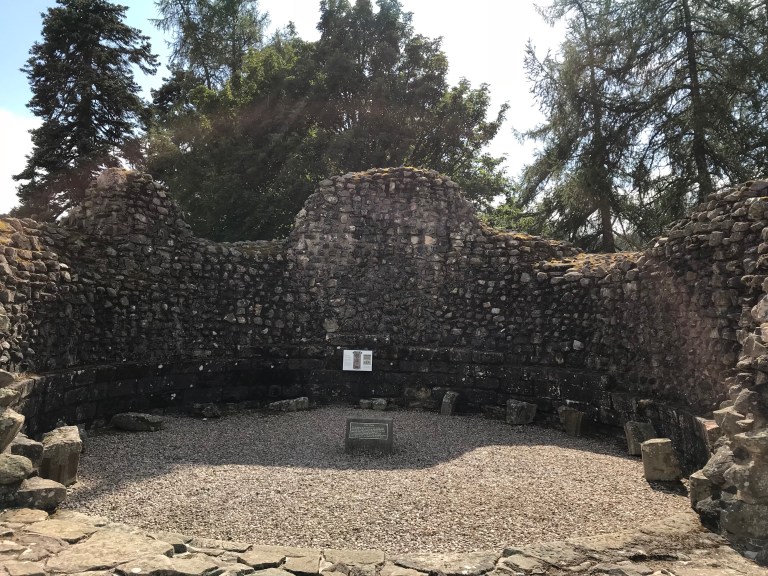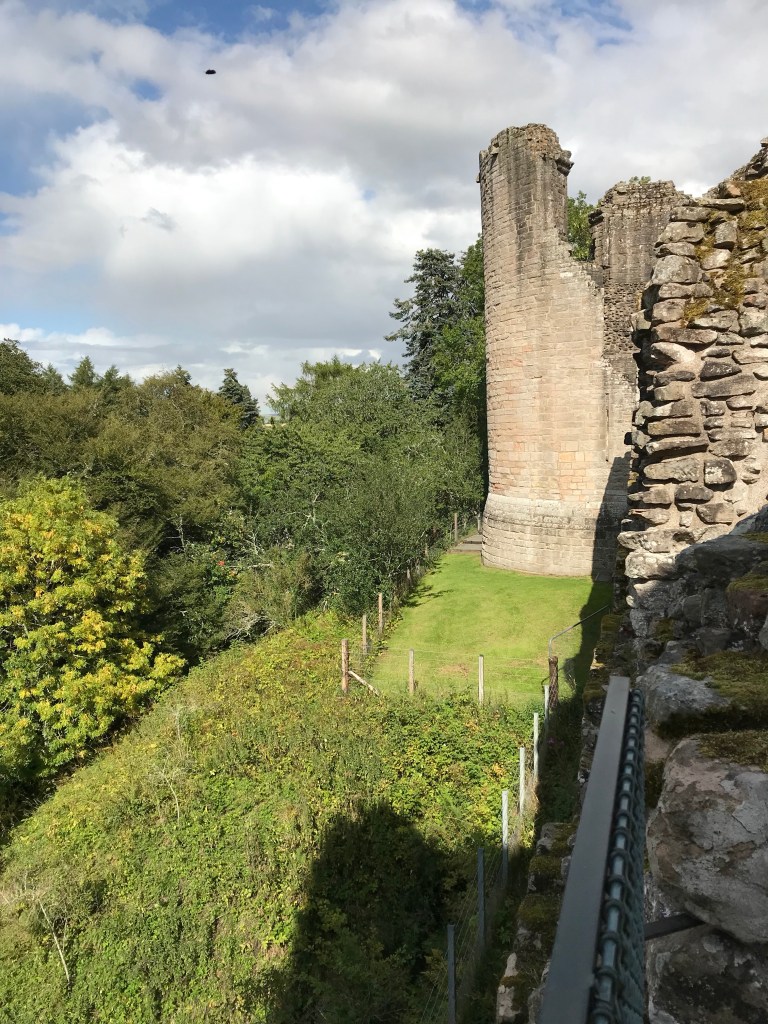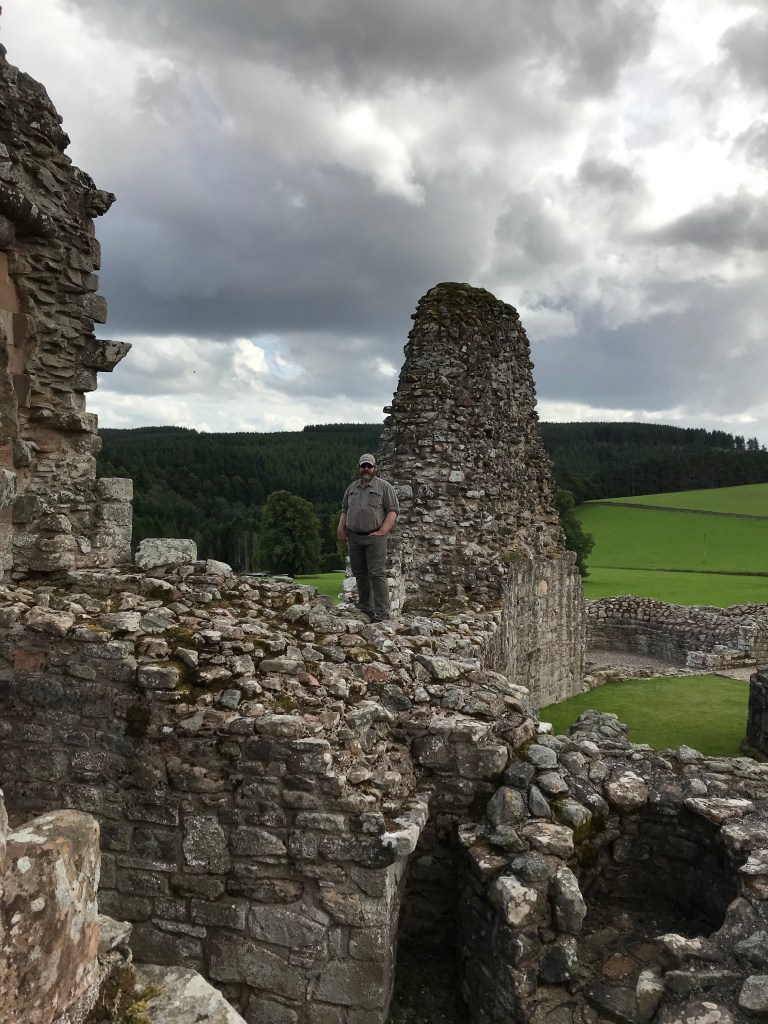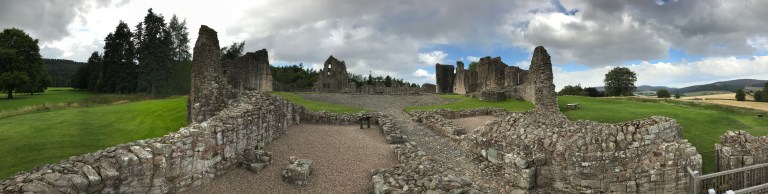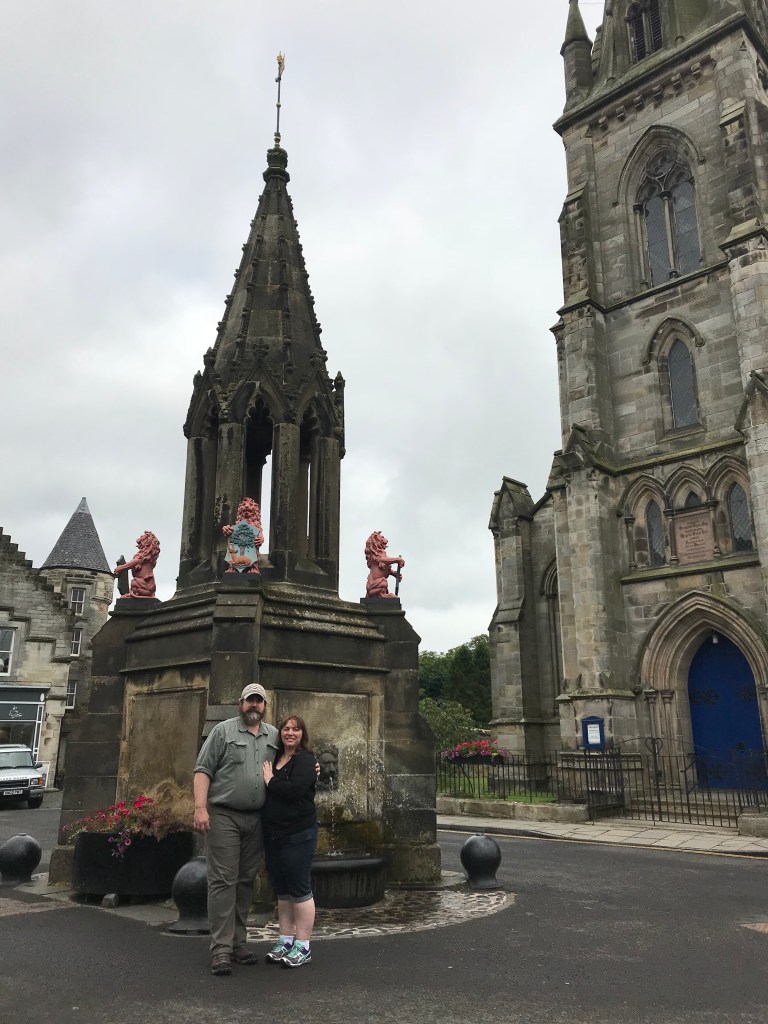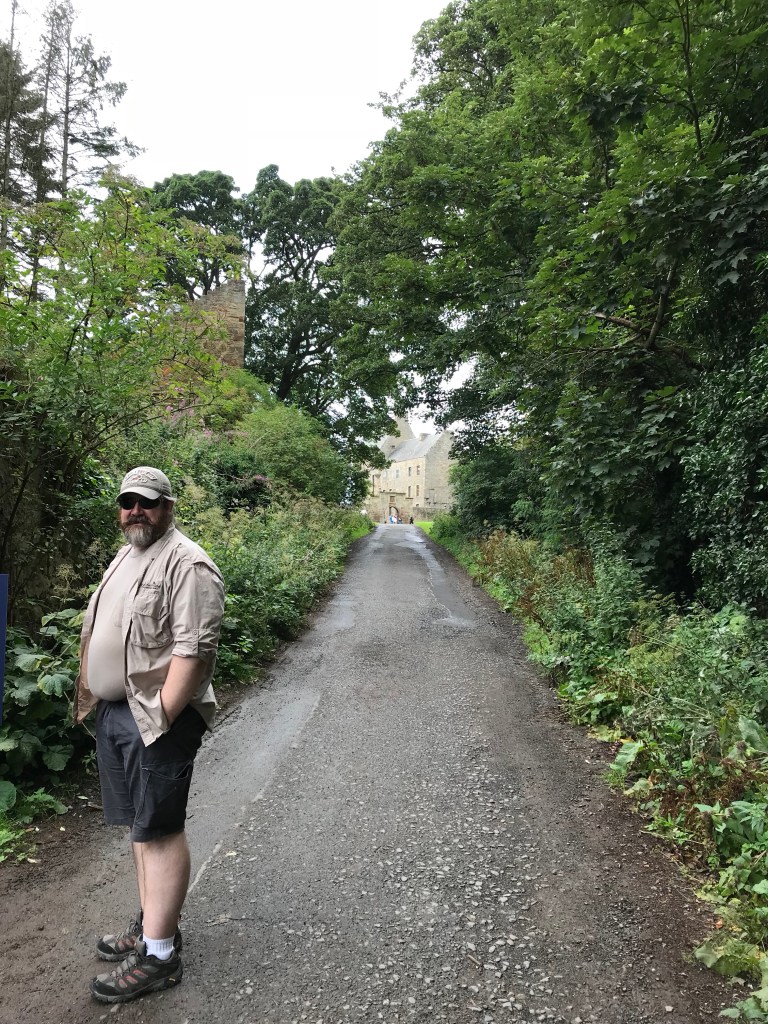
Katniss and Hawkeye

It doesn’t seem like we did a lot today, but boy am I tired anyway.

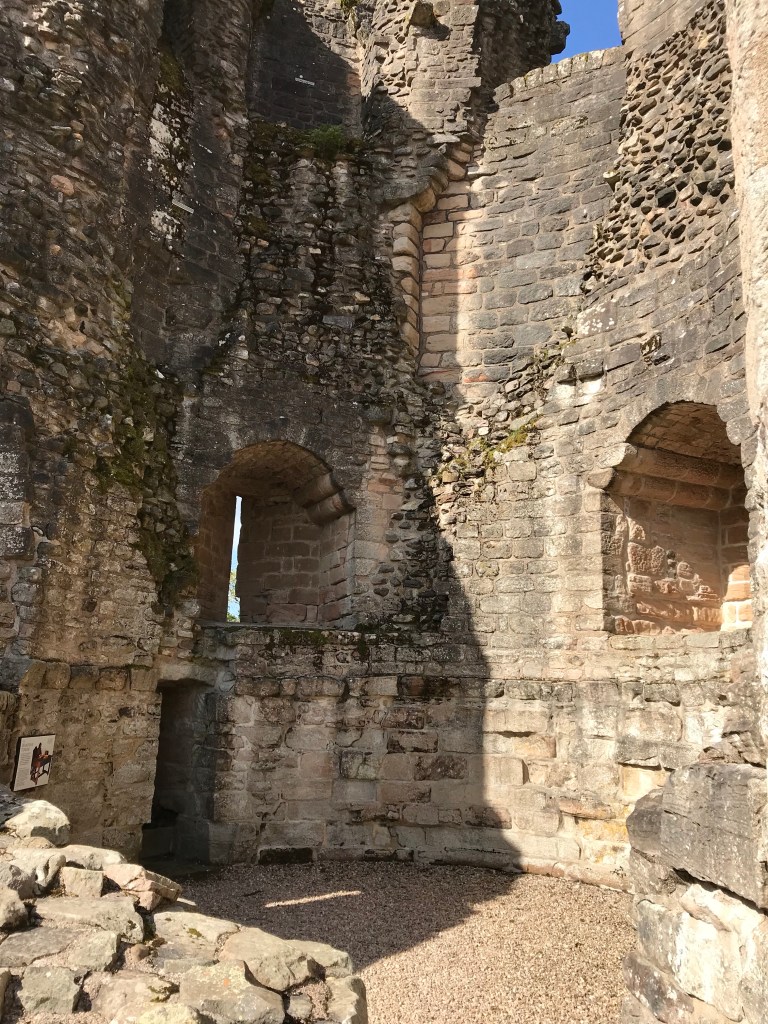
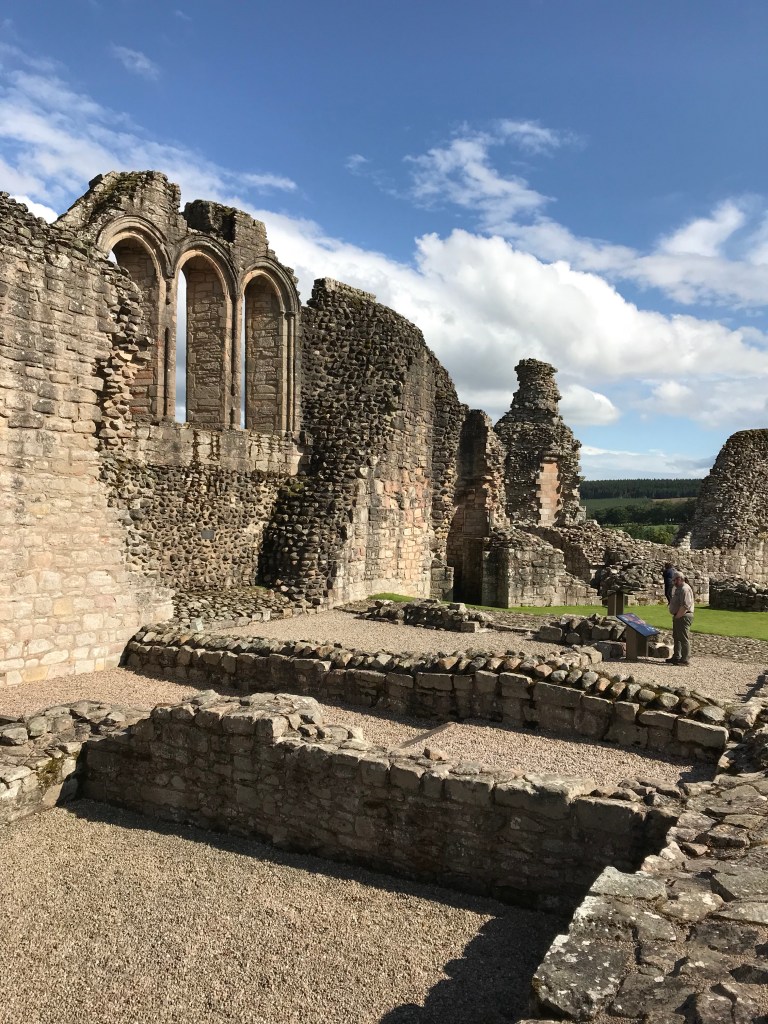
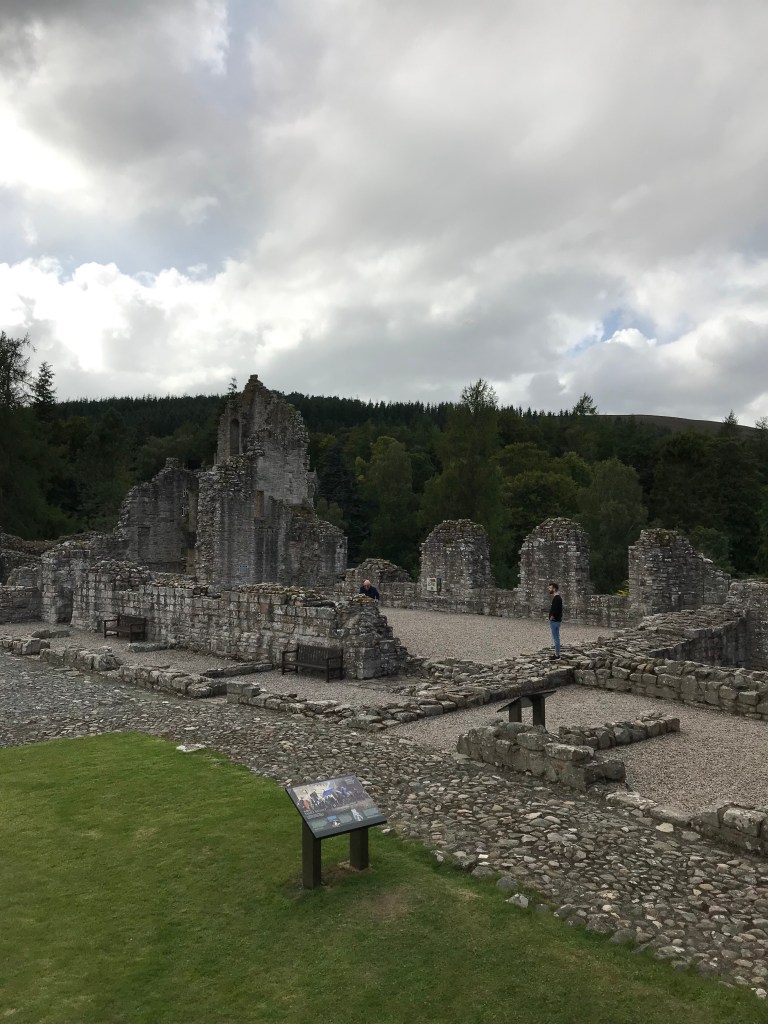
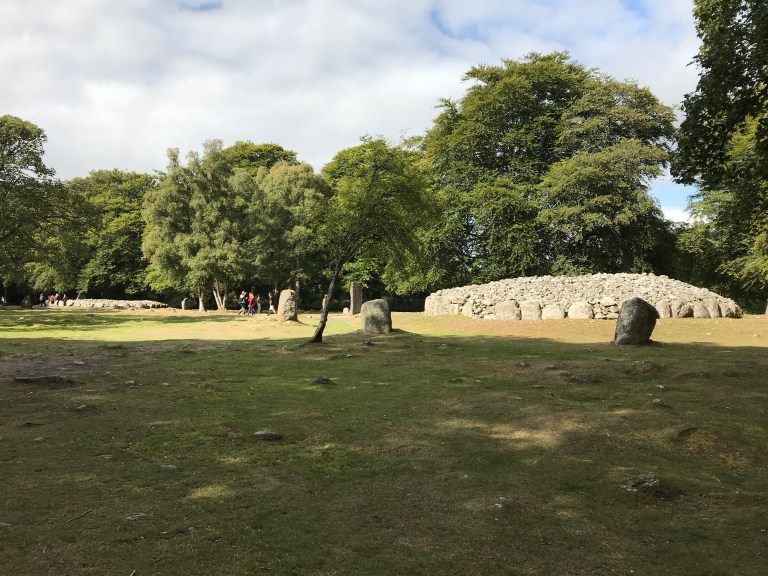
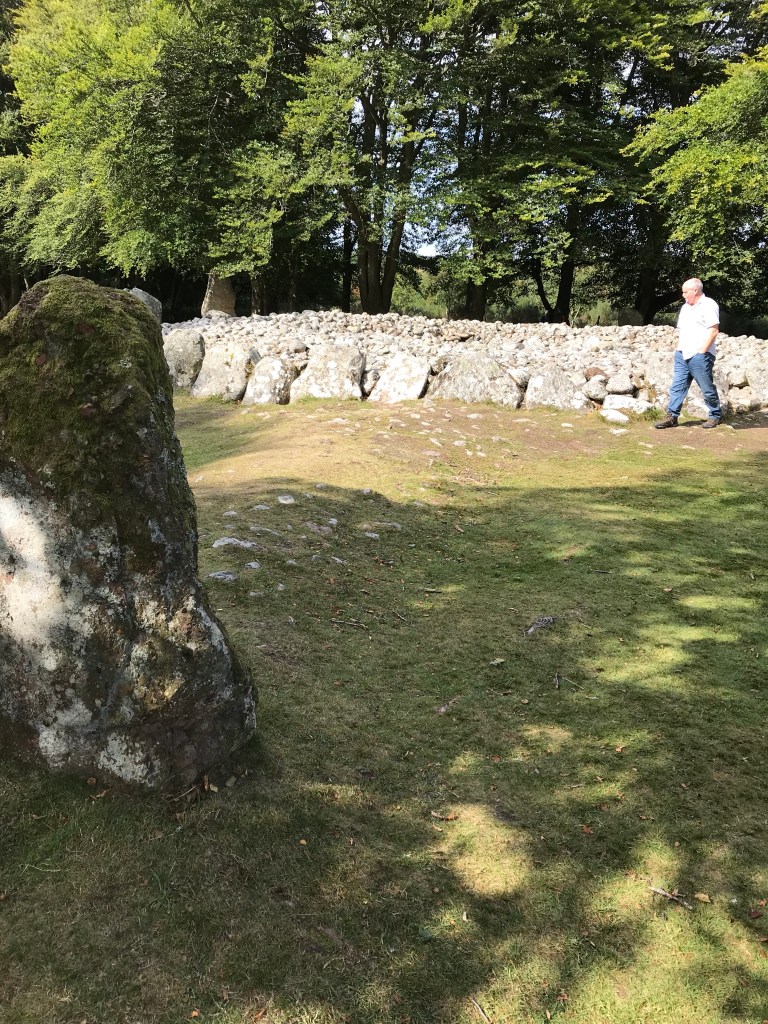
Our first of two stops was at Clava Cairns, just outside of Inverness and not far from Culloden. We did both of those the last time we were here, but did not make it to Clava. Now, this is a bit out of the way from where we intended this trip to focus, but there is a reason for that.

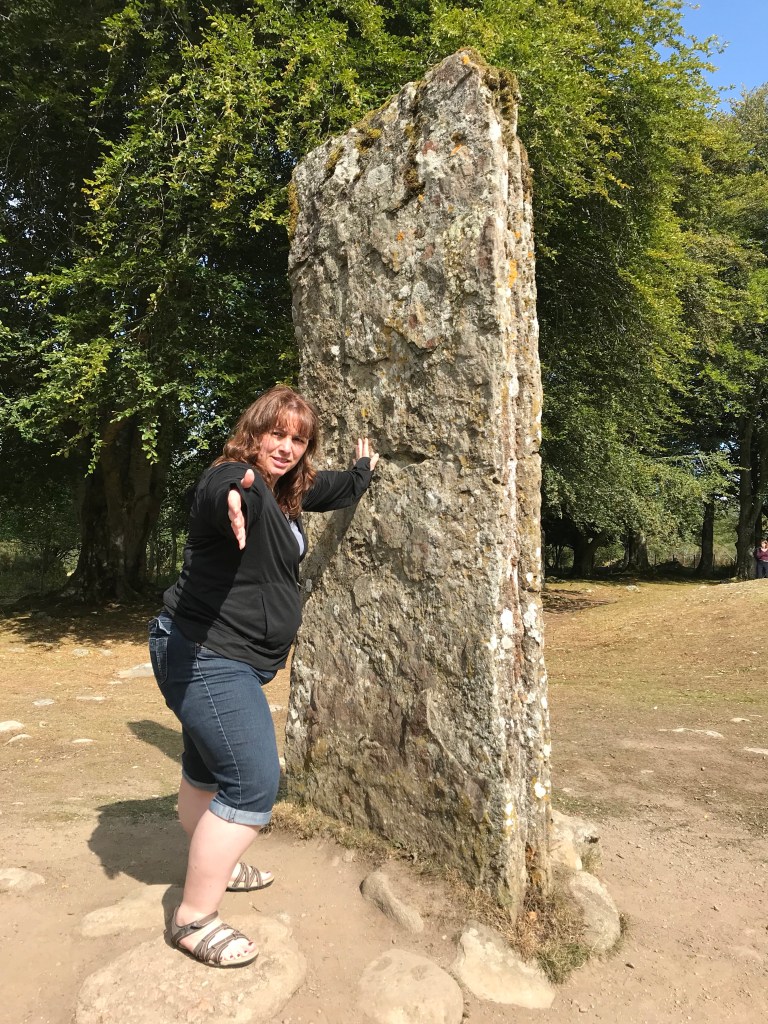
The Cairns are surrounded by standing stones, and have been dated as old as 4,000 years. Now this pre-dates the Picts, but the Picts are believed to have used the Kerb Cairn for their own cremations. So to my mind this still falls within our sub-theme of Pictish Stones.

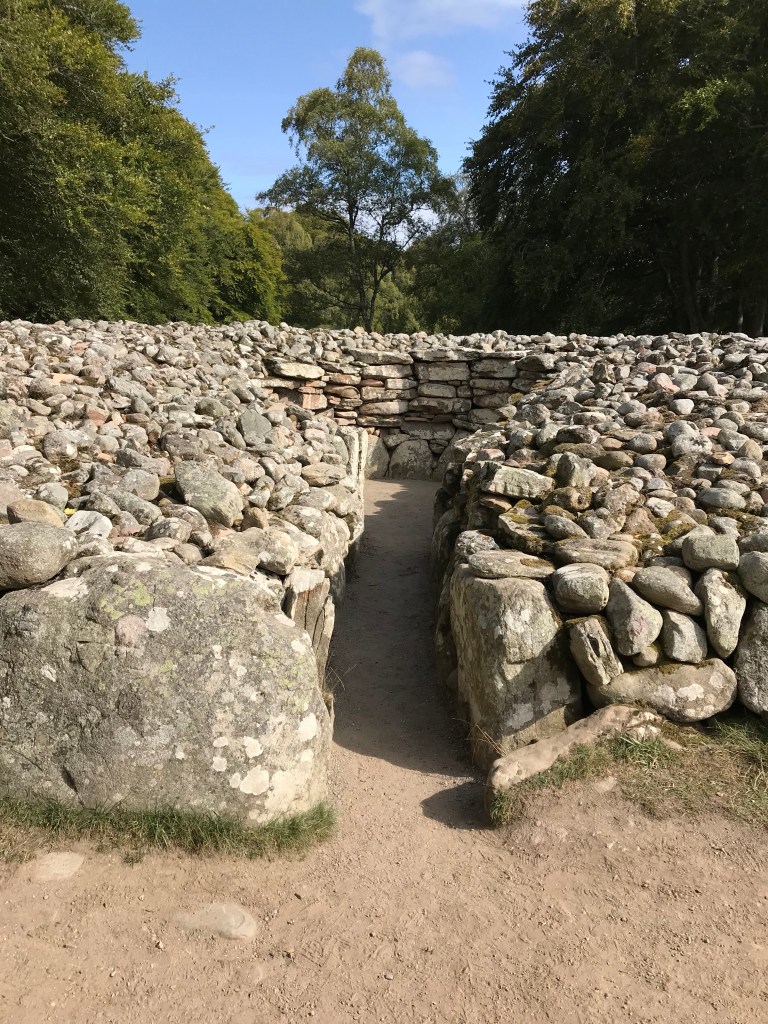
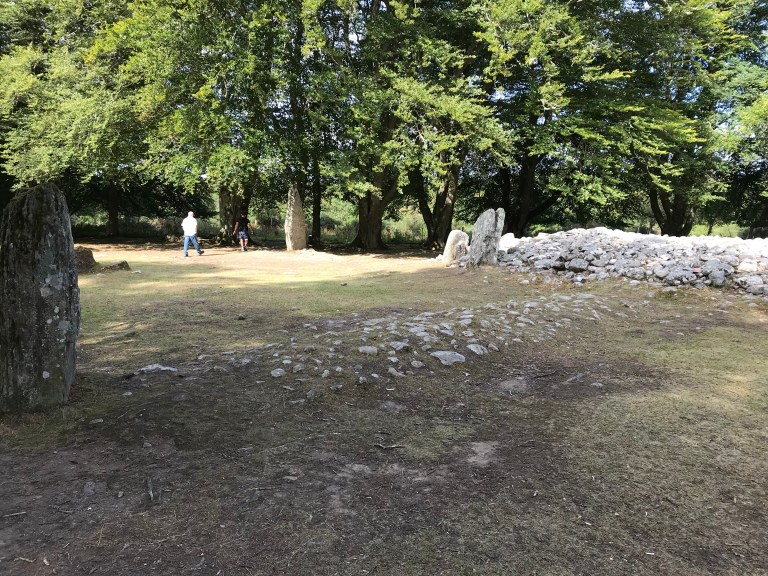
There are four cairns — three large and one small — and the three large are surrounded by circles of standing stones. The stones and entries to two of the cairns are aligned with the midwinter sunset.

The central ring cairn has no identifiable entry point, but is open in the centre and has three cobble paths linking the outer edge of the ring to the standing stones that encircle it. It is believed this ring cairn might have been used as a temple when the outer cairns were used to house the dead when they were originally built.

While fire is believed to have been an important element of the ceremonies of the ancient people’s who built these monuments, it is not believed that cremations were done here. Cremations were not yet practiced, but would be in much later times, and it is believed that the Picts may have placed cremated remains in the Ring Cairn.

The fourth, smaller cairn previously mentioned is the Kerb Cairn, and it was made about a thousand years after the three larger cairns. This is when newcomers to the area started reusing the cairns for their own burials. It is in this Cairn that there appears to be evidence of the Pictish cremation burial, which occurred in about 500-600 AD.

And yes, of course this stop was partially influenced by Outlander. Craig Na Dun was based on the Clava Cairn Stones.

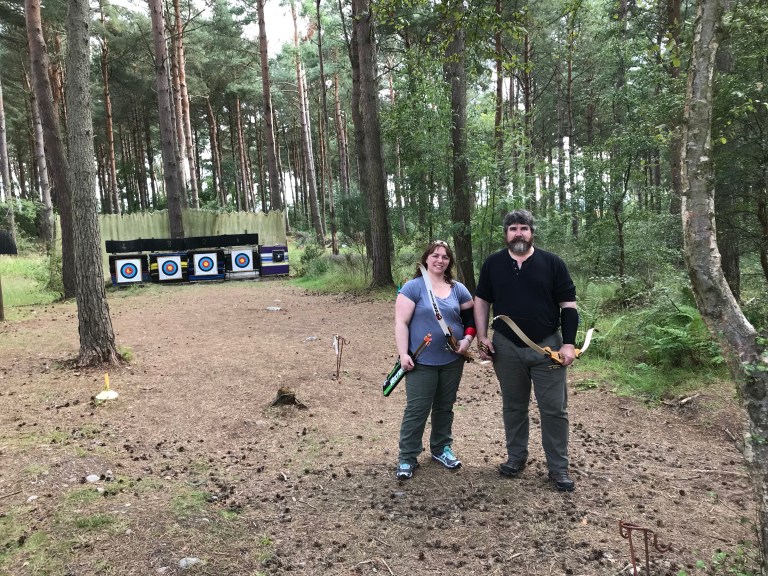
Our second stop was a surprise for Dan, and the real reason we went so far out of our way today. I booked us a two-hour introductory archery session at Bowhunter Archery. Yes, I did!

Bowhunter Archery

This was a fantastic experience that Dan and I enjoyed very much. We spent the first hour with Andy teaching us proper technique and practicing it until we got it reasonably correct.

We used recurve bows, we were taught how to string them, and we were kitted out with forearm protectors and quivers.

Andy first taught us how to target shoot, which involves using pins on the bows as sights to aim for the target. He explained that teaching target shooting technique is usually the easiest for beginners to learn and develop the proper technique. The technique involves pulling the string to the chin, and then a little more until it touches the tip of your nose.

It took three quarters of an hour of doing adequately before Andy suggested I try bow hunting instead, which means don’t use the pins, just aim from the tip of the arrow and pull to your cheekbone instead of your chin. He said most people don’t start out with bow hunting. It turns out I’m naturally inclined to bow hunting, because there was a noticeable improvement once I started using the technique.

The second hour was spent on the wilderness course they have set up in the forest. It was sort of like mini-golf for archery. You go around to different targets on uneven ground and with trees and bushes in somewhat distracting places. It tests your ability to gauge distances and where you need to aim to hit the target.

The end of the course was at the 3D site. They’ve got lizards, alligators, pigs, wolves, dinosaurs, and deer placed throughout the area for you to shoot at. We finished with a mini competition between Dan and I that we ended up tying. He got one kill shot and one wound shot to my three wound shots.

I may not have mentioned this, but despite Dan recently having purchased a recurve bow and arrows neither of us had actually ever used it. After today’s experience I think we’ll be calling our local archery club…

A couple hour drive back to Ballater followed by a short nap before supper at Clachan Grill brings us to the end of our day.

Adelle and Dan

Monkey Puzzles, Spiky Nuts, and Redwoods, Oh My!

Back to chronological order today…

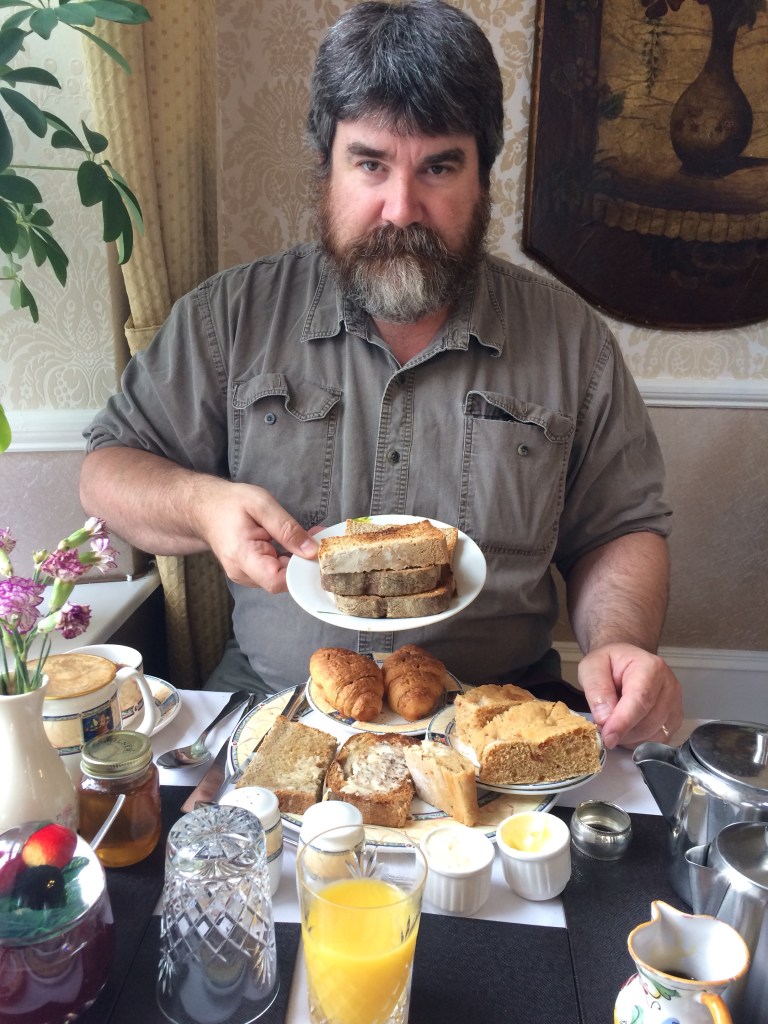
As much as we’ve loved every breakfast we’ve had so far, we had to call today’s the best just because of the fresh thick cut toast. And when I say thick cut, I don’t mean Texas cut, I mean thicker than that. So yummy!

Our theme today was meant to focus primarily on Pictish Stones, and we did see them, but we got distracted on the way with two castles and a wrong turn…and various species of trees that did not look like they fit the area.

First stop was meant to be The Maiden Stone, but when we saw the sign for Craigievar Castle on the way we diverted.

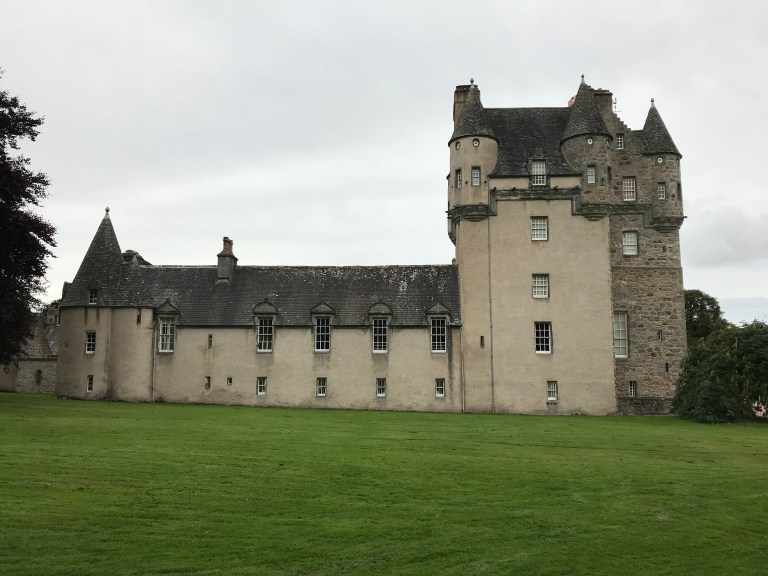
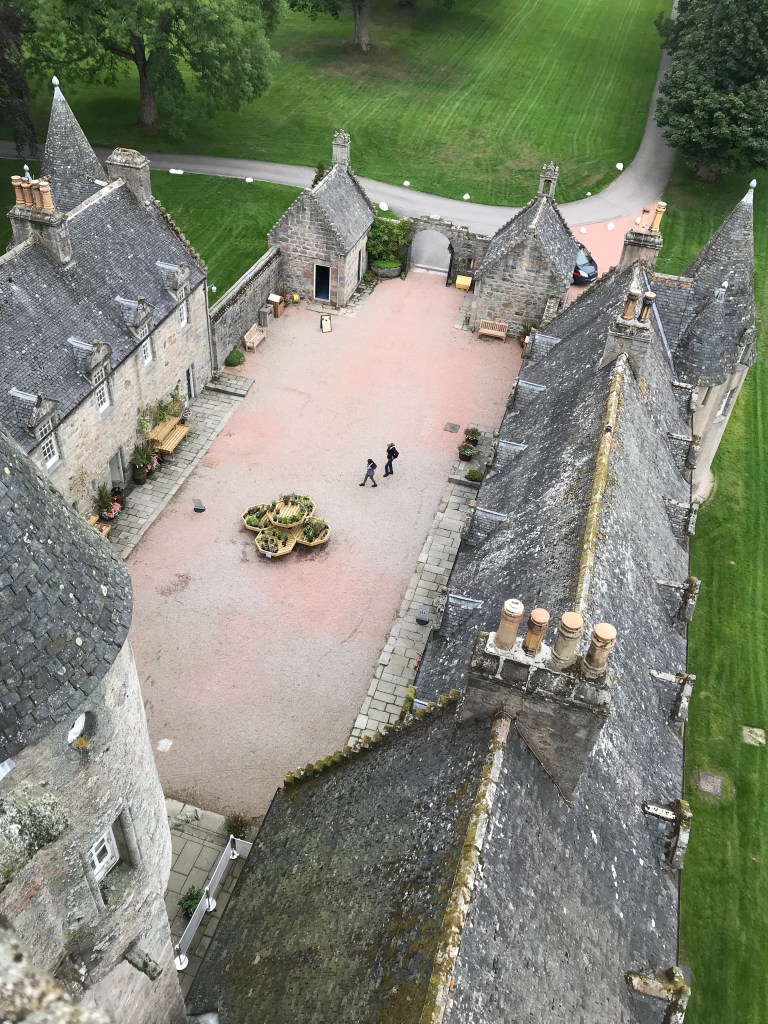
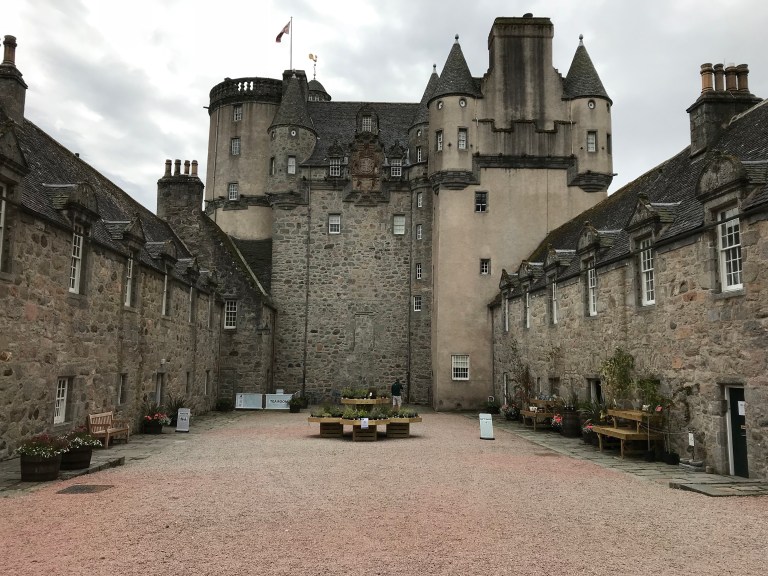
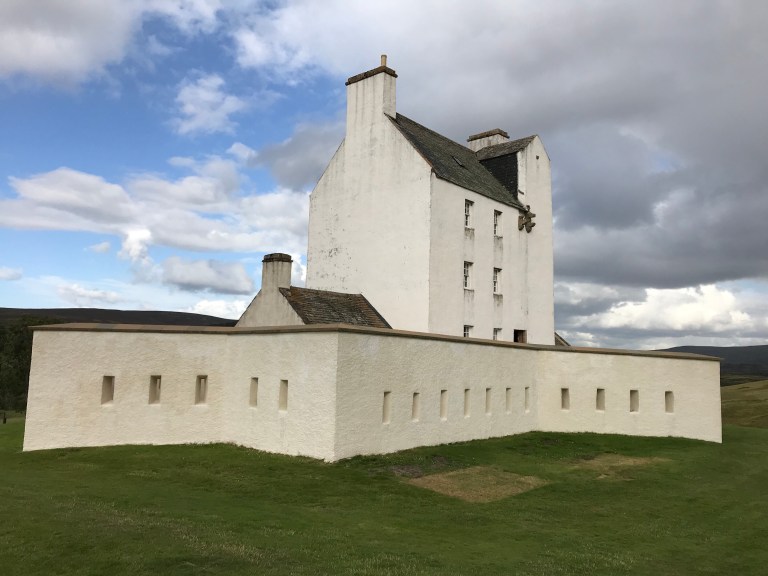
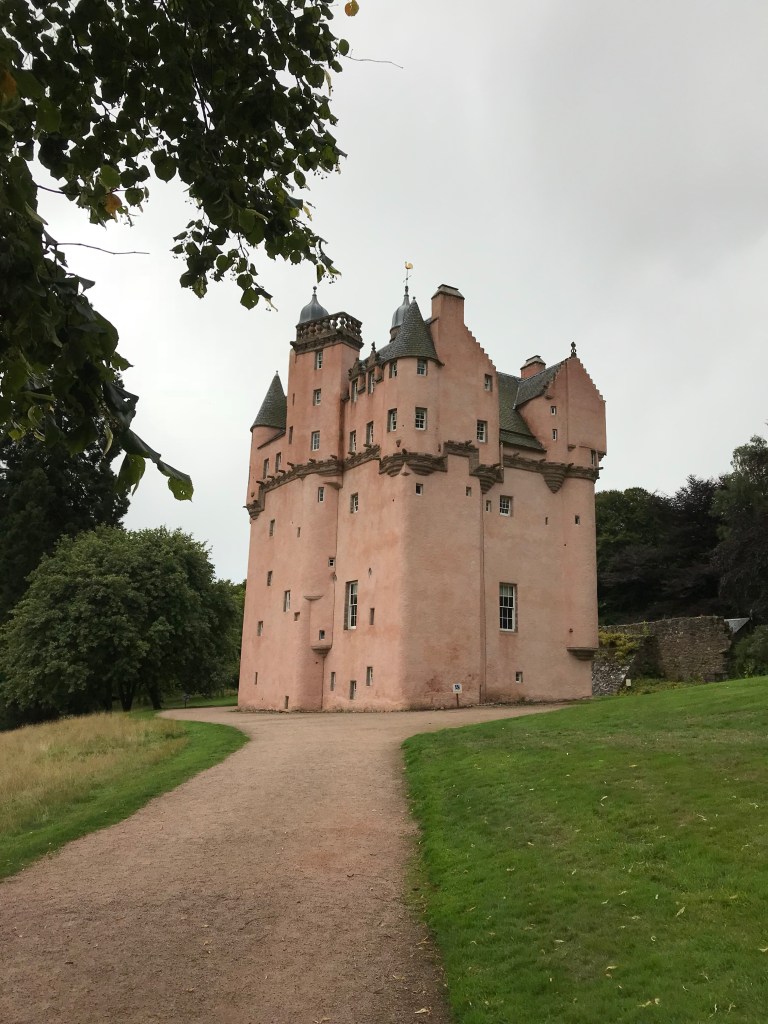
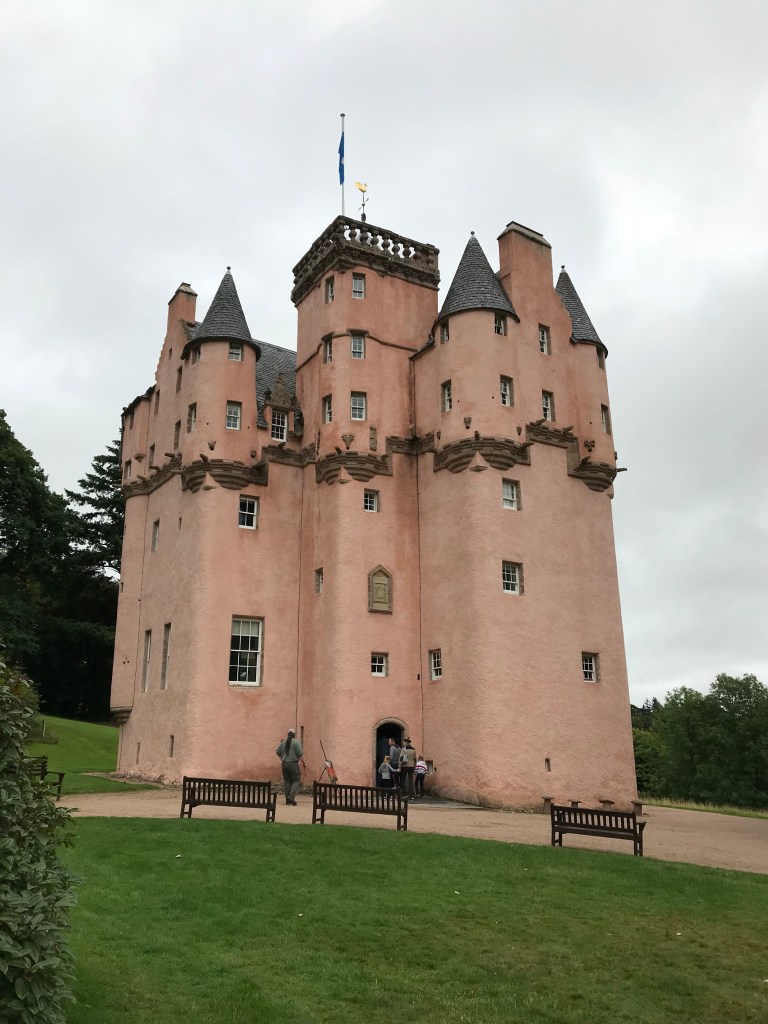
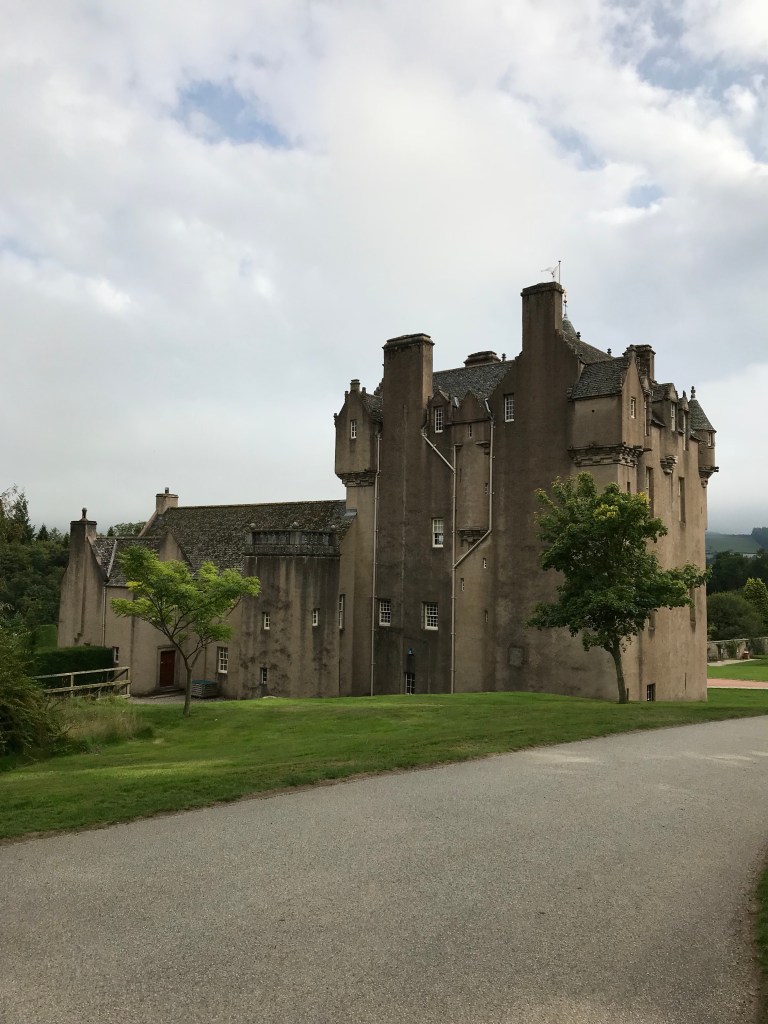
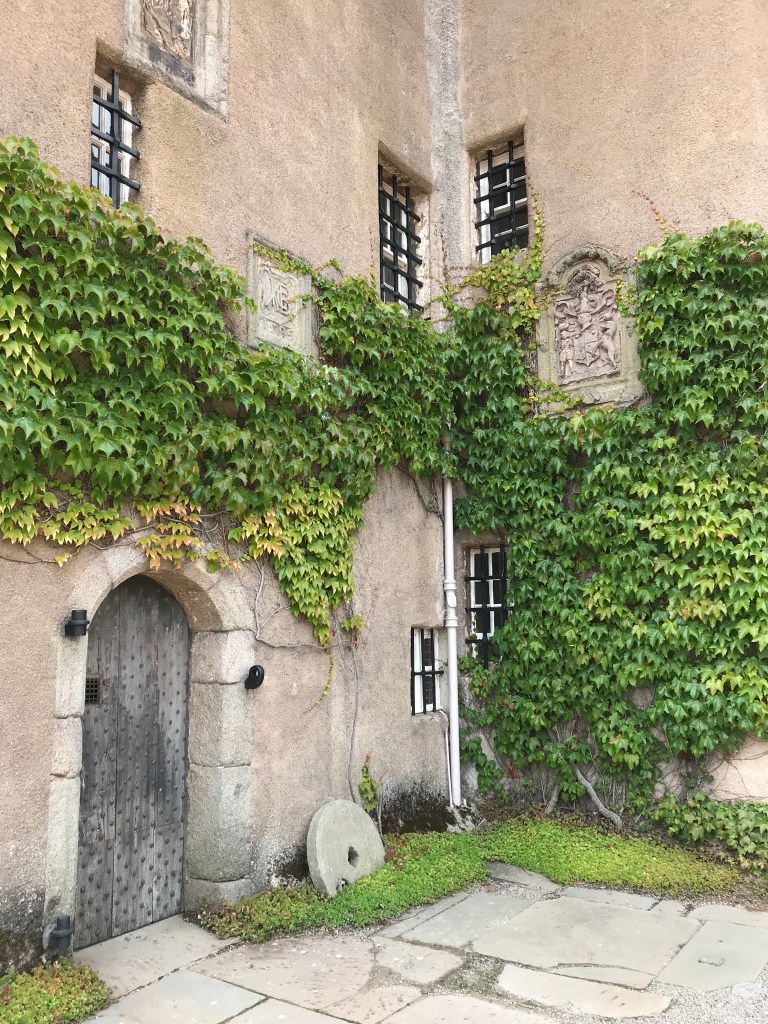
As you can see, Craigievar is a pink castle. It is made of stones, but the outside is plastered with pink-coloured lime harl. Why pink, you may ask. Well, originally it was a cream colour, but in 1825-26, after Sir John Forbes inherited the title and properties, he hired an architect by the name of John Smith who directed that the harl should match the colour of the granite mouldings; so, pink.

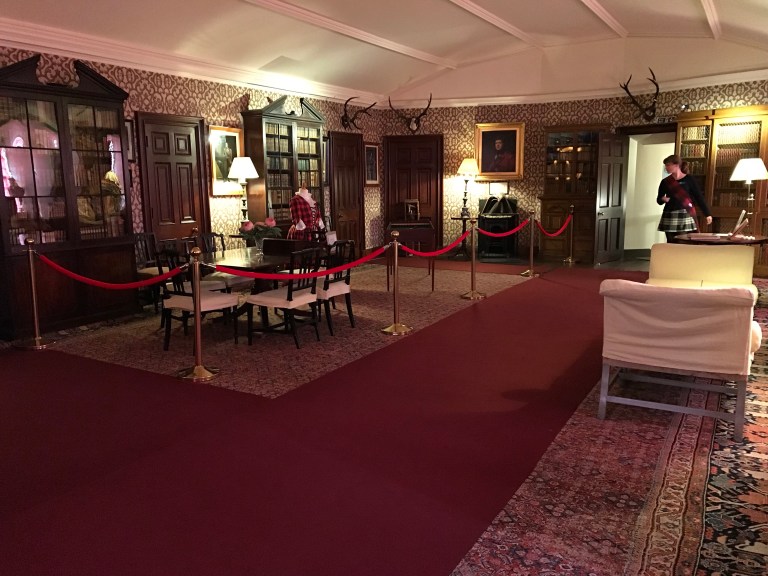
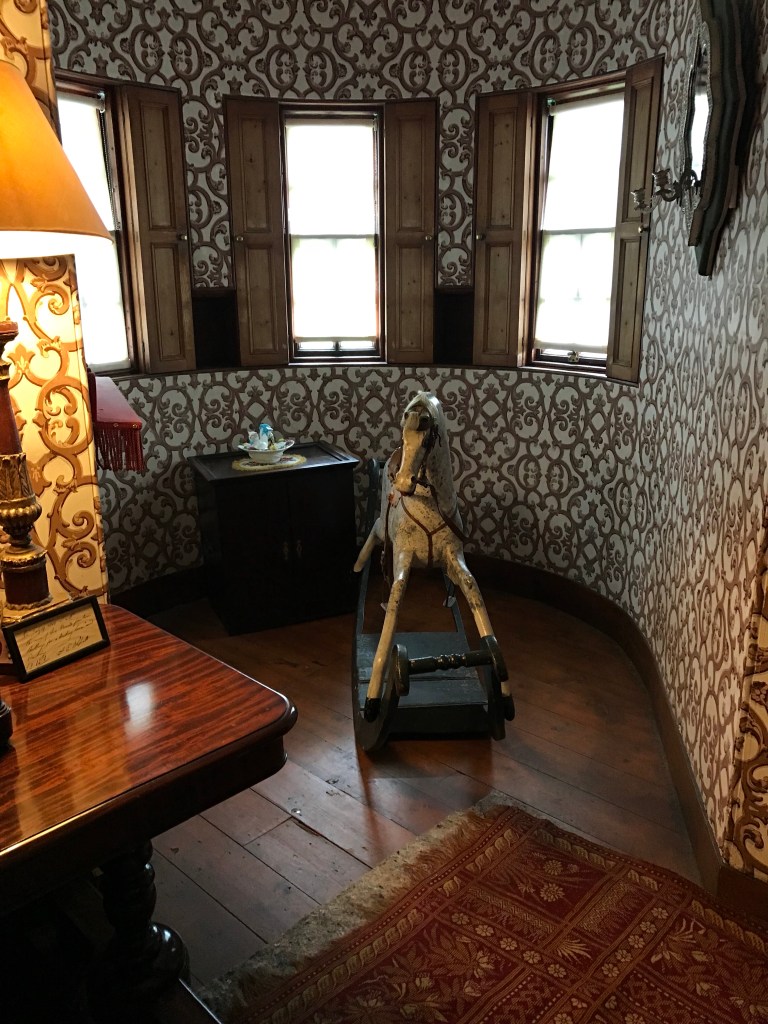
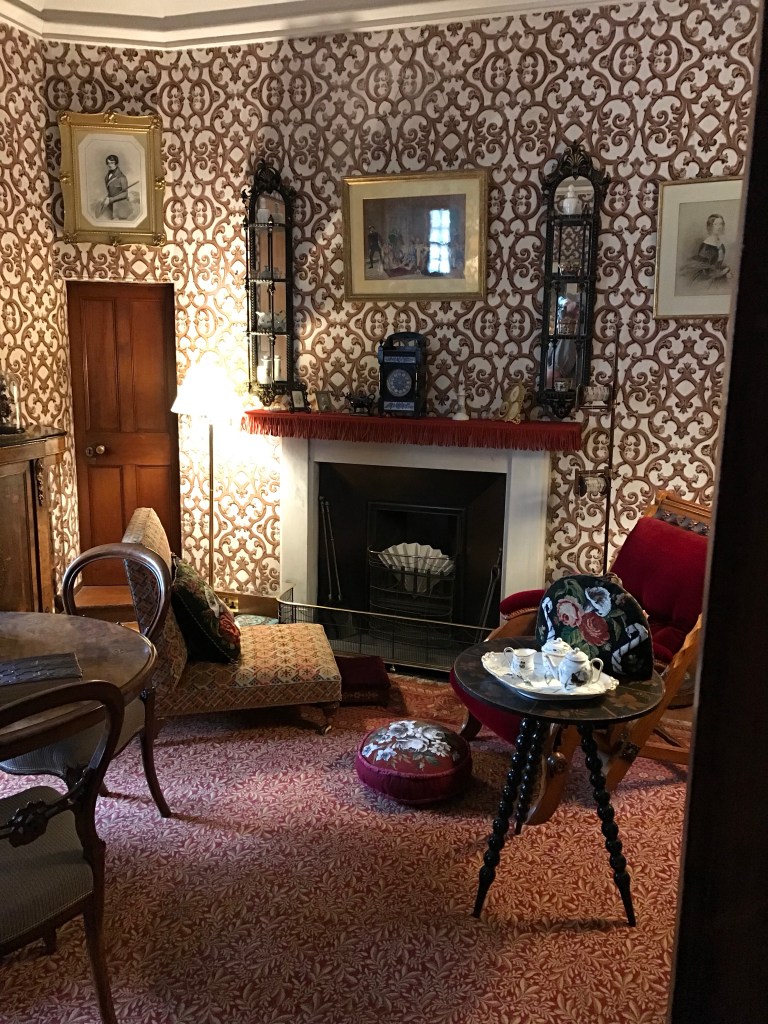
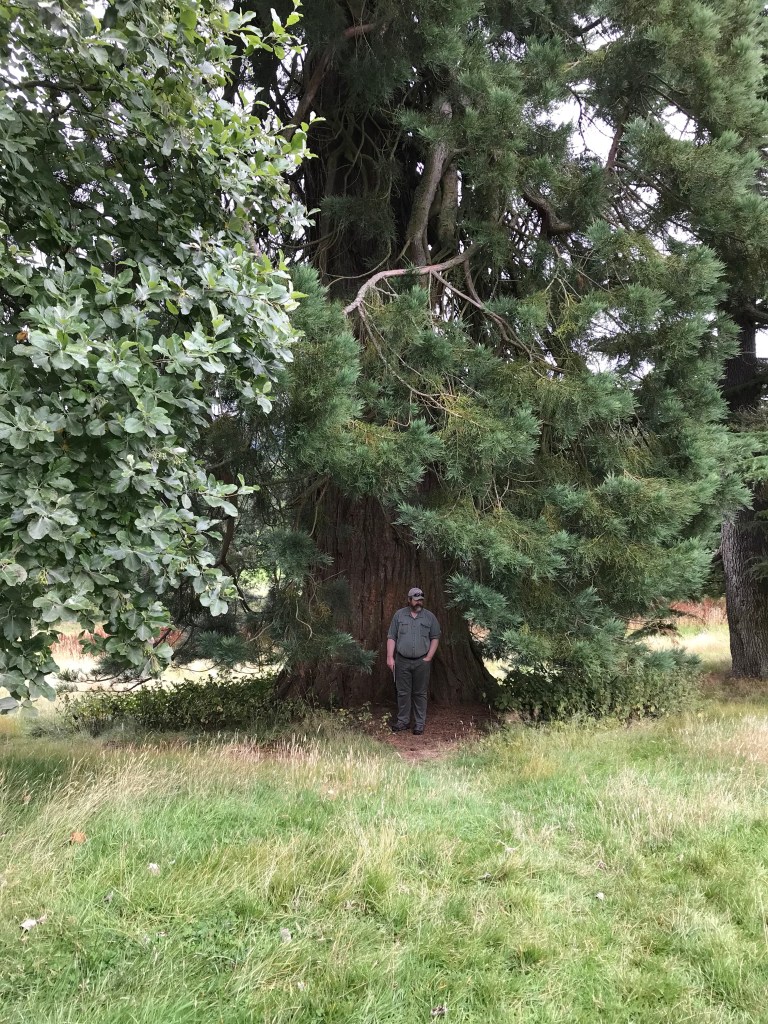
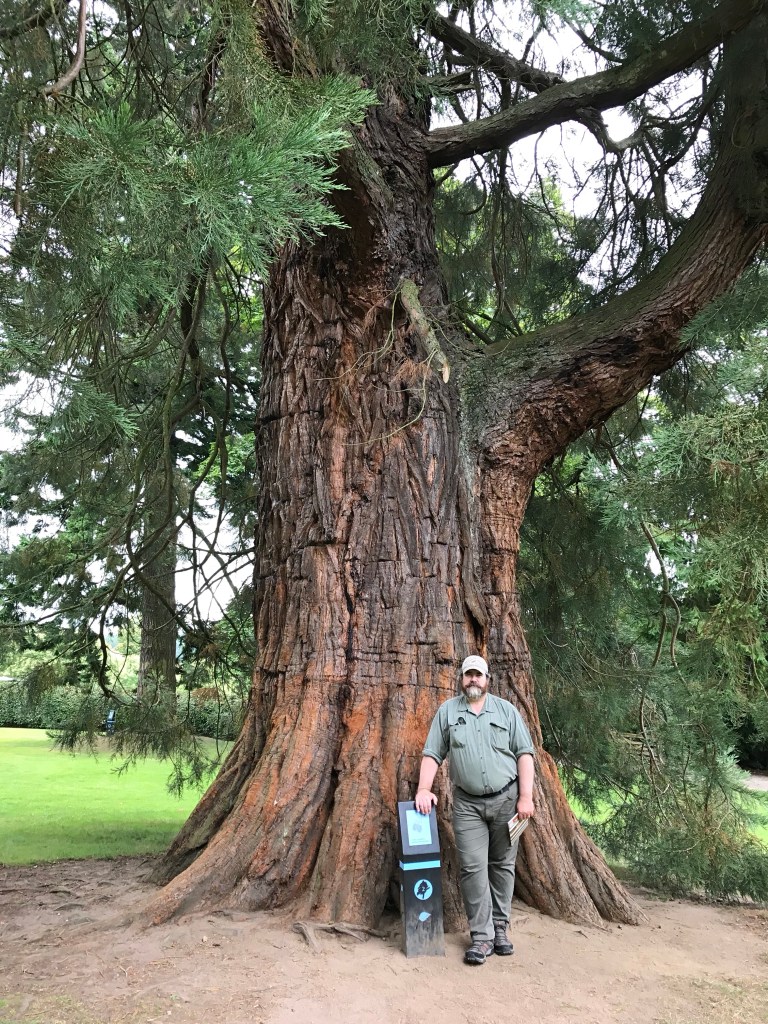
No interior photographs are allowed, and the only means of viewing the interior is to take the 45-minute tour. While we were waiting for our tour to start we walked a little around outside. Dan was looking at the foliage, and suddenly walked right up to a rather large tree to read the plaque in front of it. Even I noticed then that it was a suspiciously large tree. A tree of a suspiciously familiar nature. One that we thought we were on the completely wrong side of the Atlantic Ocean to be seeing in Scotland. Sure enough, the little plaque identified this large tree as a Giant Sequoia. You know, the ones we’ve only previously seen along the west coast of northern North America. Yes, those ones. We figured, well, this must be a one-off, because sequoias are indigenous to North America…aren’t they?

Back to the castle, which was built some time between 1575 and 1595 during the Mortimer of Craigievar’s occupancy. At that time it was only a four story tower house, but made to specifications befitting a baron. In 1610, William Forbes of Menie purchased the Craigievar lands. Wanting to show off how rich he was, William replaced the uppermost parts of the castle with turrets, dormer windows, and viewing platforms. Sculptural ornaments are displayed throughout. The inside ceilings are all molded plaster, and this was one of the first castles in Scotland to display them.

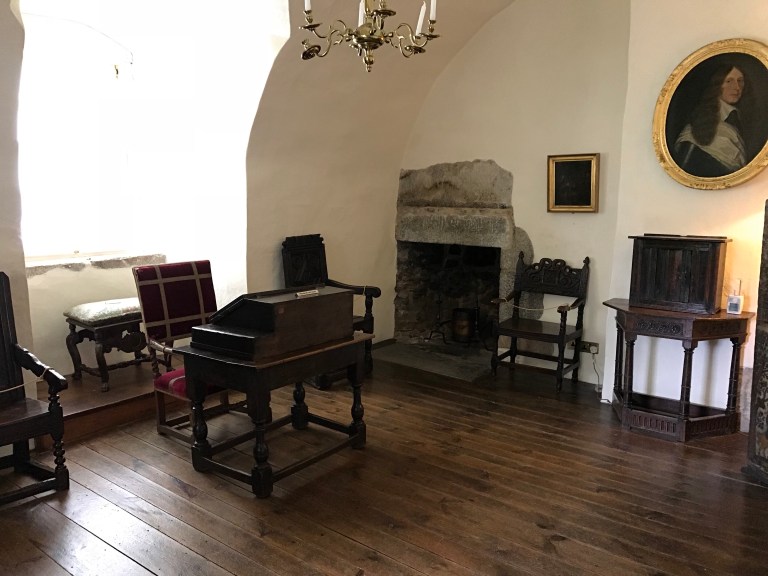
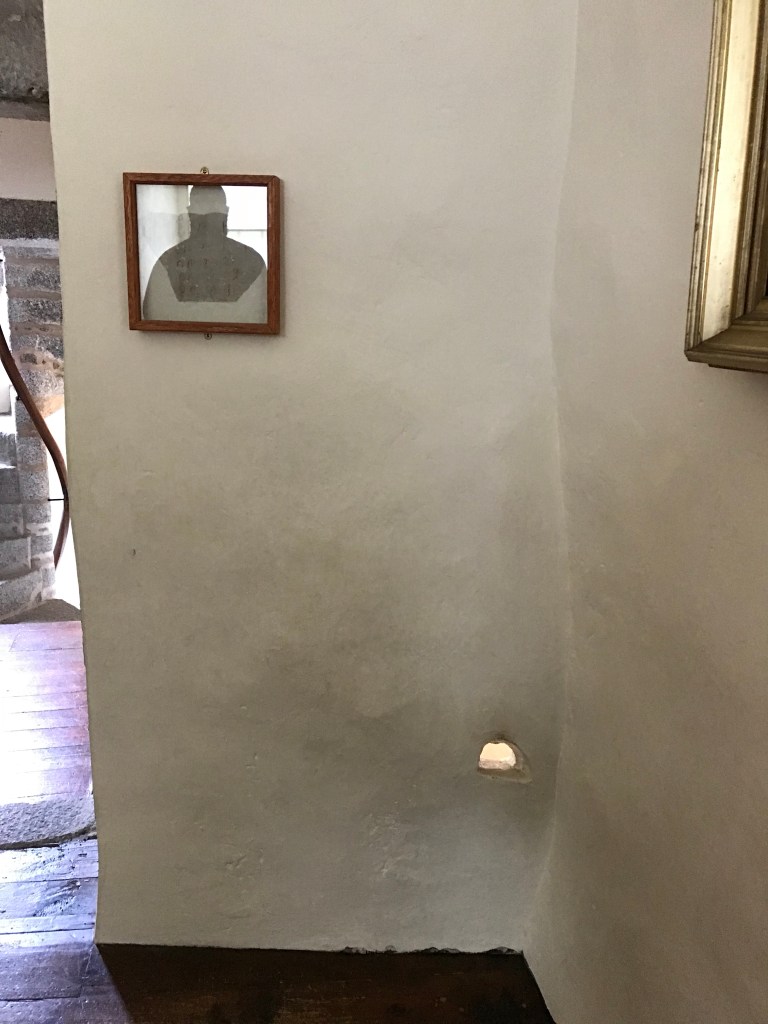
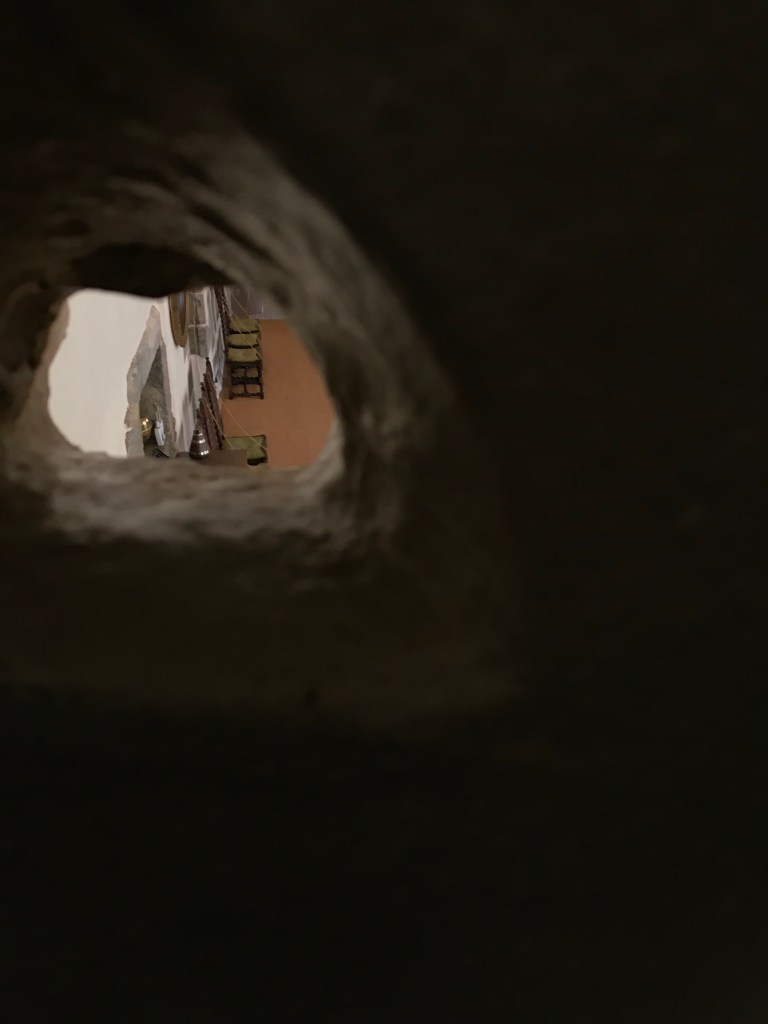
There is what appears to be a priest hole above the hall, which would not be unusual given the Mortimers were discreetly Catholic after the Reformation. Of course, it is also possible the hole was used by ‘Red’ Sir John Forbes during his tenure as Baron as a way to spy on his guests in the hall to find out if they were planning to attack him. Apparently he was called ‘Red’ John not only because he was red-headed, but also because he was a mean, paranoid, asshole.

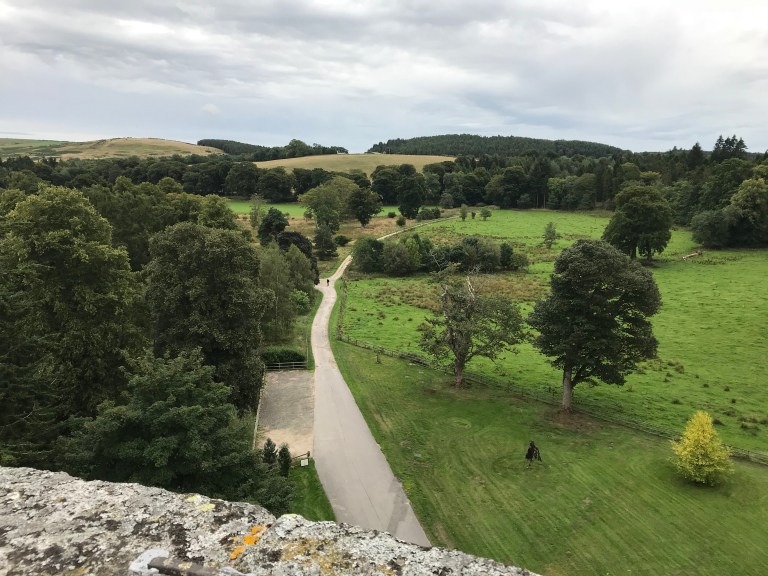
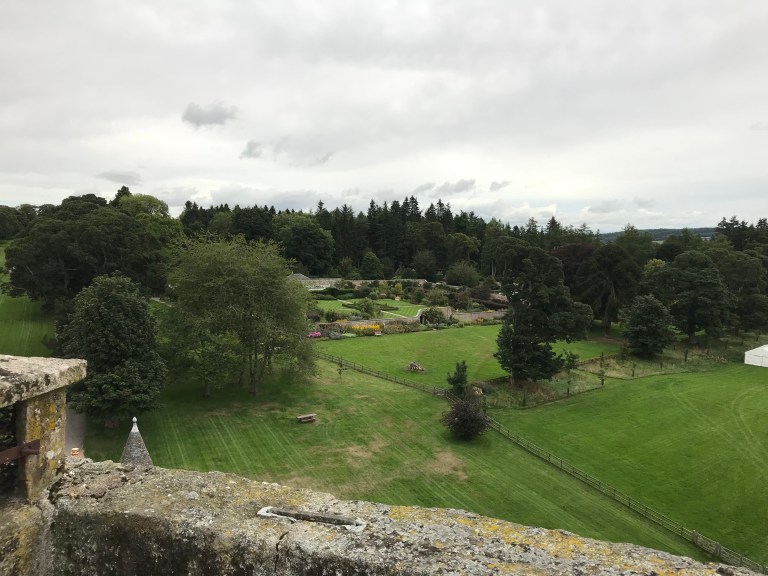
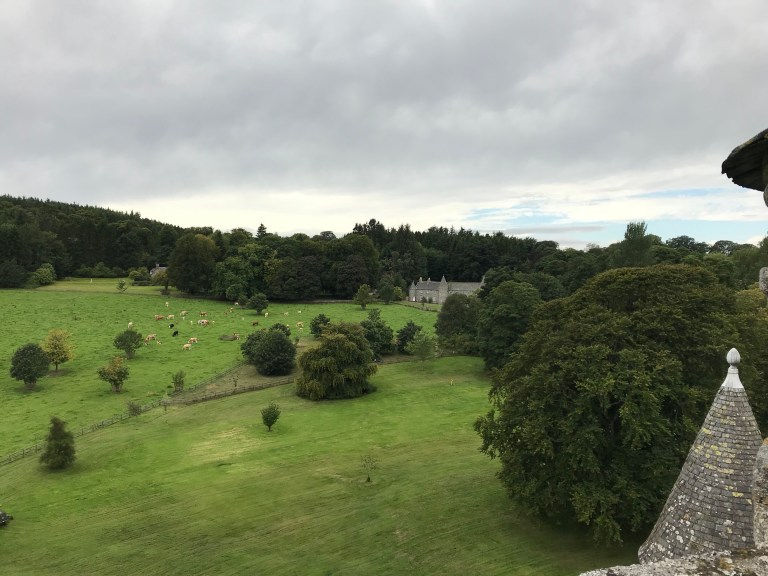
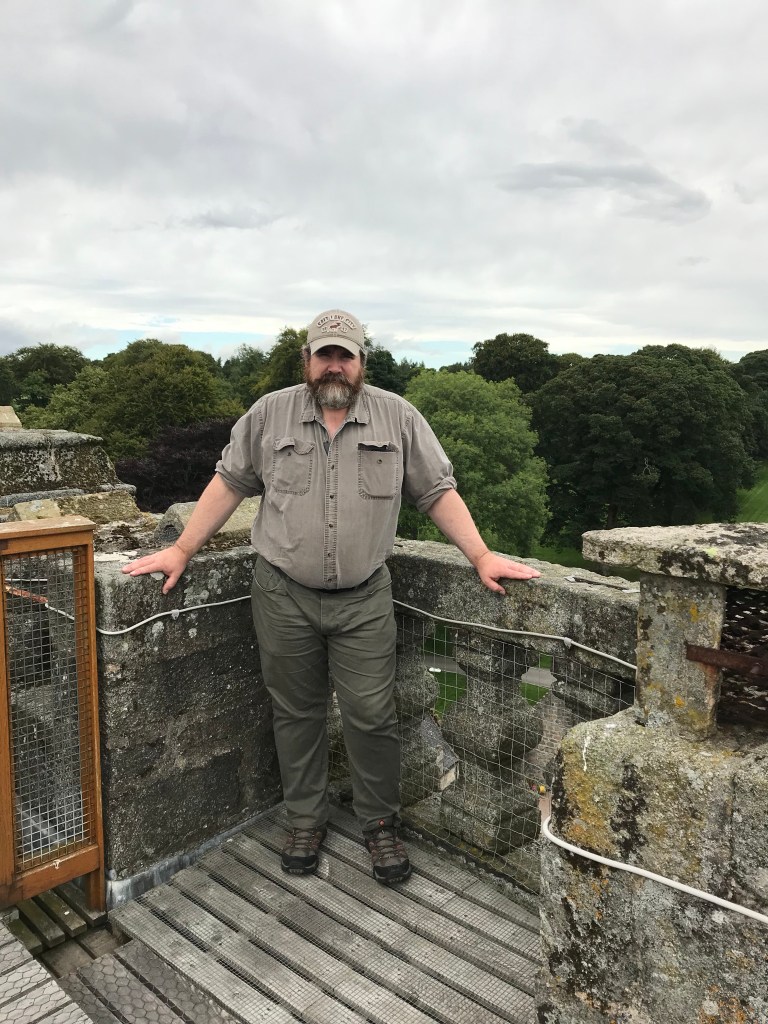
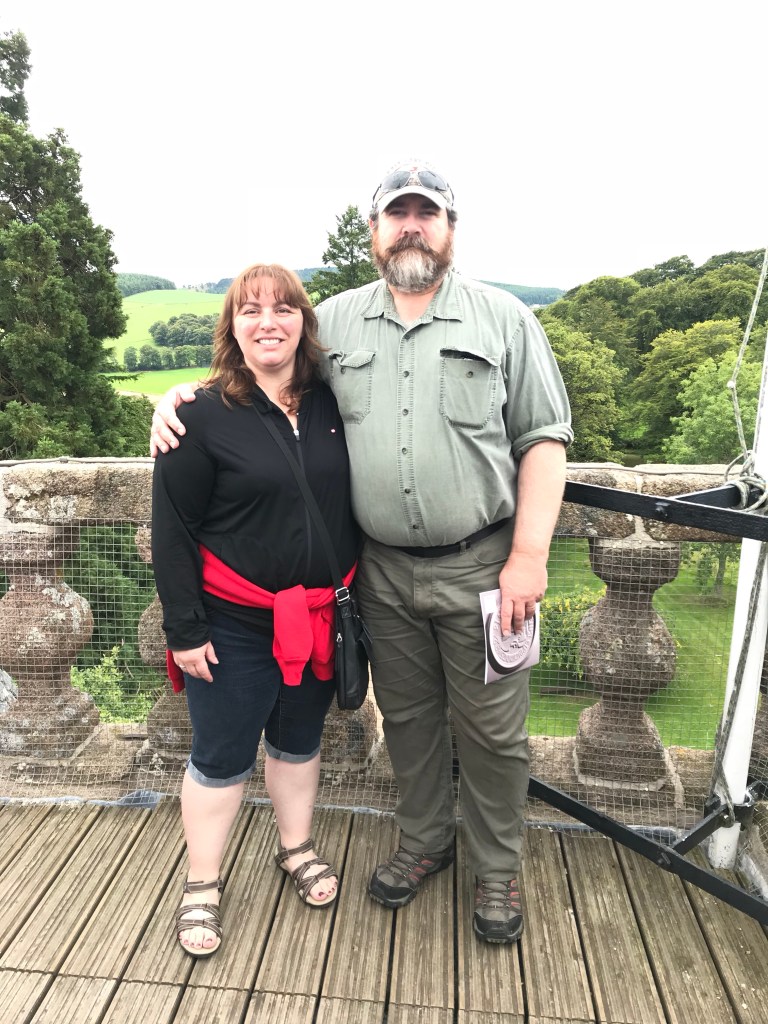
The tour took us all the way up to the viewing platforms at the top of the castle, which is where the above photo of Dan and I was taken.

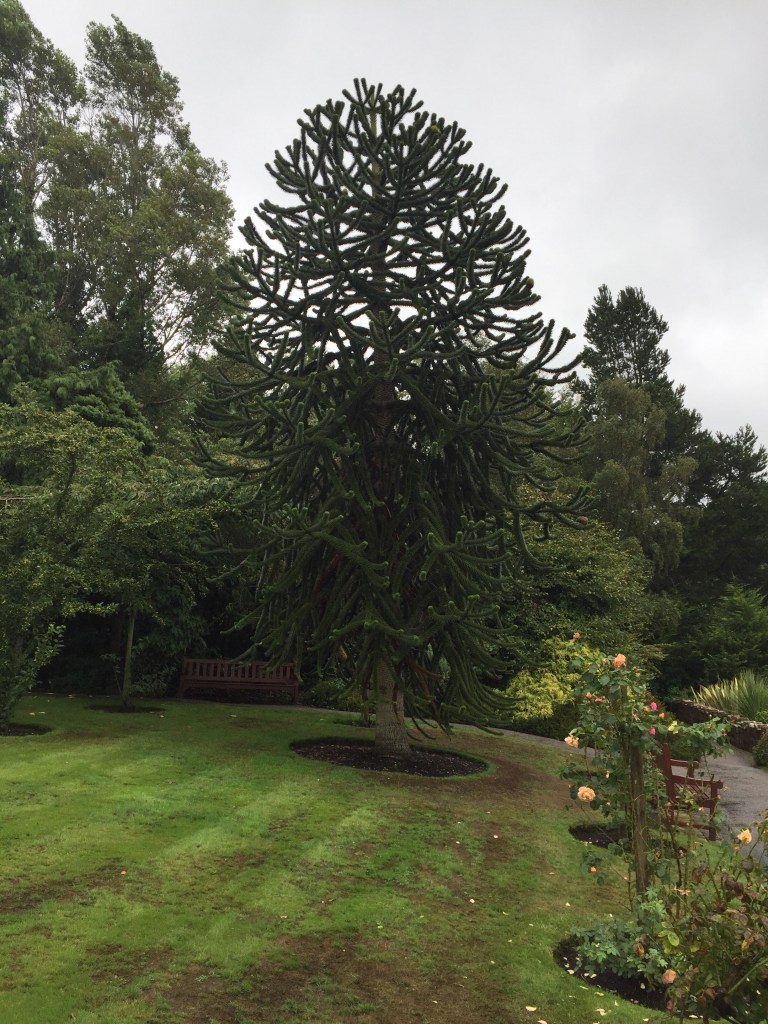
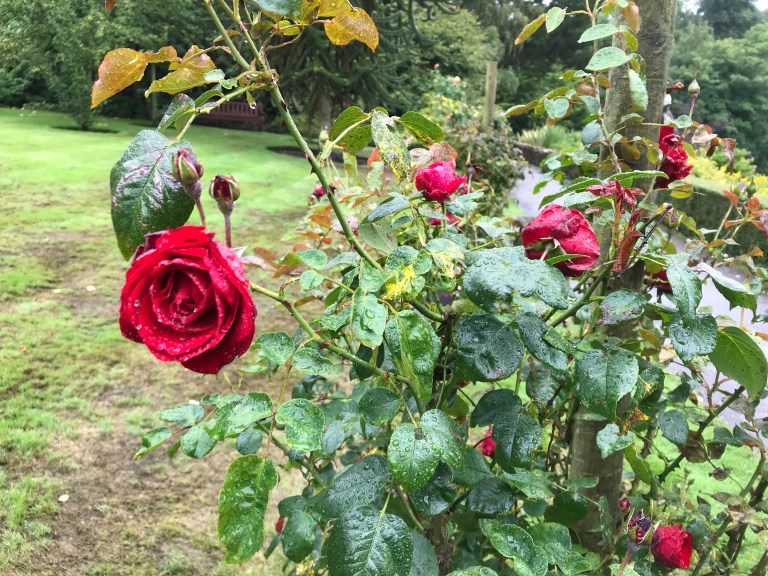
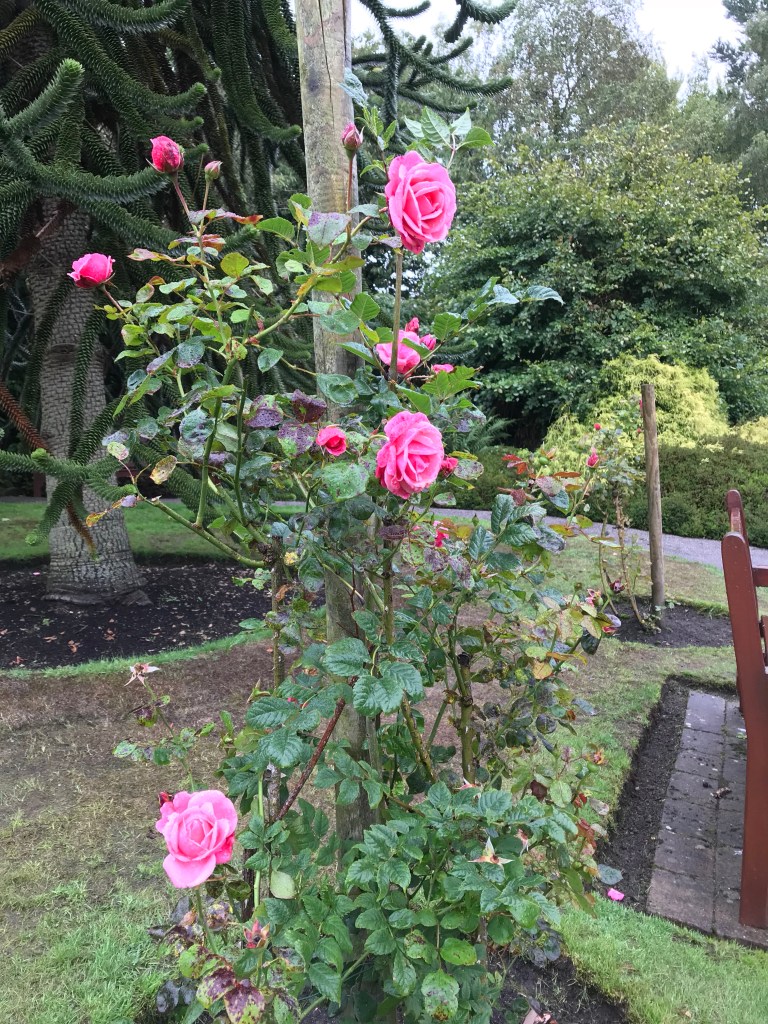
During our walk back to the car, we spotted yet another oddly out of place seeming tree, which we didn’t think could possibly belong here. Of course we had no idea what it was called, and we had actually seen it at the Robert Burns Gardens, so the only reason we didn’t think it fit in Scotland was because it was so weird looking. It turns out it’s called a Monkey Puzzle tree because the branches look like monkey tails. This picture was taken at the Robert Burns Garden a few days ago, not Craigievar Castle.

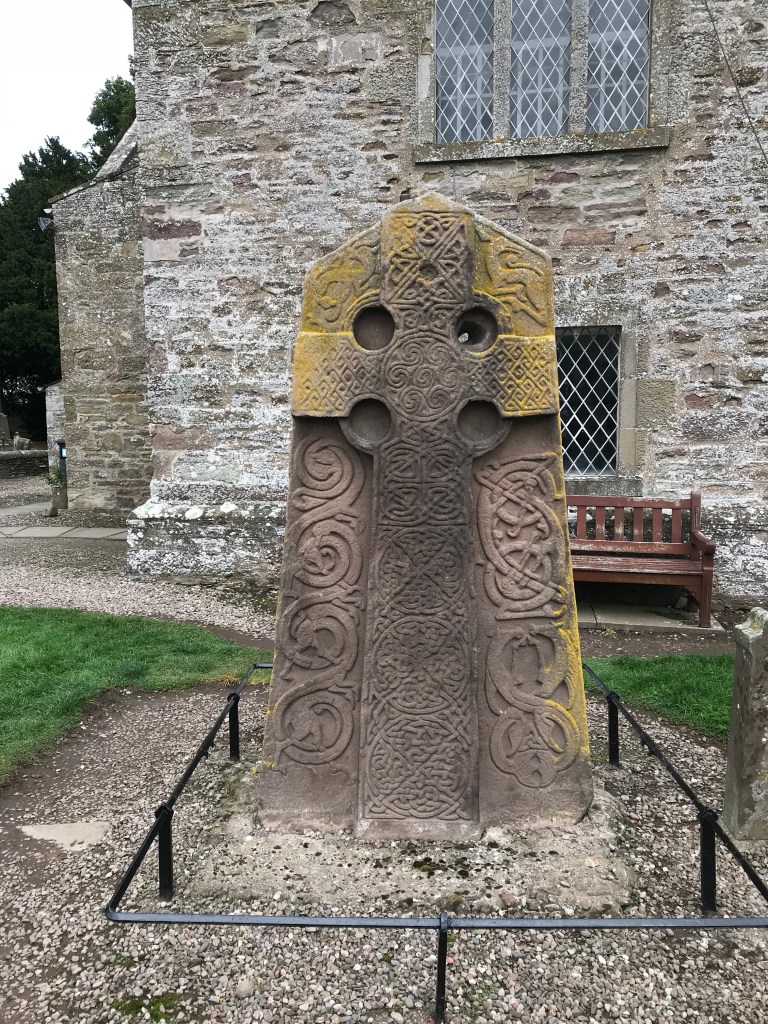
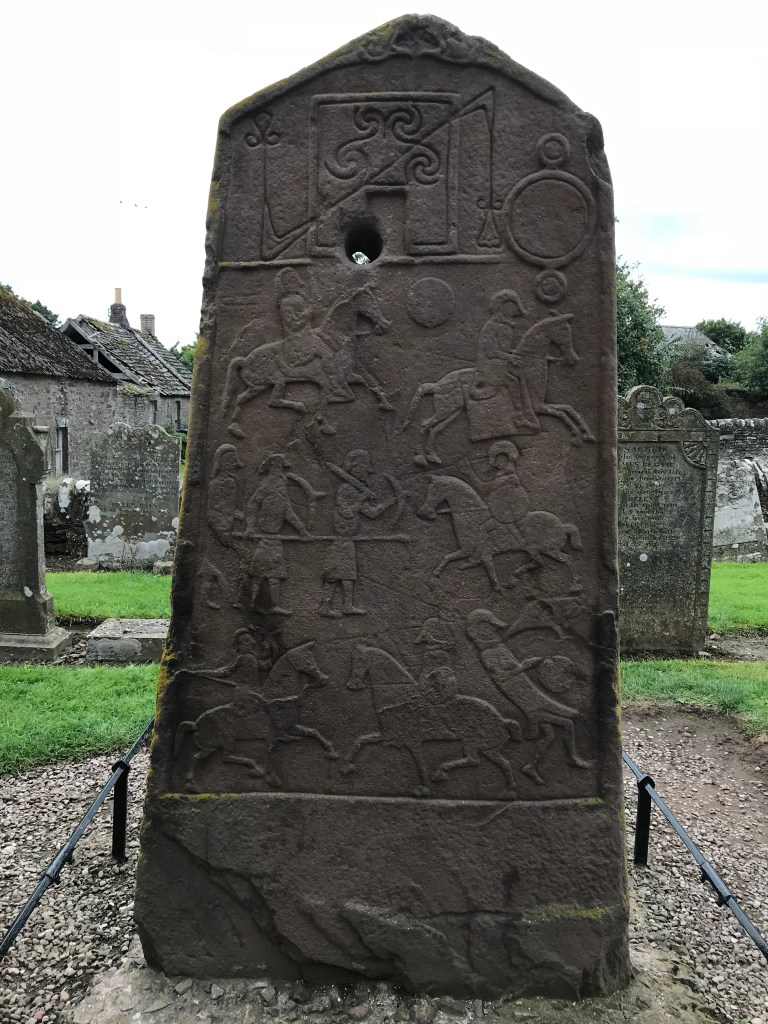
Our next stop was The Maiden Stone, which is a Pictish Standing Stone believed to have been carved by the Picts over 1,200 years ago. The placard seems to suggest the Stone is in its original location, but I’m not sure that’s true. Either way, it is believed to be placed there to mark a place of prayer for travellers on the road between Aberdeenshire and Moray. Frankly, scholars acknowledge that there is not remotely enough information available today about the Picts to actually understand the meanings of their symbols and the purposes of their stones. The Picts did not have a written language, other than the pictographic symbols that they used. The Picts were completely subsumed by the Scots by about 900 AD.

What is really fascinating is the amount of detail that remains visible on the stones after more than a millennia. Most of the remaining stones found have Pict symbols on one side and Christian symbols on the other, indicative of the transition of their faith at the time.

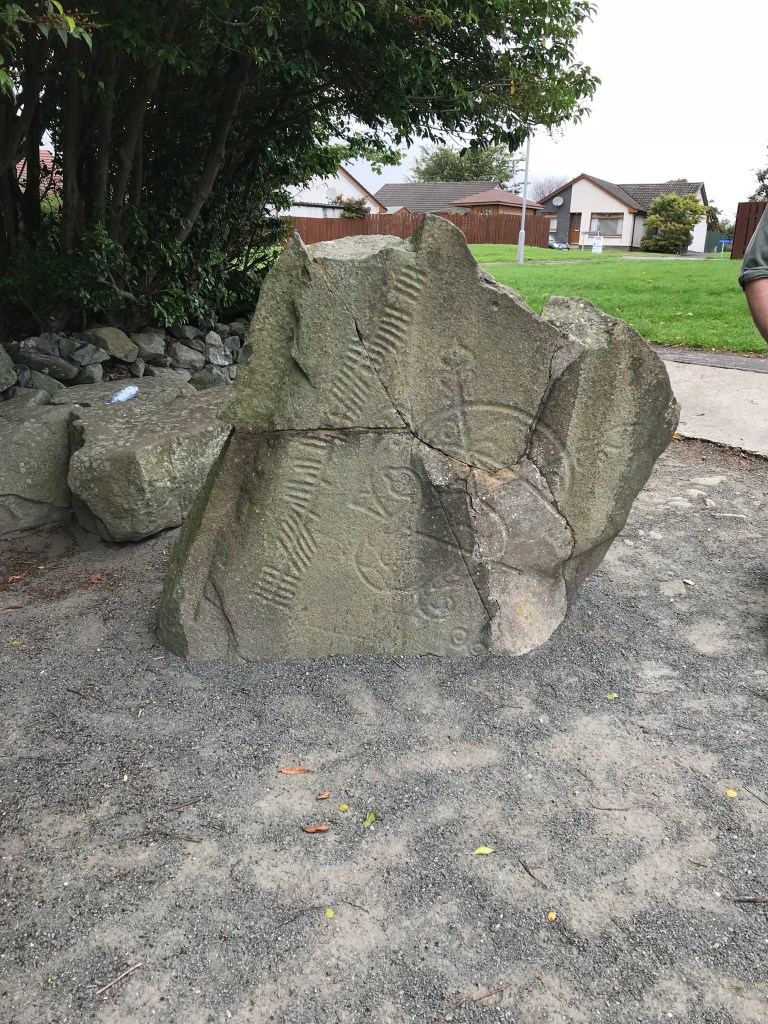
However, as can be seen in the above partial stone pieced back together in Brandsbutt, other cultural influences can also be found — in this case by the Irish runes on the left side. Others, like those we saw in Whithorn, and yesterday at the Meigle Museum, have geometric shapes influenced by the Vikings.

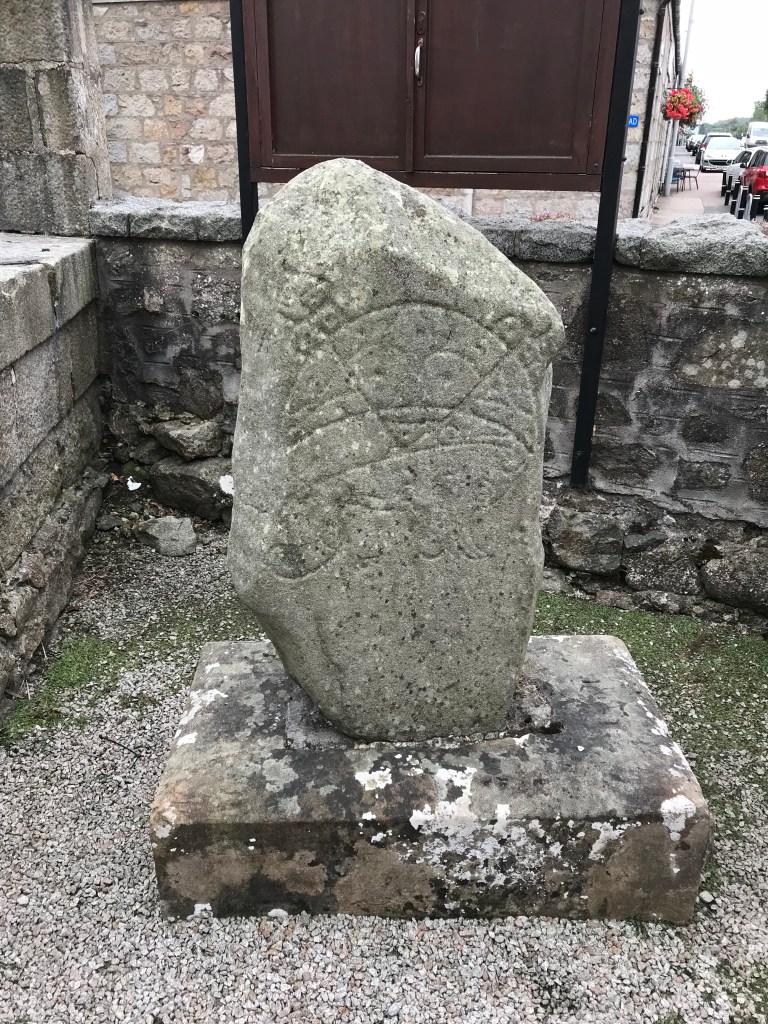
To reinforce just how ignorant we are about the meanings of Pictish symbols, while we may certainly recognize those symbols like the salmon and cauldron on one side of the stone at the Kintore Churchyard (above) and the beast (dolphin? swimming elephant?) and broken arrow (V shape) on the other side (below) nobody has been able to decipher the sideways crescent moon shape with the three round balls and curved lines.

Our final stop for the day ended up being much quicker than the place deserved at 40 minutes before closing. Crathes Castle is one of the best preserved 16th century castles in Scotland, and was lived in by a single family for over 350 years. Fourteen generations of Burnett’s lived there, right up until 1951 when the 13th Baronet made over the castle and part of the estate to the National Trust for Scotland.

Unlike Craigievar, we were allowed to take pictures inside the castle. Good thing too, considering how quickly we went through the place…we’re going to need them to remember what we saw!

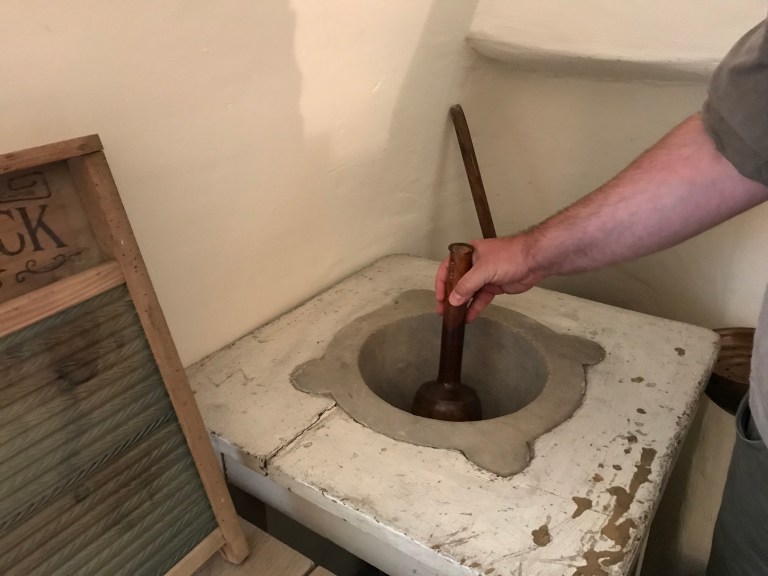
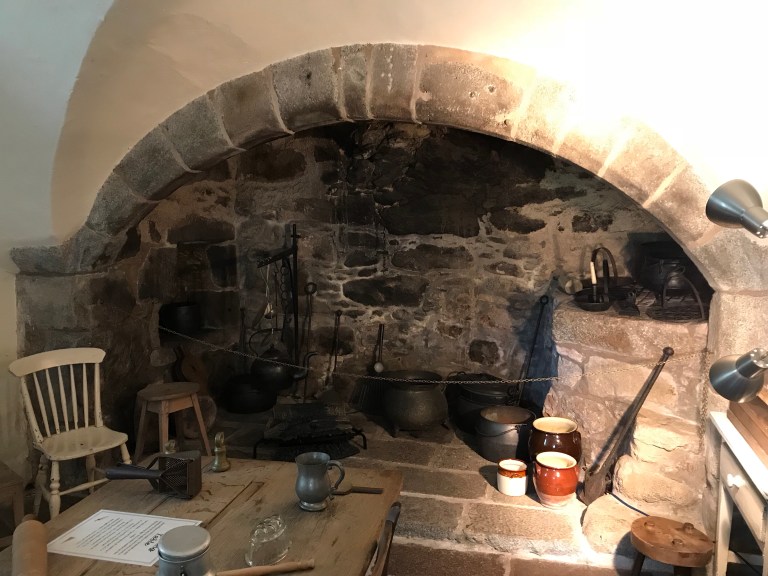
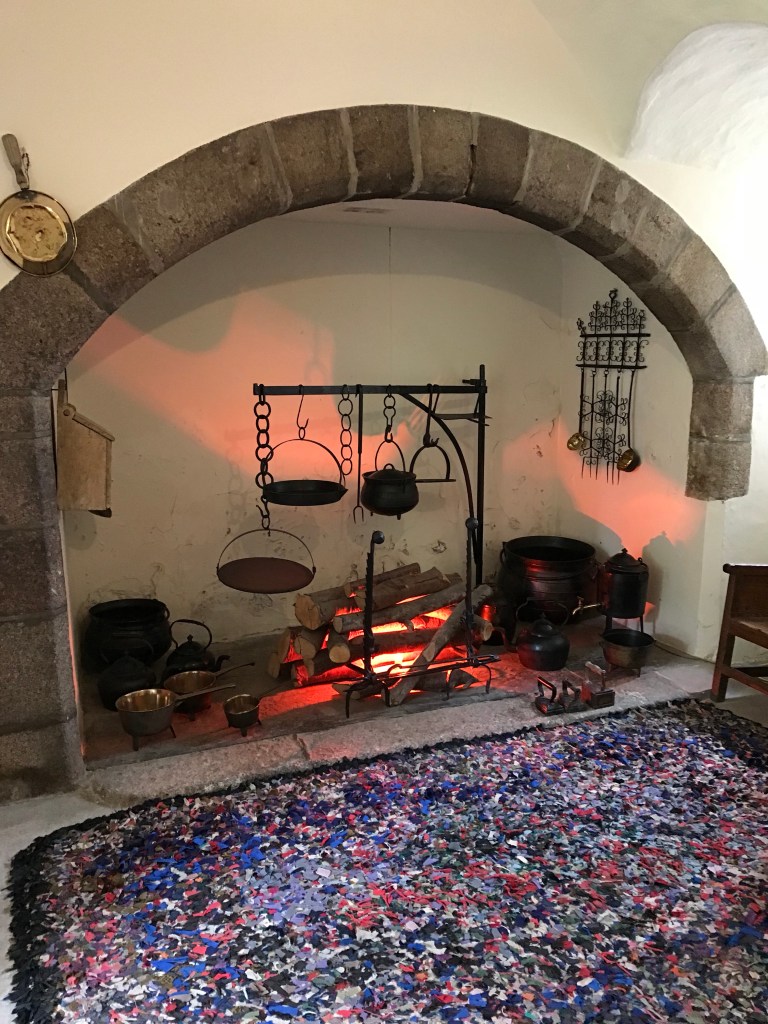
The lower kitchen.

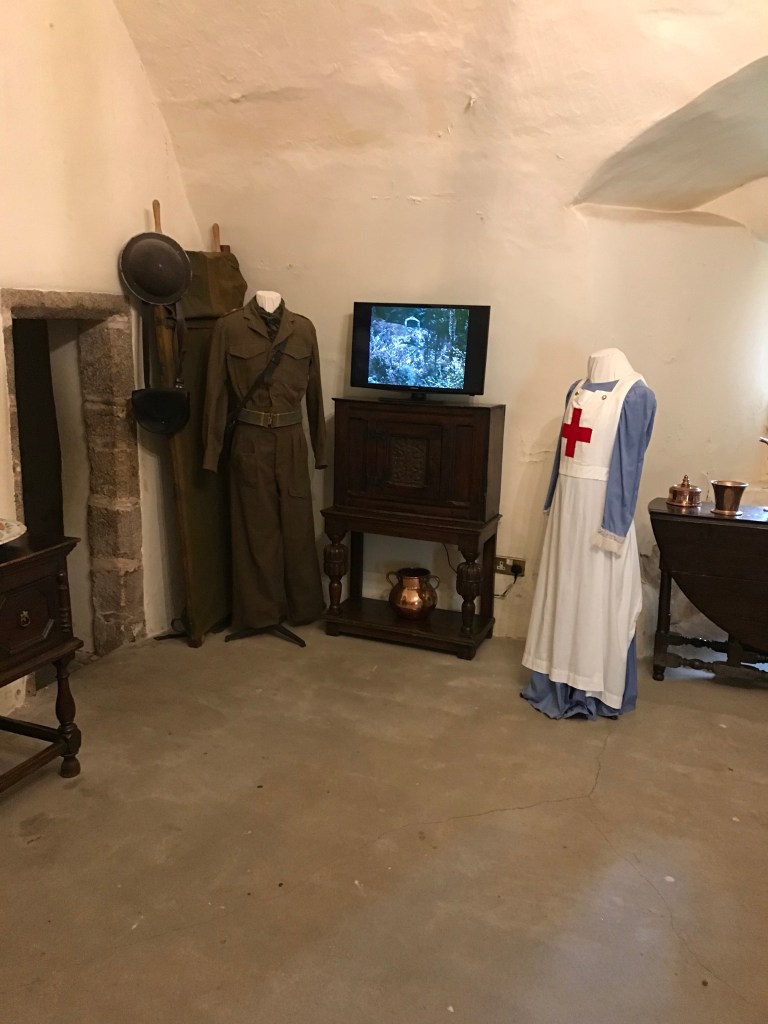
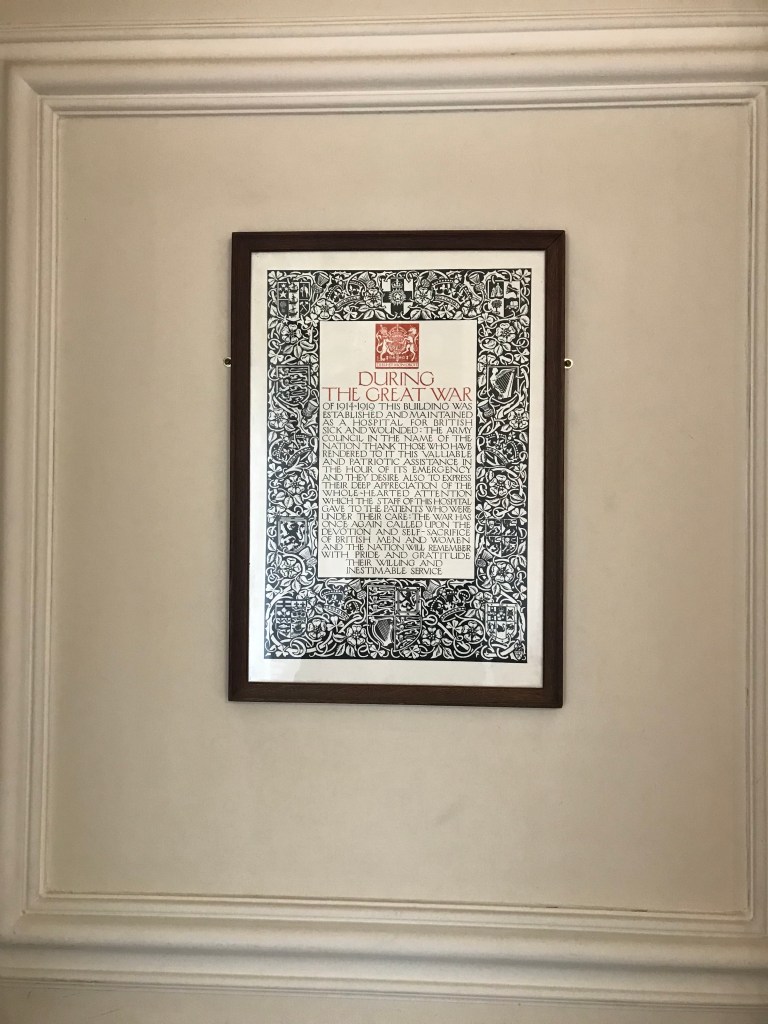
Another Downton Abbey moment: Crathes Castle was used during both World Wars for a convalescent hospital.

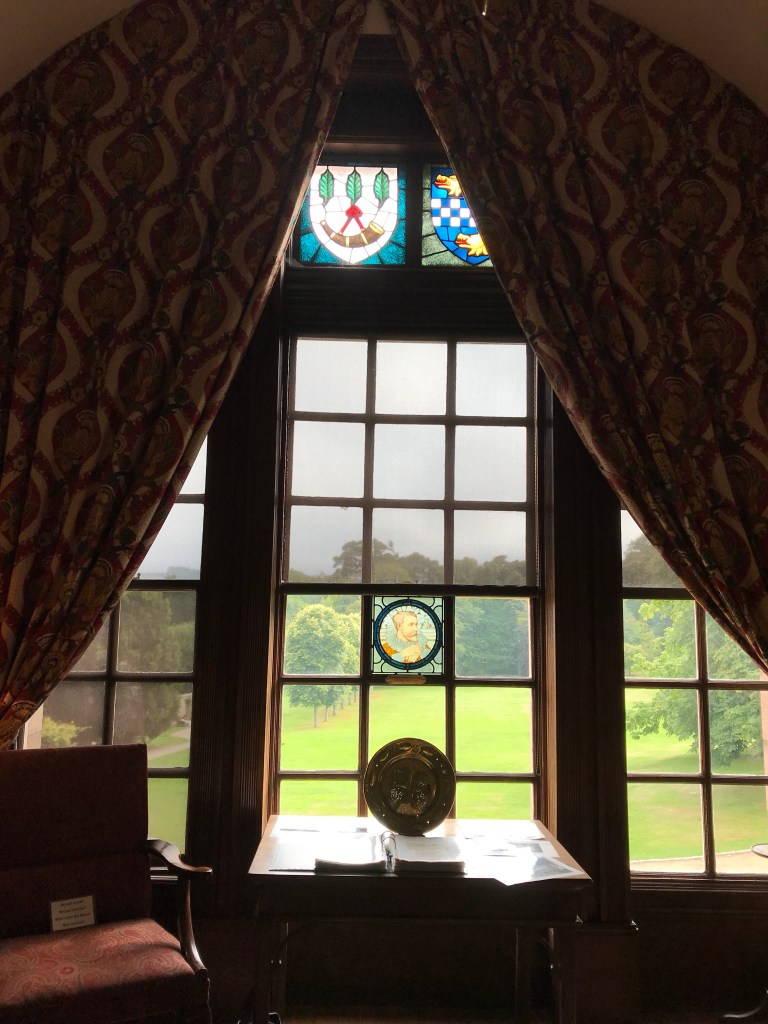
These large windows were installed in the hall after the 11th Baronet returned from California, where he made a butt load of money as a successful rancher and sold off the land where the LAX airport now sits.

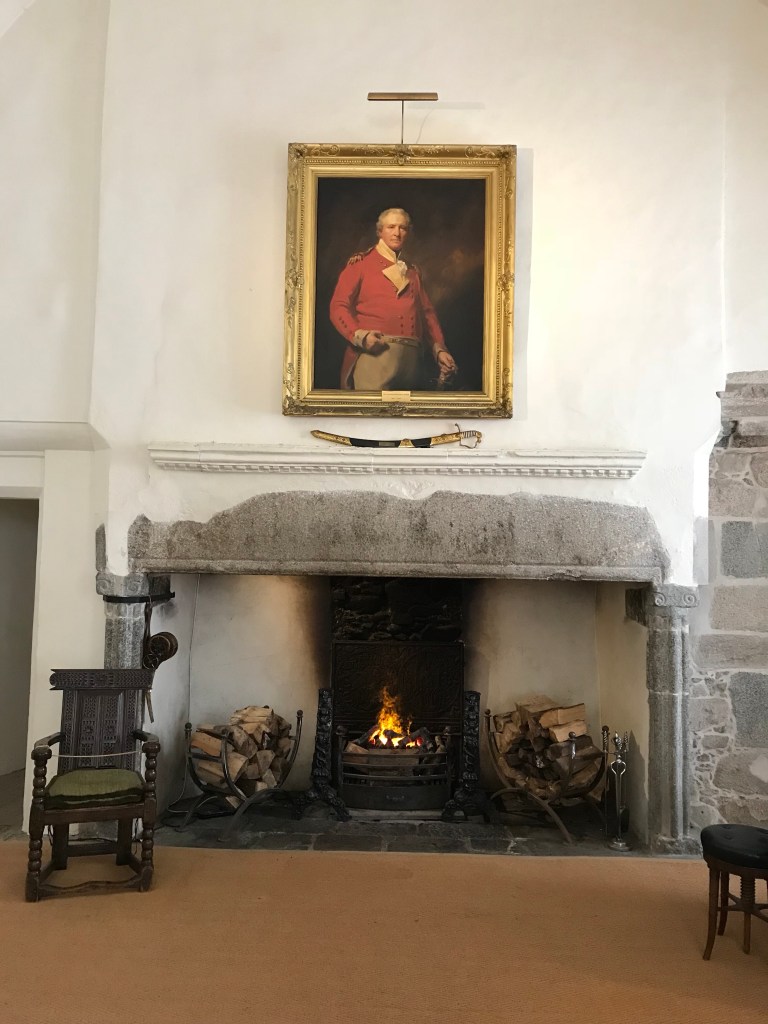
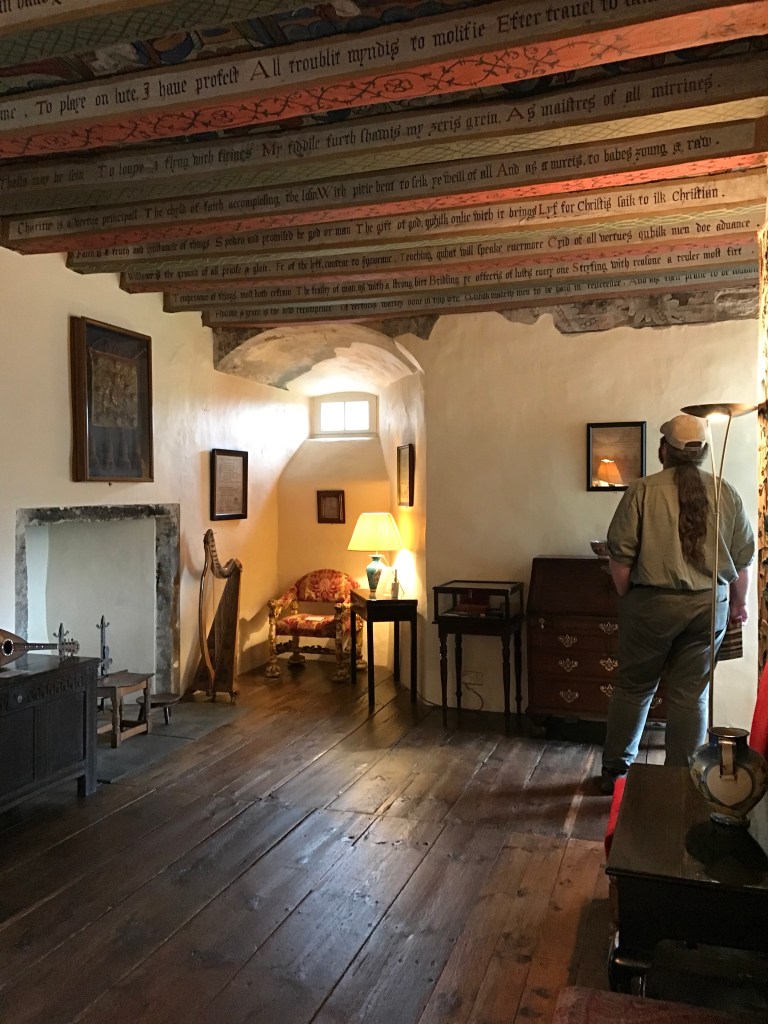
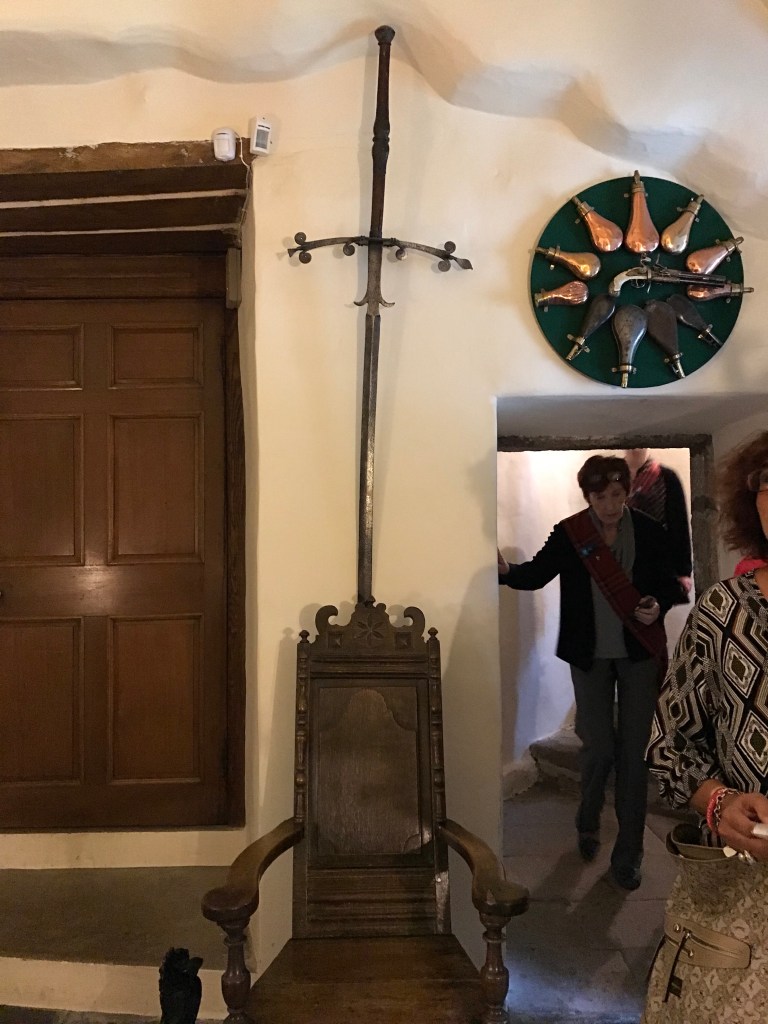
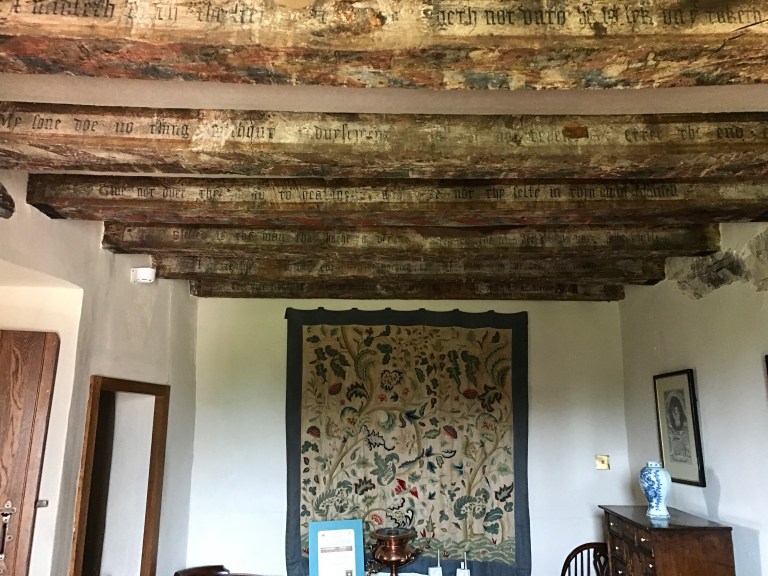
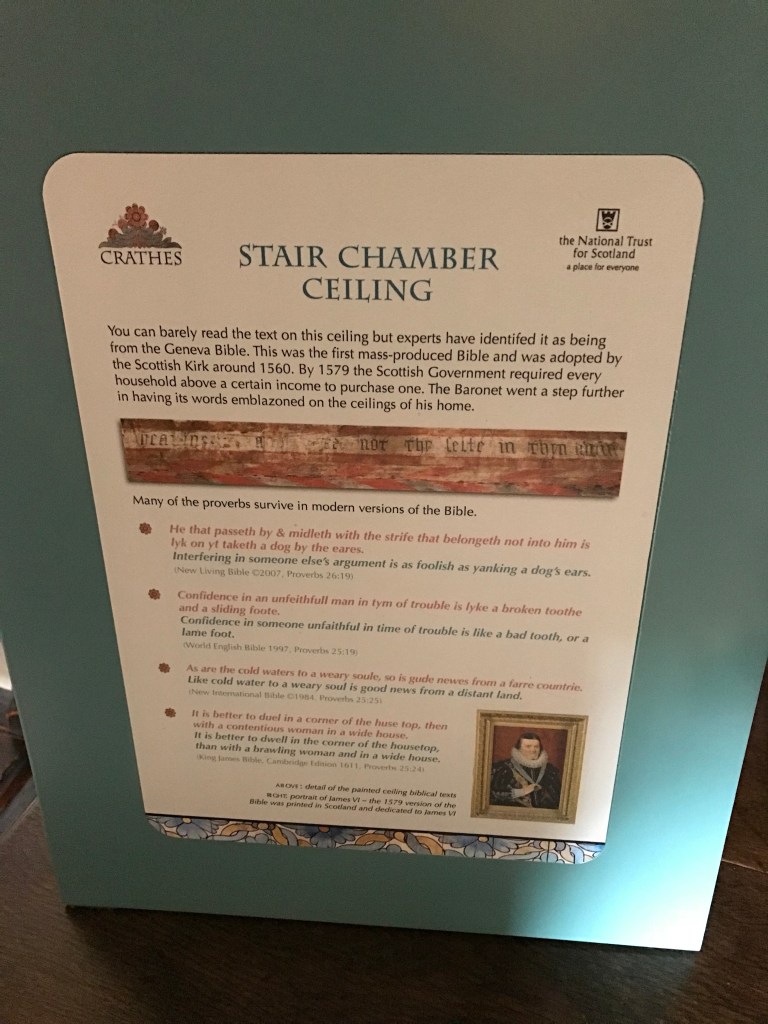
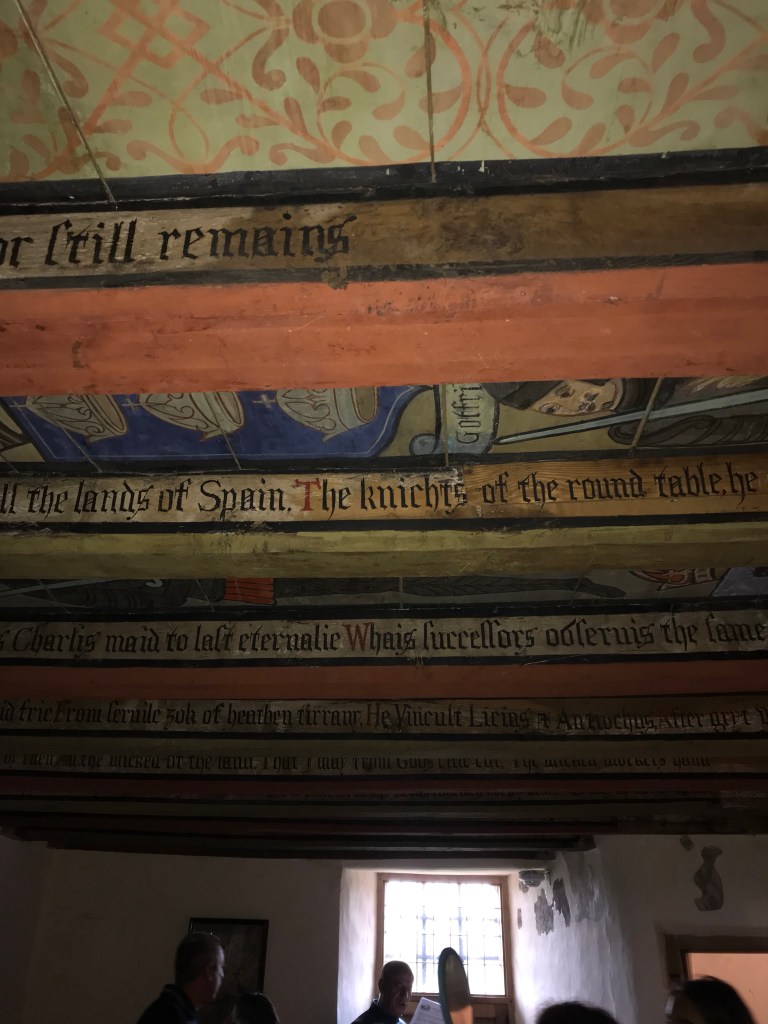
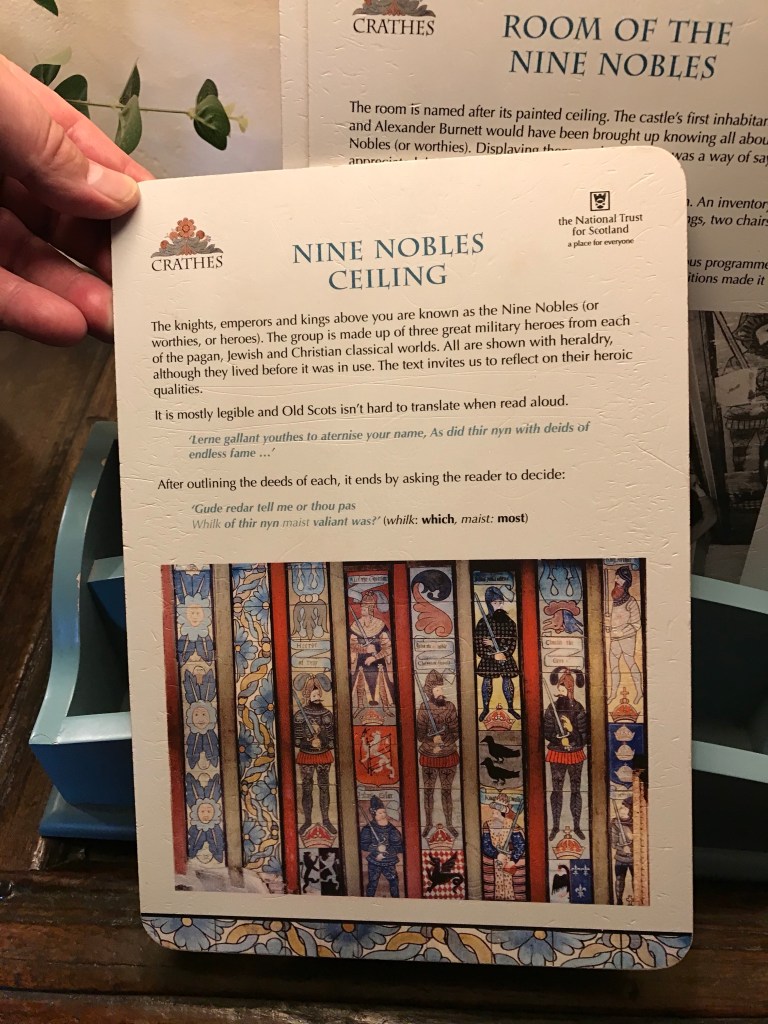
Also in the great hall is this feature wall with the fireplace and the armour displayed in the painted domed ceiling alcove. In other rooms in upper floors the ceilings are painted with characters and scenes, and the joists have various quotes.

Like I said, we went through this castle very quickly…

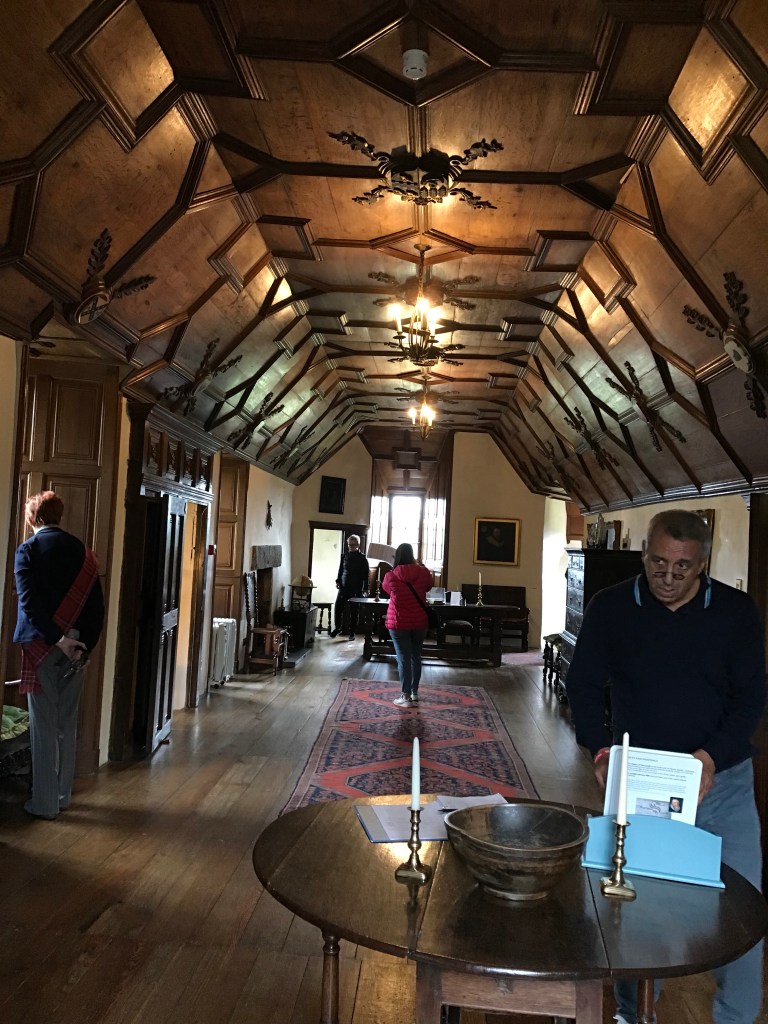
The Long Gallery is gorgeous! It runs the full length of the top floor of the castle, and was originally used for exercise in bad weather (really? Huh). In later years until comparatively recently it was used as a library, and it still holds many classic, old, and down right ancient books. We weren’t allowed to handle the books, but boy did I want to!

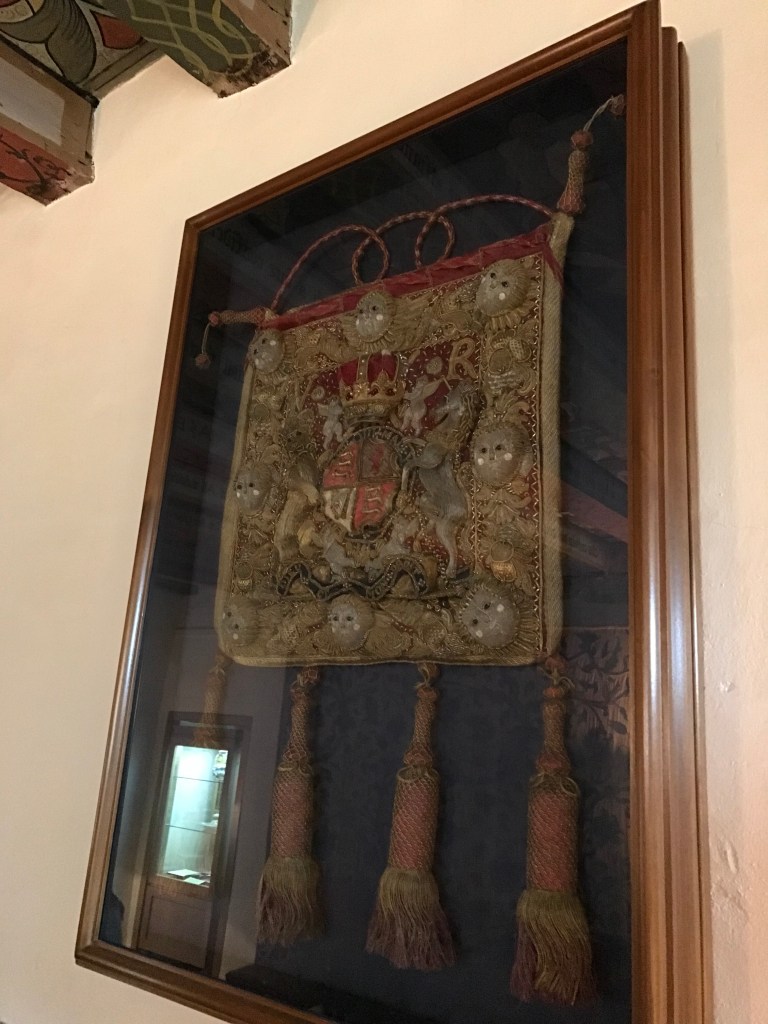
I have to admit that the needlework that would have gone into creating this pillowcase (I think it’s a pillowcase…) is really impressive.

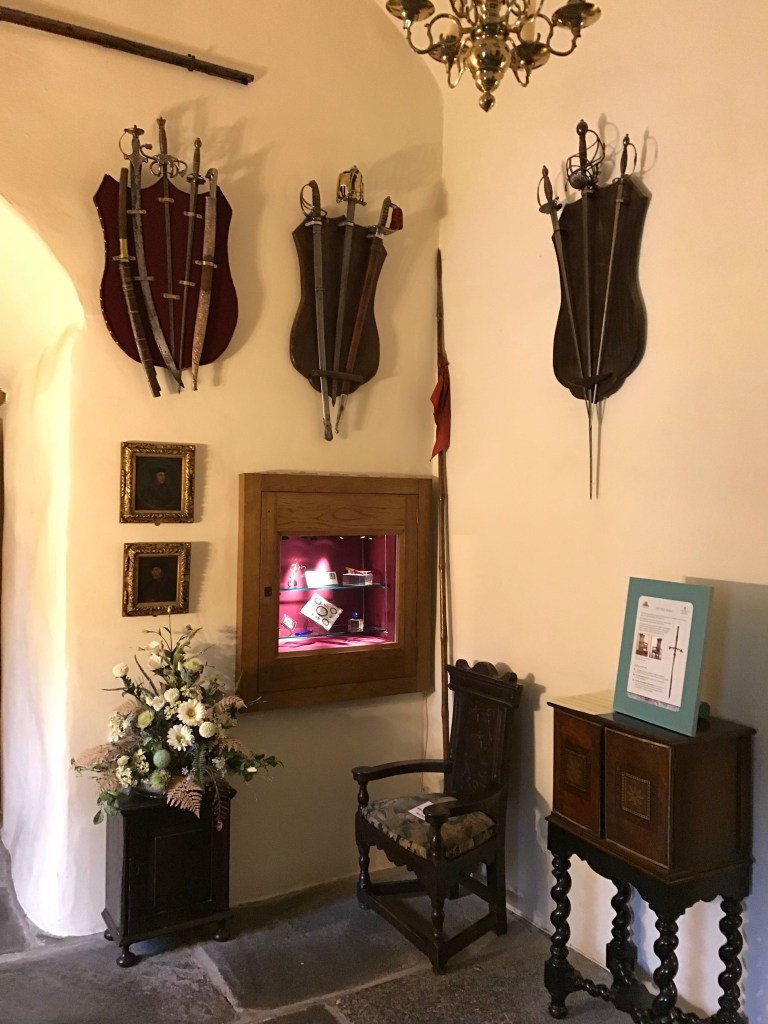
And, well, the weapons room…

And that was all we had time to see and learn. Good thing we picked up the information booklet.

Of course, when we wandered the grounds briefly what did our wandering eyes see? More sequoia…

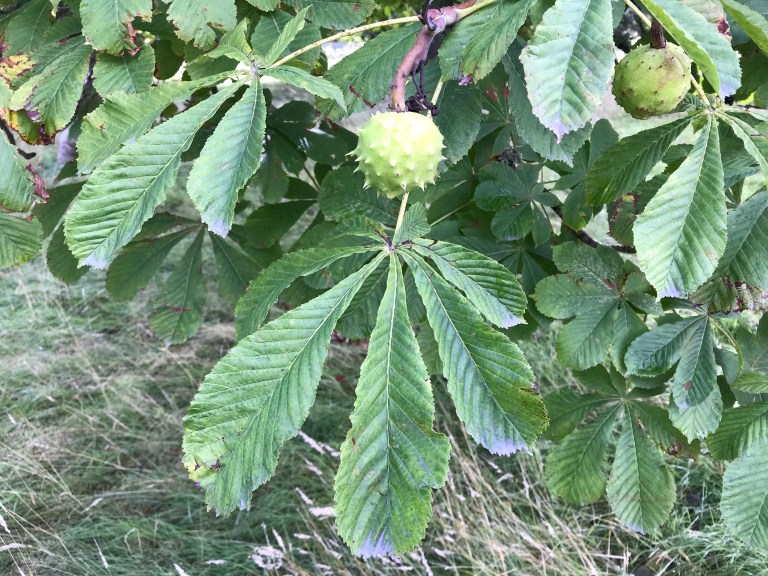
And a tree with a prickly fruit (?) that we had noticed at Scone Palace as well, which we discovered from the placard here is a Horse Chestnut and is actually indigenous to Northern Europe…so it actually belongs here.

That picture was taken at Scone Palace, not Crathes Castle.

A little surfing when we got back to our room confirmed that the Giant Sequoias are indigenous specifically to the west coast of North America, and were brought to Scotland in the 1850s, where they did very well in Scotland’s climate.

A little more surfing confirmed that the Monkey Puzzles are indigenous to Brazil and were brought to Scotland around the same time that the sequoias were.

So, how’s that for a day full of new information?

Adelle and Dan

We Made it by the Scone of Our Teeth

I’m going to write today’s entry in reverse chronological order. Why? Why not?

We ended our day with a wonderful supper at The Deeside Inn Restaurant, before retiring at our splendid room on the third floor of The Gordon Guest House in Ballater. Definitely an improvement over The Covenanter.

We won’t be able to get a tour of Balmoral Castle because the Royal Family is actually in residence there this month. I actually knew that before, but it turns out it may not be entirely unlikely to see various members out and about the area. Even the Queen and the Duke have been spotted driving themselves around. Yes, you read that right. Driving their own vehicles themselves. I’m surprised at how much I want to see that.

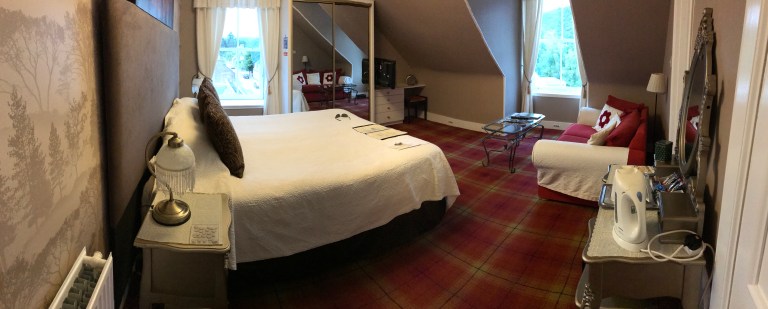
Martin, our host at The Gordon Guest House introduced us to our room, the amenities, and the history of the house. The Victorian-era house was built in approximately 1856. It started out as a small hostelry. In the 1940’s it was used as a grocer. At some point the house was occupied by the local bank manager.

And boy, do I know how to pick my locations! When I booked our B&Bs for this trip I aimed for relatively centralized locations for the regions we were visiting. So, I pretty much picked a place on Googlemaps that was roughly no more than a two-hour drive to any corner of the northeast of Scotland, and then searched for B&Bs in that area. Ballater was the resulting community. It’s located in the Royal Deeside area, not terribly far from Balmoral Castle.

Ballater is a beautiful community, similar in feel to Banff, Alberta, as a resort town. What I failed to realize is that it is also well within the lower edge of the highlands, eastward from Aberdeen. Which means the roads were mountain roads, narrower than what we generally see in the Rockies, but still wider (mostly) than most of the roads near the western end of Scotland. The further into the highlands we ventured the more hilly and winding the roads naturally became. The worst part, though, was that the national speed limit of 60 miles per hour (97 kilometres per hour) was maintained the entire way. Not maintained by me, mind you, and certainly not by everyone on those roads, but those crazy people who actually did maintain those ridiculous speeds technically weren’t breaking the law. They were just scaring the shit out of everyone else on the roads.

To be fair, it really wasn’t as stressful a drive as I’m making it out to be, I just didn’t have it in my head what kinds of roads we would be travelling on. It was actually a very beautiful, scenic drive when I didn’t have the pressure of the nutbars on my tail.

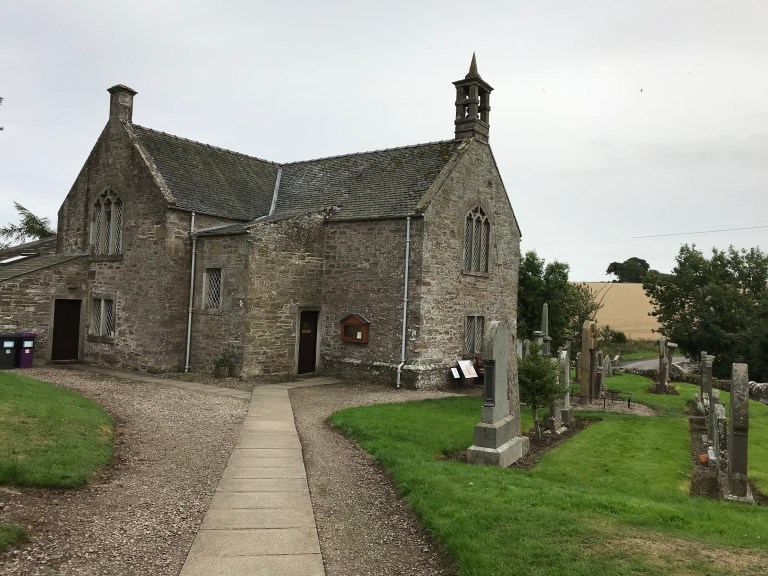
We briefly stopped at Aberlemno to view the Pictish stone in the church graveyard, but did not have time to stop at the few more along the sides of the road.

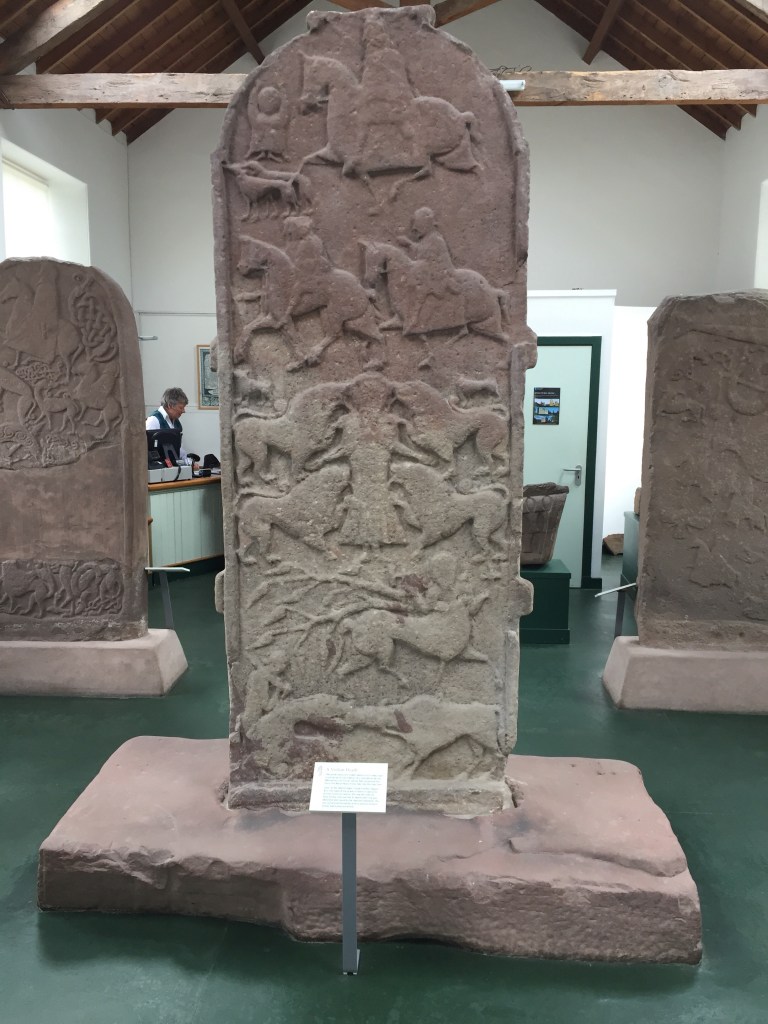
We visited the Meigle Museum of Standing Stones, as well, which was fascinating. The Meigle stones have been housed in the church since sometime in the 1850s by the local lord, who understood their value. The stones all originated from the immediate area, which was a major Pictish community. The stones, including the Aberlemno Stones, are made from sandstone and date back to between 600-800 AD. It was during that period that the Picts were brought into the Christian faith, so the stones depict elements of both their previous beliefs and cultural references and their adopted Christian beliefs. It’s remarkable just how much detail remains clearly visible in the stones today, given their age and the material they are made of.

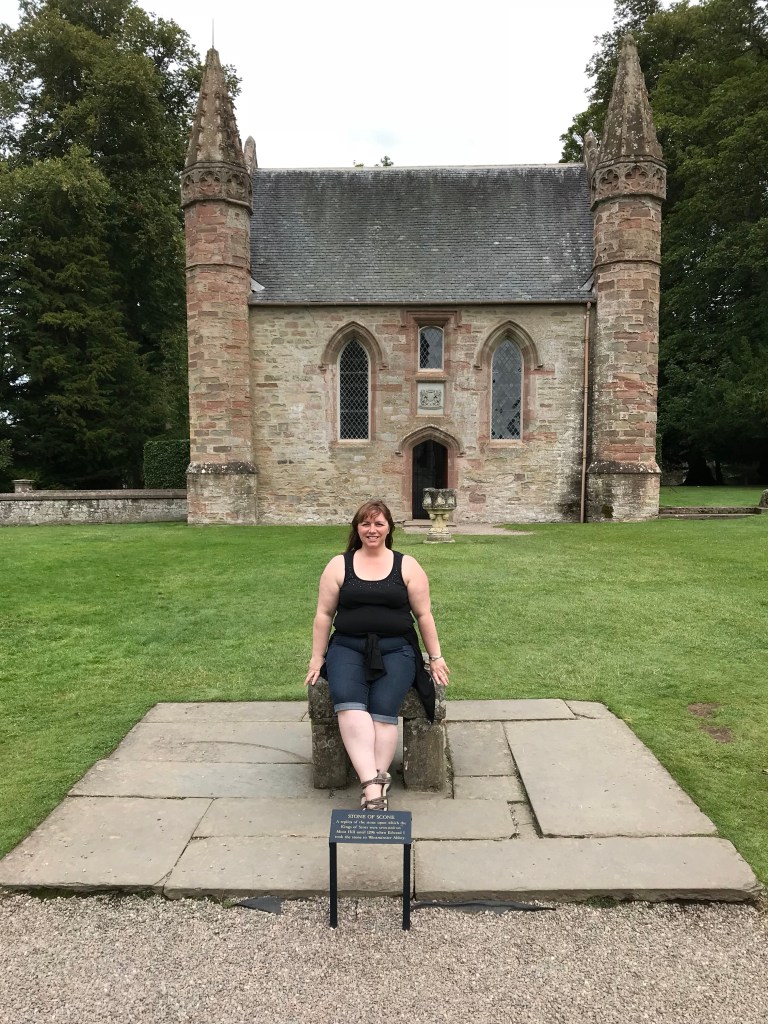
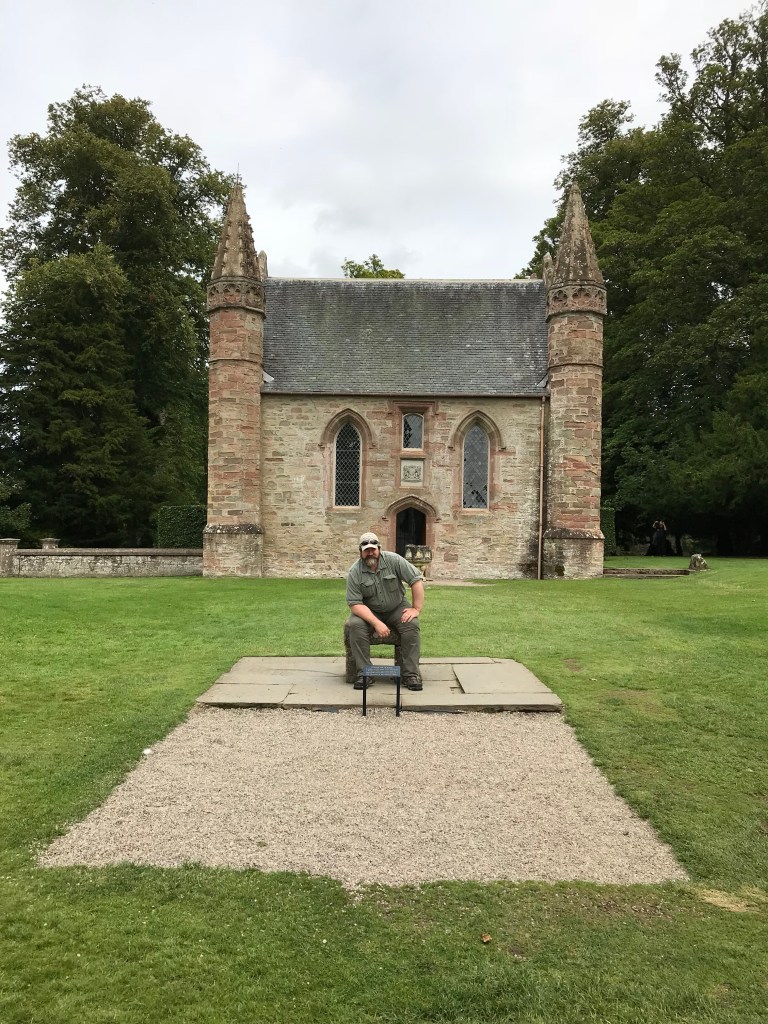
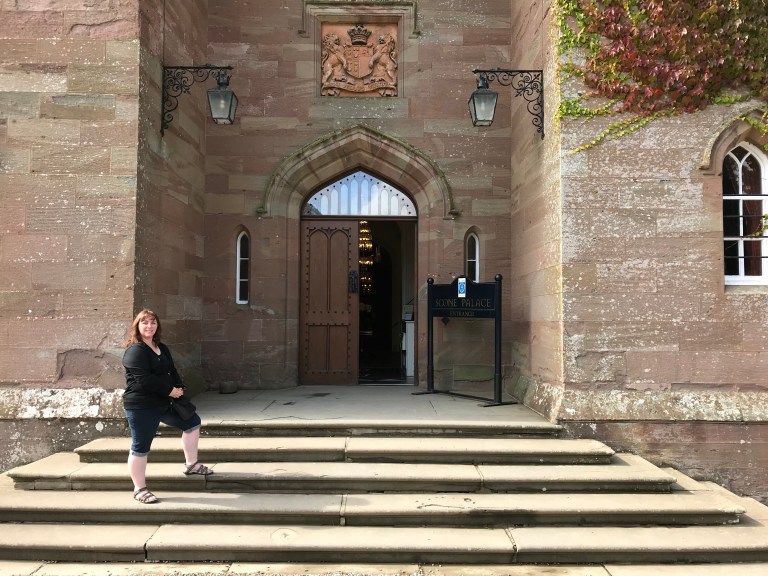
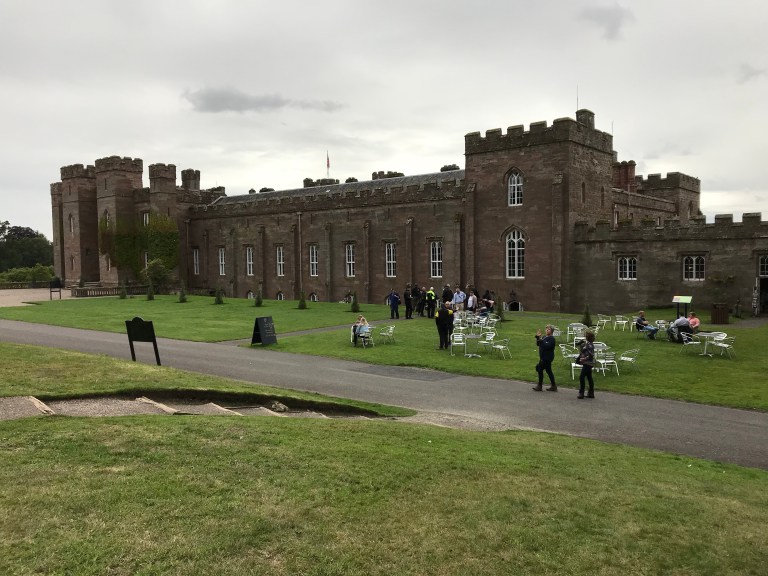
Scone Palace was absolutely lovely! The historic place where Scottish Kings were made, and where the Stone of Destiny rightfully belongs.

Dan and I are sitting on a replica of the real Stone, in front of the small Abbey. They are both on the original site where the Stone would have resided before King Edward took it to London 700 years ago. Legend has it that for roughly 700 years before that, Pictish and Scottish Kings were declared when they sat on the Stone. Legend also has it that the Stone was moved from Ireland to Scotland in about 840 AD by Kenneth MacAlpin, and it is he who brought it to Scone. The lords of the land would come to the new King there, carrying soil from their own lands to stand upon before the new king and swear fealty. The accumulation of the soil over the centuries resulted in the hill which is there now.

No photographs are allowed to be taken inside the palace itself. It is a beautiful building both inside and out, and contains numerous artefacts that I really, really, really wish I could have taken photographs of! If not taken home with me…

And there were peacocks on the grounds.

The breakfast at The Covenanter was good, the service and professionalism of the staff was excellent, and the rooms and common areas were clean, but I’m not sure I feel comfortable recommending the hotel, at least not for any lengthy stay. There was very little water pressure (almost non-existent at times) in the shower, and I’m not sure about the structural integrity of the floors. The floor in our room was dramatically uneven.

Adelle and Dan

Tick Bait and Moustache Shields

Today we left Ronnie and Angie’s fine establishment at Brookford B&B, where there is no doubt that they deserve all of the accolades, certificates, and awards that they’ve received. They are wonderful hosts, with a beautiful property, and damn can Ronnie cook a good meal! Check them out if you’re ever through Dumfries and Galloway:

Brookford B&B

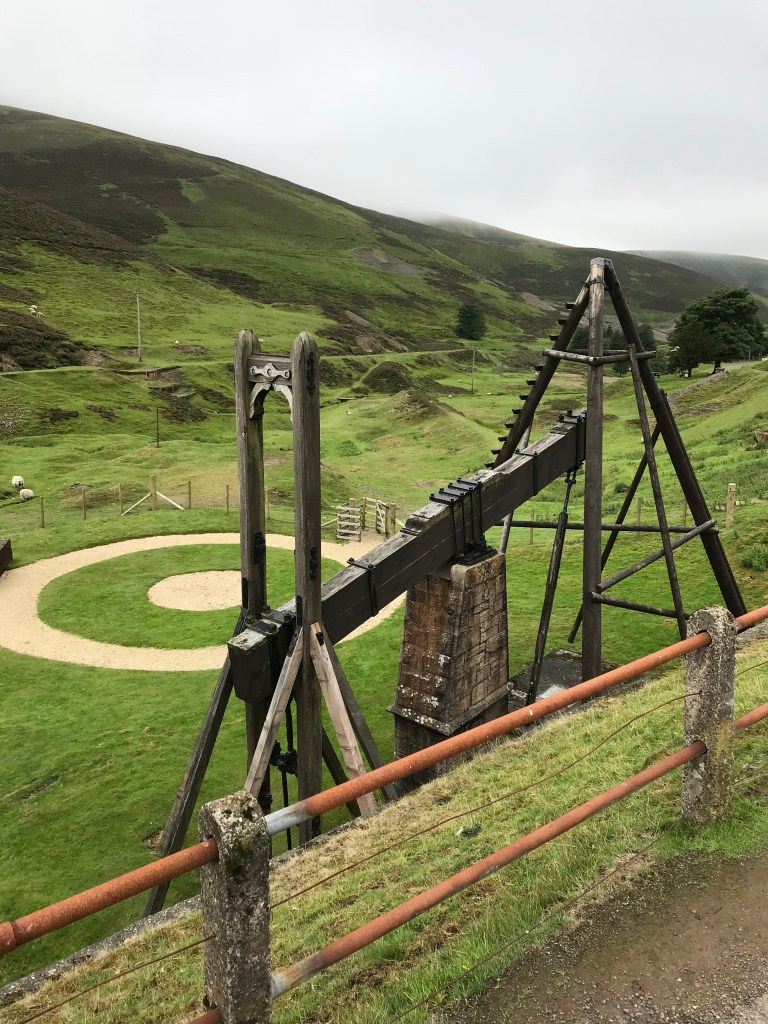
At the recommendation of our Scottish Immigrant friend John McLean, we visited the Museum of Lead Mining in Wanlockhead. Besides being the highest village in all of Scotland — I know it seems unlikely given it’s not located in the Highlands, but it’s true — it also boasts a wonderful little museum about the history of lead mining in the area, which is why the village exists at all.

The museum itself provided a history from the mines’ beginnings in 1710 all the way through to their end in the 1930s, which came about because of the Great Depression.

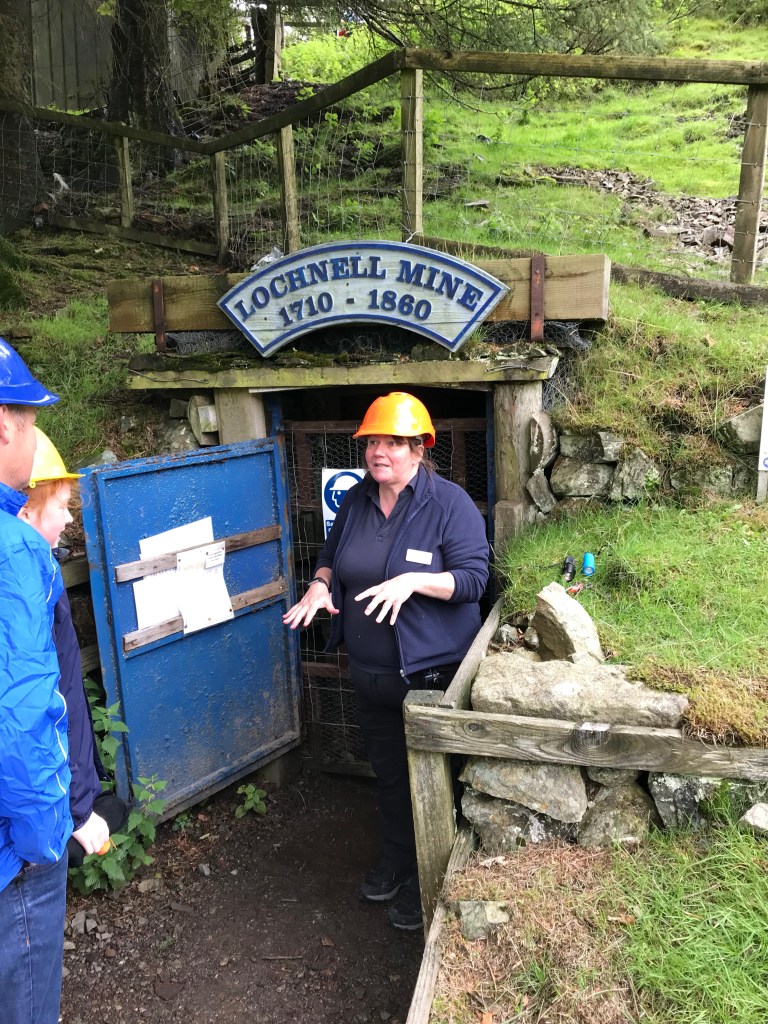
They also offered a tour of the Lochnell Mine, which was re-opened in 1974 specifically to show visitors. I admit, I did not think it through before going on the tour, we just automatically did it, so it wasn’t until we were inside the mine that I realized WE WERE INSIDE AN UNDERGROUND MINE! Being usually rather claustrophobic in underground situations, I usually require mental preparation to enter them. I must have done that sub-consciously, because I actually handled it just fine and even enjoyed the tour. We didn’t go very far, actually, although our guide, Margaret, did point out that they were working on extending the tour to go another 150 yards.

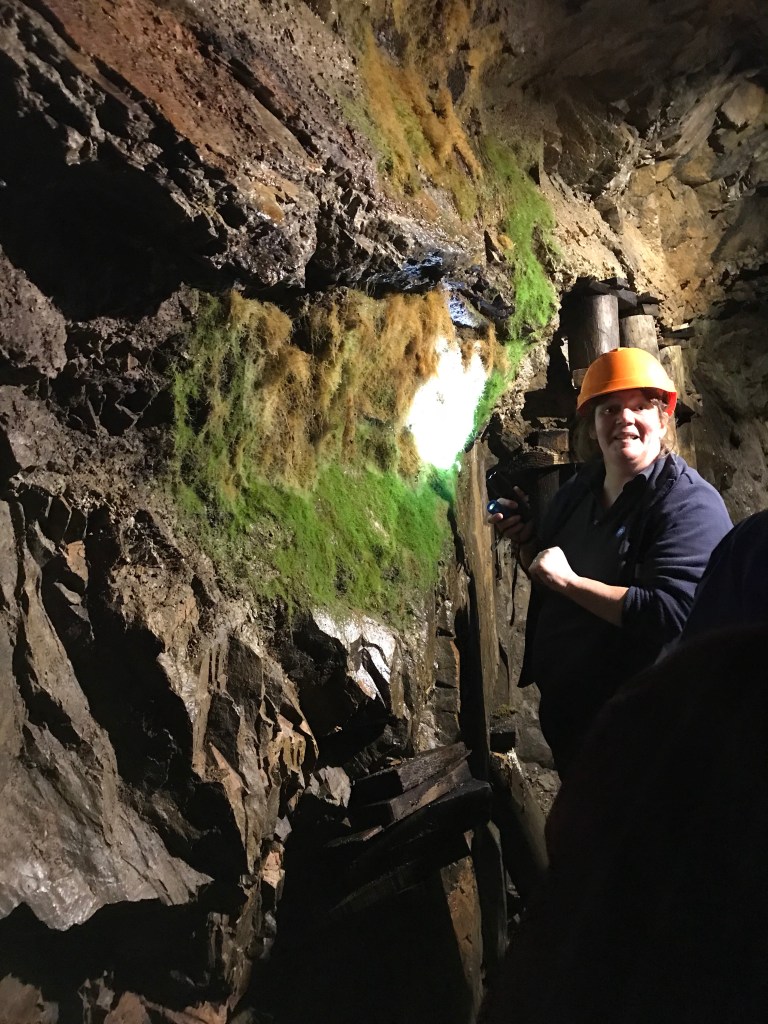
Along the way, Margaret showed us the galena, the really dirty stuff that I just can’t recall the name of, how they would blast sections of rock to reach the galena, and the bucket winch they would use to send men into the hole to retrieve more galena. This particular mine actually closed in 1861 because they couldn’t pump the water out of the hole fast enough to be productive.

It wasn’t until we were out of the mine that I asked her how far underground we just were, to which she replied about 120 yards. Glad I didn’t know that before we went in. Even Dan commented he was watching to see if I’d freak out in there. Then Margaret just had to also mention that the mine is shared with two different kinds of bats as well, and they sometimes can be ‘friendly’ while the tours are in there. Yeah, also glad I didn’t know that when we were in there.

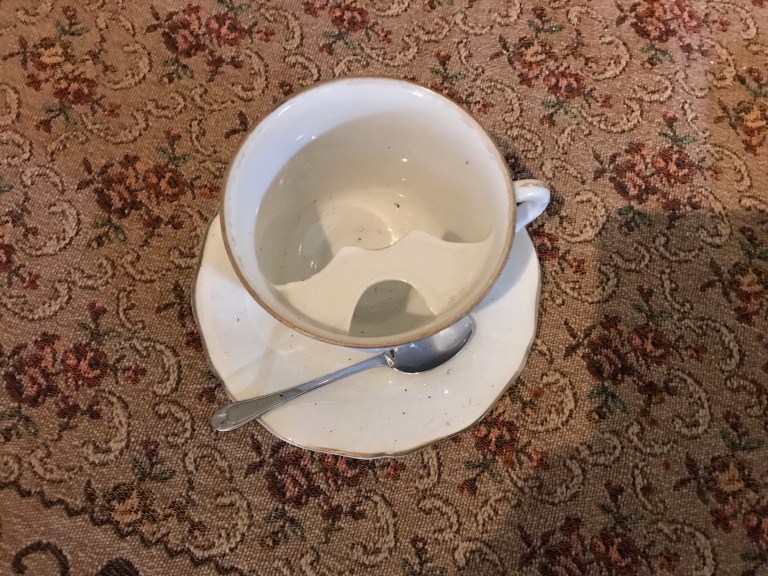
Margaret handed the tour over to another tour guide (I’m so sorry, I have forgotten her name) to take us to the Straitsteps Cottages, where they’ve recreated how the miners homes would have looked in 1750, 1850, and 1910. As time passed, the living conditions improved dramatically. Of course, the single item that peaked Dan’s interest the most were the Victorian tea cups with moustache guards in them.

We also learned that the lands are owned by the Earl of Buccleugh, and the sheep and goats are owned by the Earl of Buccleugh, and therefore the sheep and goats are free to roam anywhere on the Earl’s lands that they please. The sheep are not used for meat, nor are they sheared for their wool. The sheep, rather, are effectively used as tick bait, given that the ticks prefer them over humans, and this results in relatively tick-free heather and brush for the aristocrats who come in the fall to do their grouse hunting in.

We continued on our journey today, and just to mix things up we decided to drive for about an hour and then see what Lady Sat Nav could show us for another site to see. There was a brief delay on the highway when a swan decided to go for a walk along the centre line. Our photos didn’t turn out, sorry.

Lady Sat Nav failed us this time, but Googlemaps once again saved the day. Castle Campbell ended up being the nearest option.

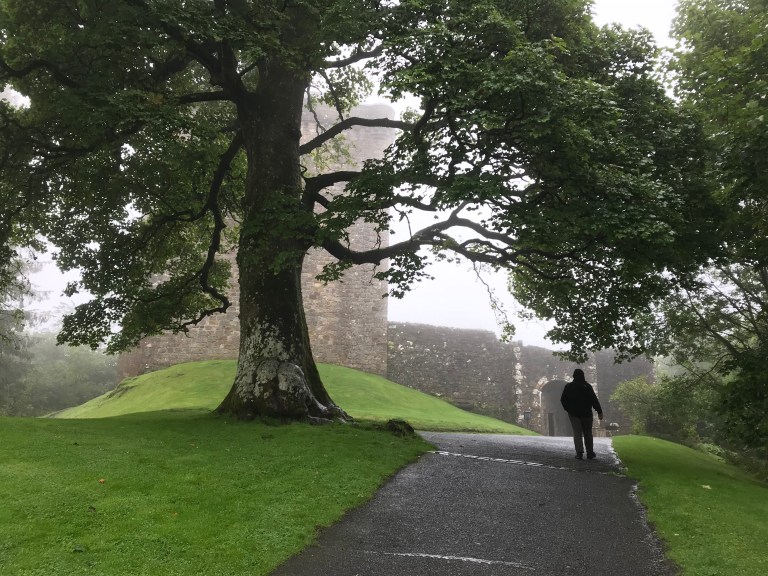
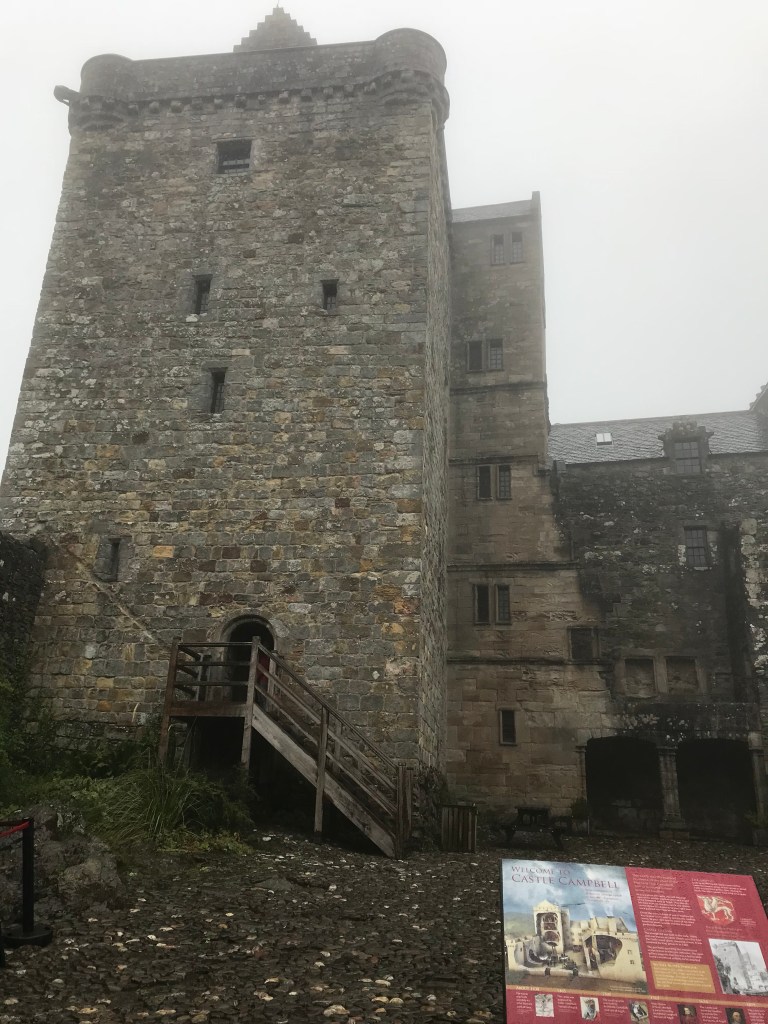
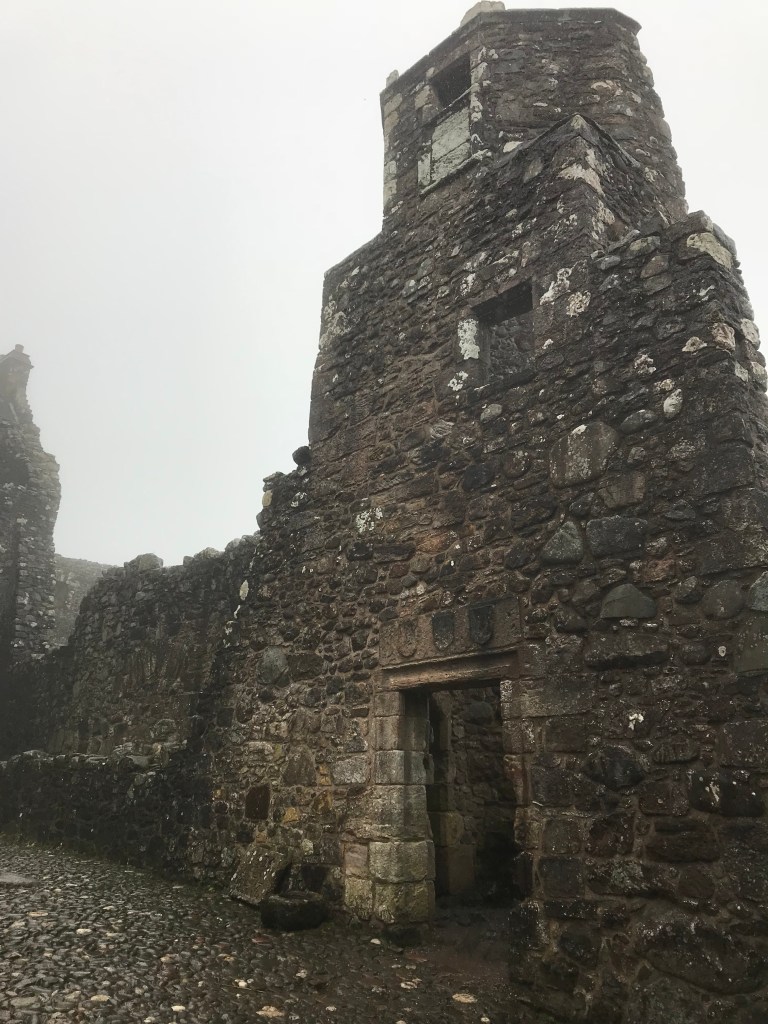
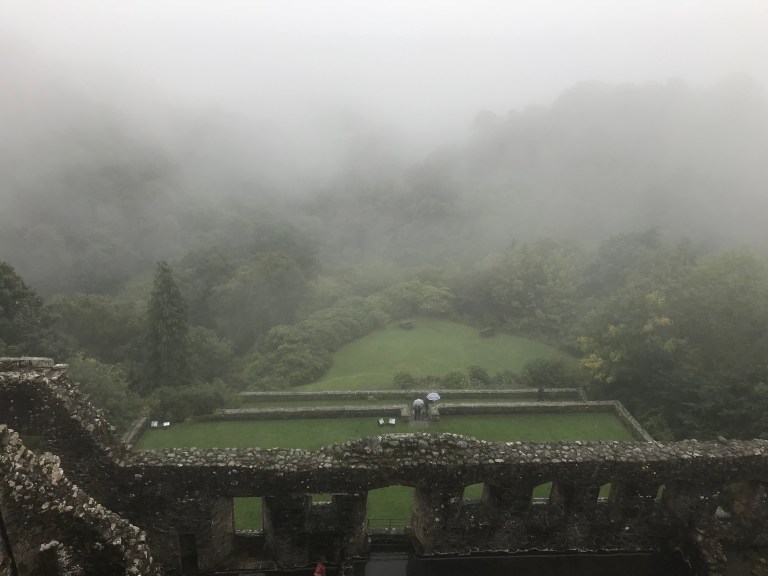
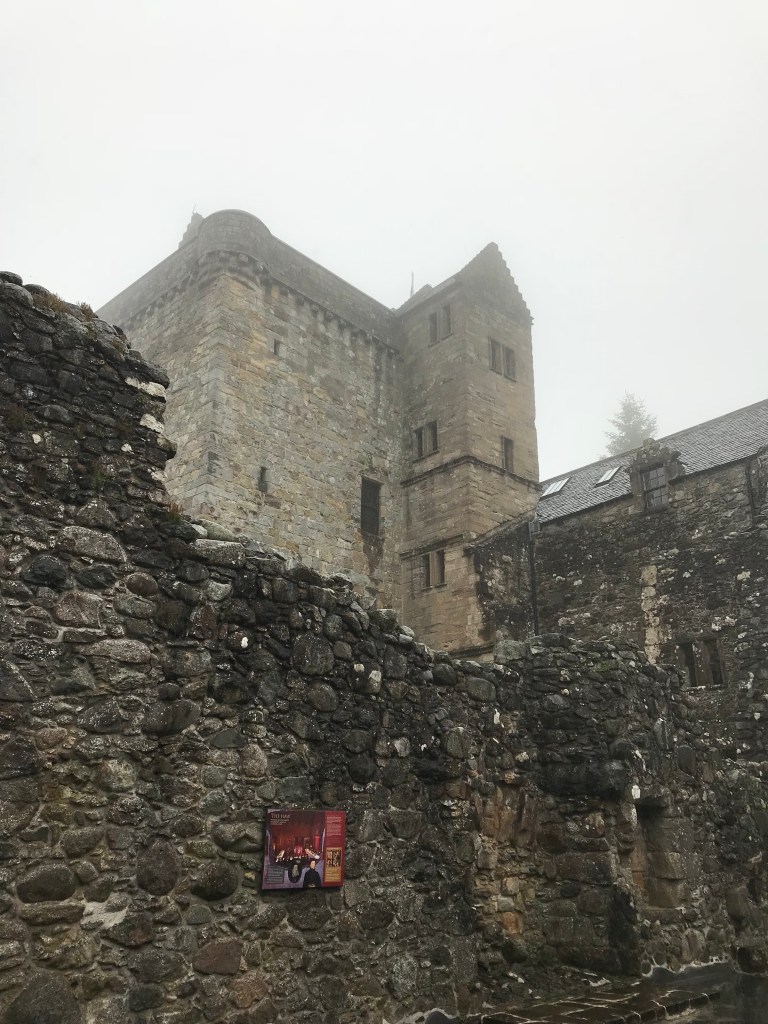
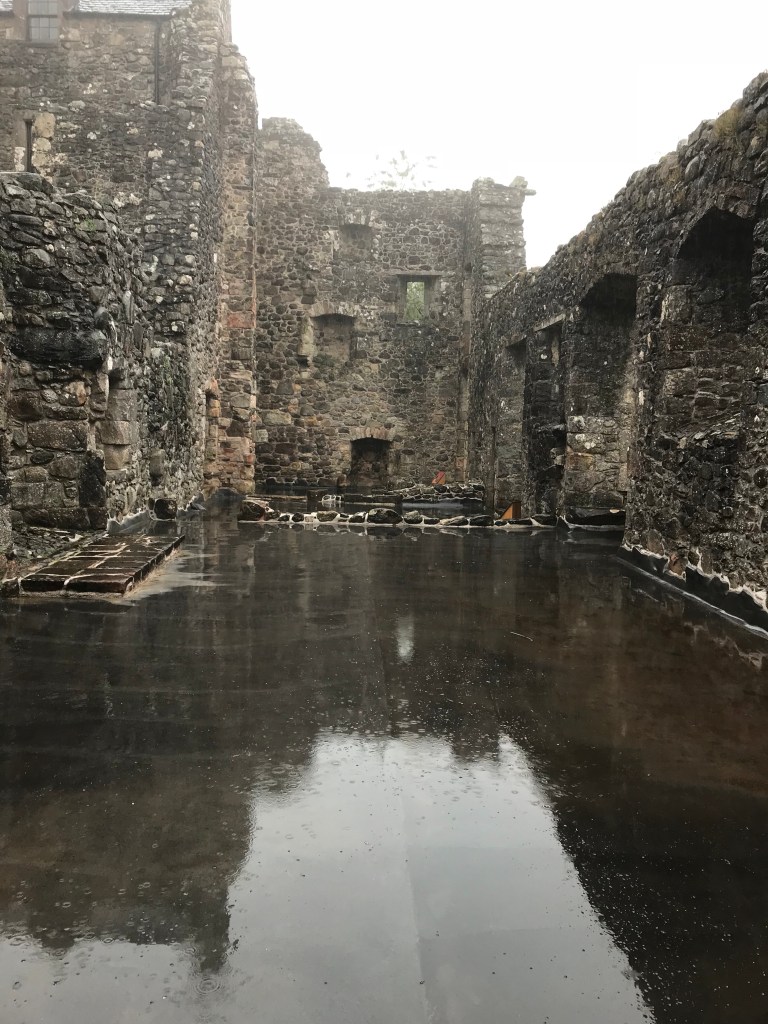
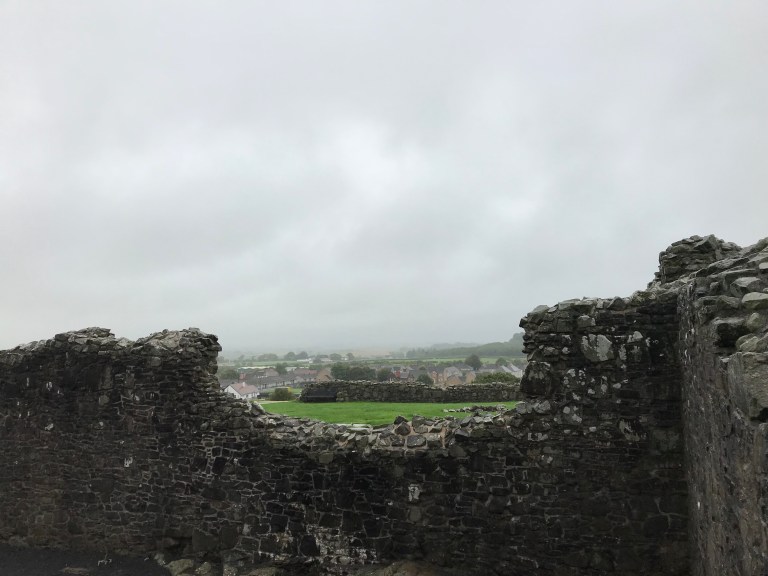
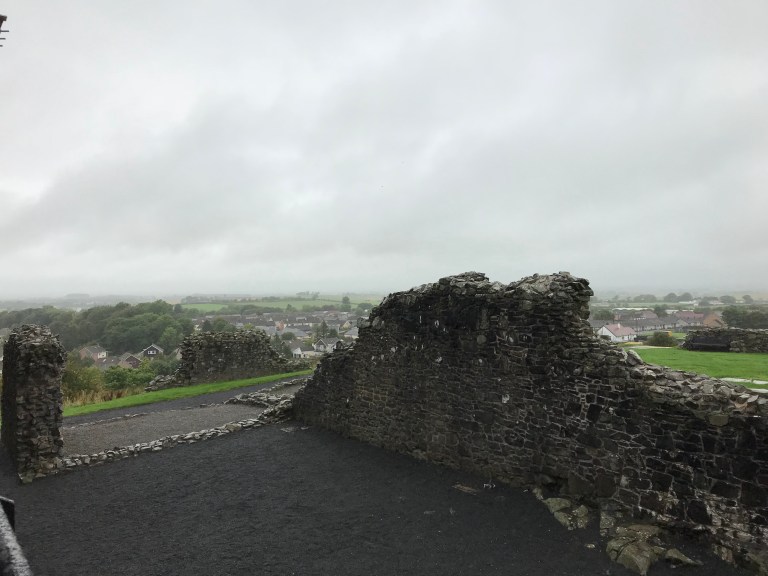
Our detour to Castle Campbell was actually pretty cool for being on the fly. It’s located pretty much in the middle of nowhere, on a narrow ridge separated from the Ochil Hills be deep ravines. On a clear day it must offer spectacular views. We wouldn’t actually know. As soon as we got there it was misty and foggy.

It’s a bit of a slog up and over a couple of hills, but actually quite worth it.

This is another site that is believed to have originally been a motte from as early as the 1100s, but the existing tower is dated to the early 1400s. At the time it was referred to as Castle Gloom (likely spelled differently), and may have been built for John Stewart, Lord of Lorn.

The Campbells came into possession of the castle through marriage around 1465, and King James IV granted Earl Colin’s request to change the name of the Castle from Gloom to Campbell.

The Castle was extended and renovated three times during the Campbell’s occupancy, until 1654 when Scottish Royalists razed the castle because the Marquis of Argyll allowed Cromwell’s British forces to use the castle as a base.

We toured the castle from the highest point in the tower down to the lowest point in the garden. Dan and a bird kept bumping into each other whenever he’d try to look out a tower window. The first time actually surprised Dan so much he squeaked and flinched. Can’t really blame him though, the bird literally flew into his face through the window, and at first he thought it was a bat.

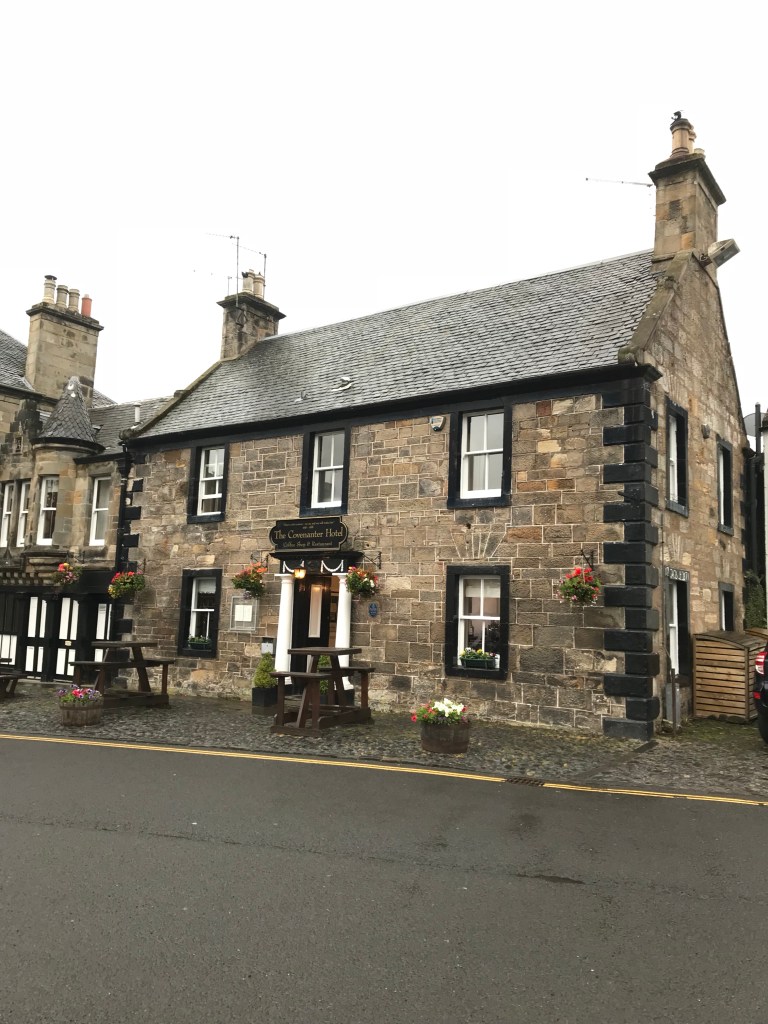
We enjoyed this stop, as brief as it was, but had to continue on to our final destination: The Covenanter Hotel in Falkland. This is where my fellow Outlander fans should be collectively gasping in envy. For those who don’t know, The Covenanter was used for the hotel where Claire and Frank stay when they first go to Scotland in 1946.

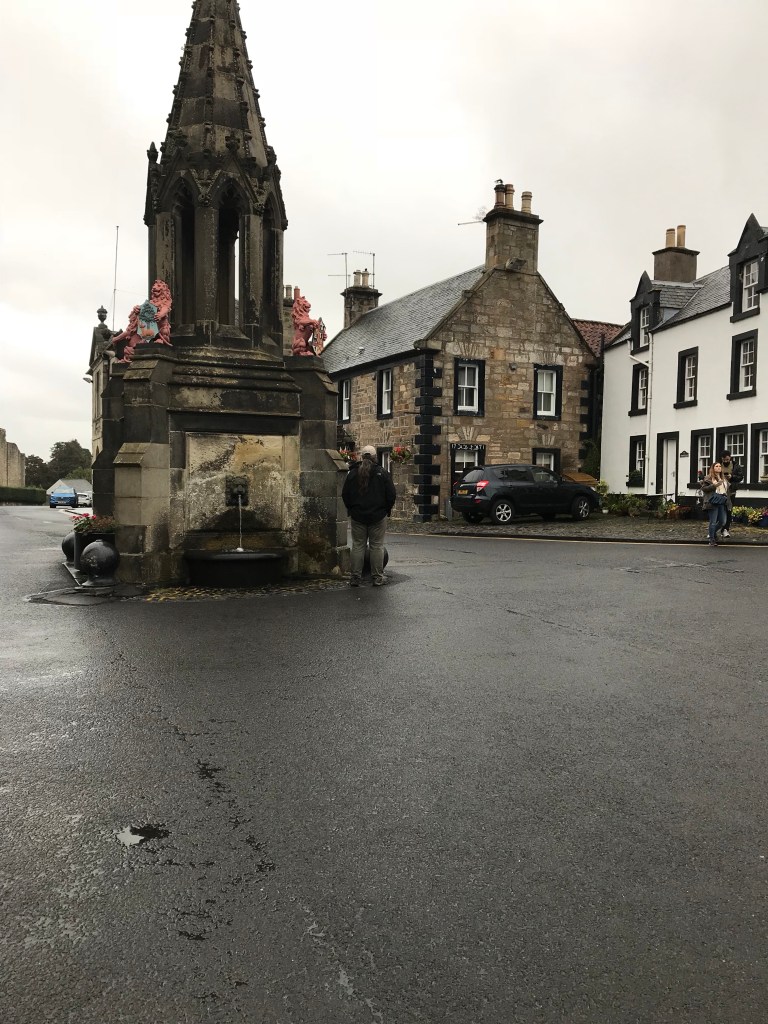
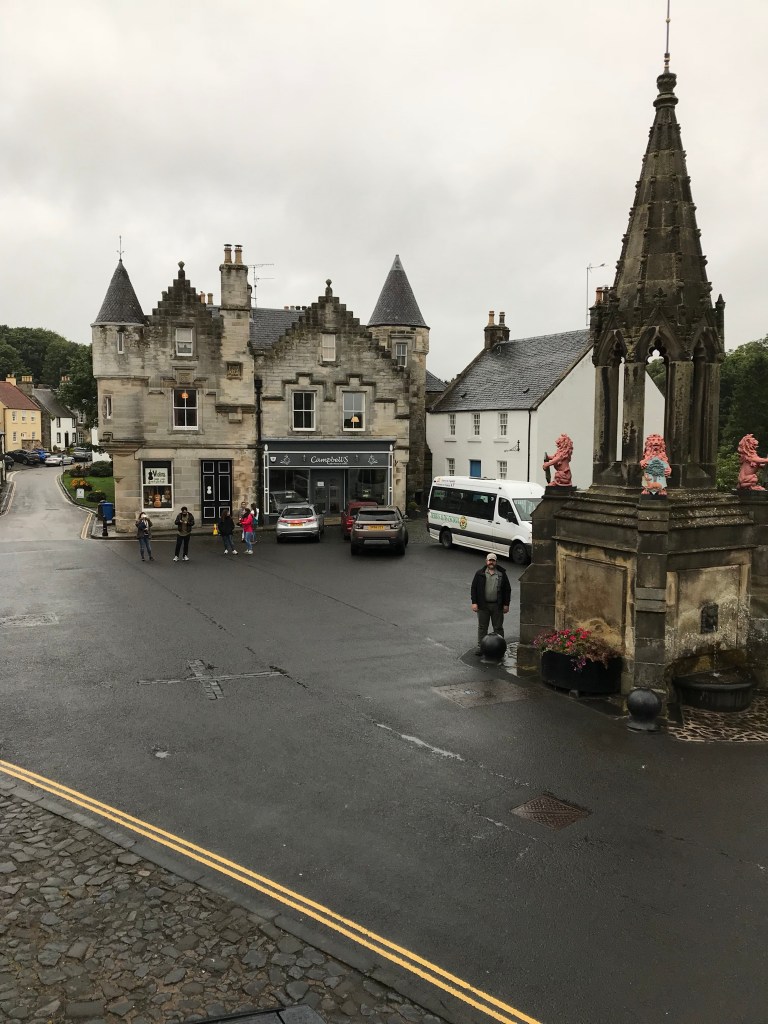
Right outside the hotel is where Frank see’s Jamie’s ghost at the fountain looking up at Claire.

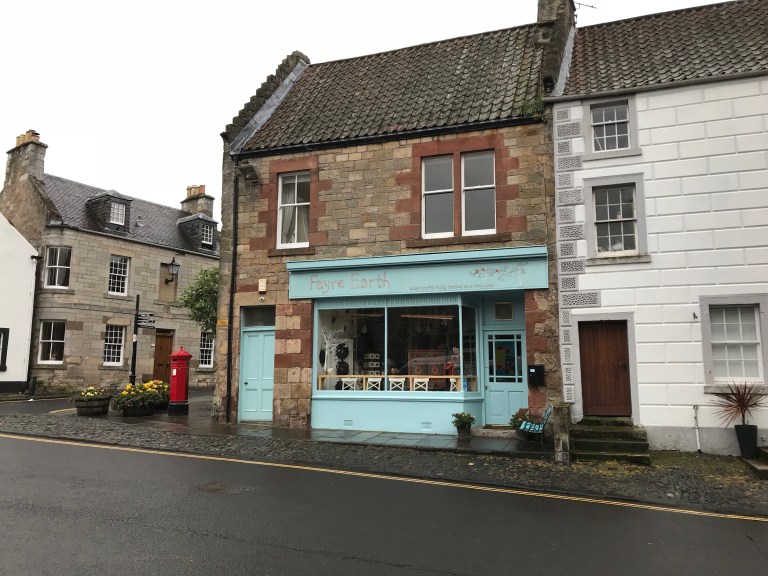
And just across the street is the store used for the store where Claire admires the vases through the window.

Now, here is where you can really collectively sigh: we are actually staying in the corner room where Claire would have been combing her hair while Jamie watched. Actually, the room looks nothing like what we see on TV, and the window Claire is seen at is actually the bathroom window, which is not accessible without reaching over the toilet and across a deep ledge, but that doesn’t really matter, now, does it!

Outlander fix achieved, we went to the only place our hotel concierge was sure would still be open for supper this late on a Sunday: Wetherspoons at The Golden Acorn. The service was pretty great, and the establishment itself wasn’t too bad, but the food was awful. Apparently Wetherspoons is a huge chain in the UK, and Dan had heard of it referenced in Jimmy Carr’s comedy routines, but really, don’t bother going there.

Adelle and Dan

The Reason Why We Keep Coming Back

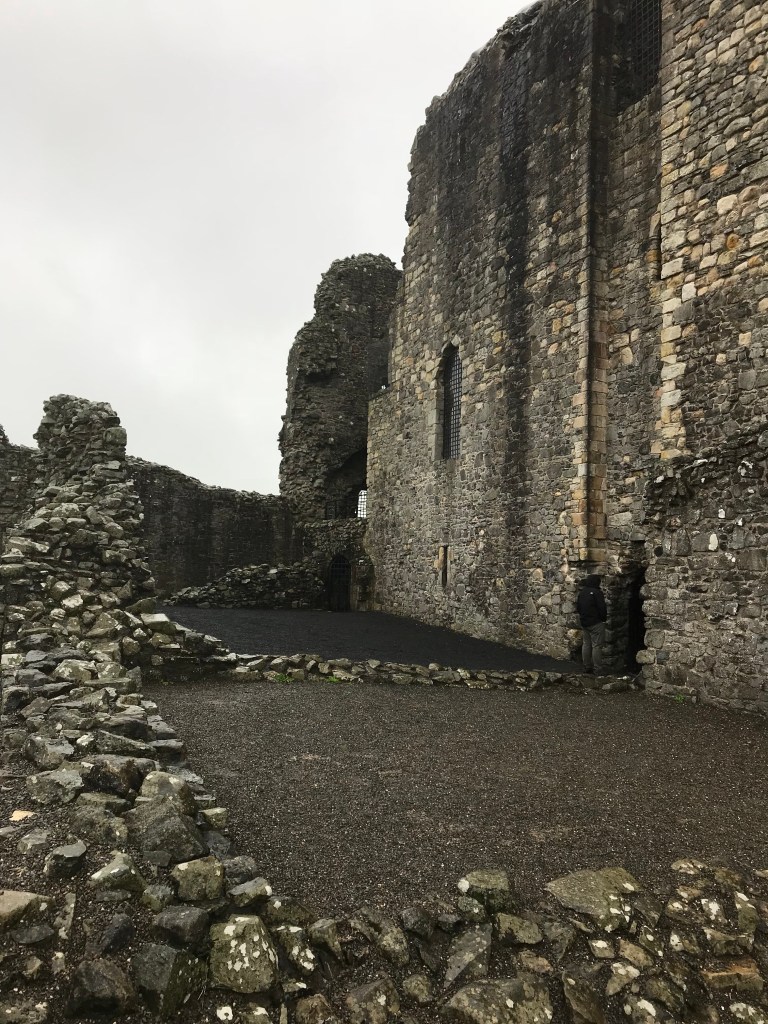
An hour’s drive from the B&B brought us to the west coast in Ayrshire. Our first visit was to Dundonald Castle, which frankly I expected more from. The visitors centre was rather cramped, and their small museum had potential to be very interesting if it weren’t being used for storage as well.

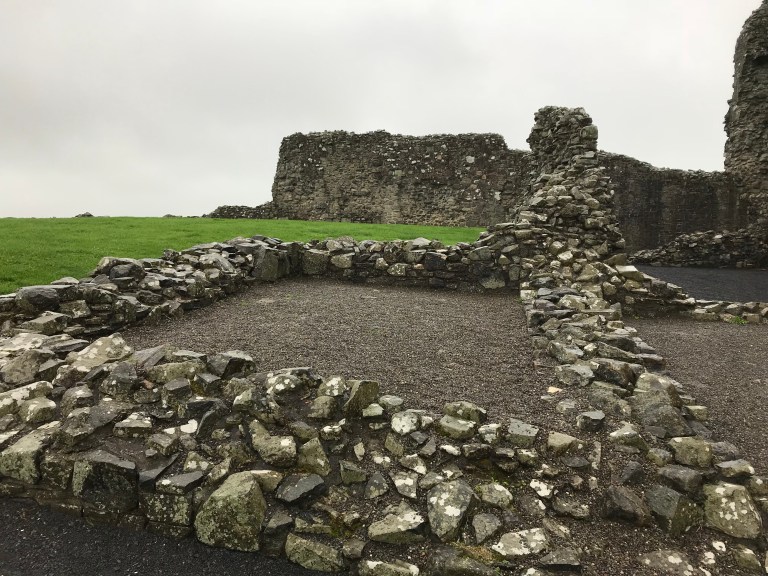
The hill the current castle ruins sit on is believed to have been where royal families have resided since prehistory — meaning there is evidence of settlements from the late Bronze Age. Further evidence of roundhouses has been found establishing continued occupancy of the hill through the Iron Age, and onward.

Dundonald’s known history begins around 1160 with the FitzaAlan family from Normandy, arriving as Steward to David I. Walter FitzAlan’s descendant becomes the King of Scots in 1371, beginning the long line of Stewart monarchs with Robert Stewart, who was the grandson of Robert the Bruce. The current castle was built around that time, and was frequented by King Robert II, but by the 1630s it had been abandoned for the far more comfortable Auchans House.

What we actually found interesting, and actually an unexpected addition to one of our sub-themes, was that the first medieval castle (and hence all subsequent castles) was built on a motte. So we had another hill to climb today.

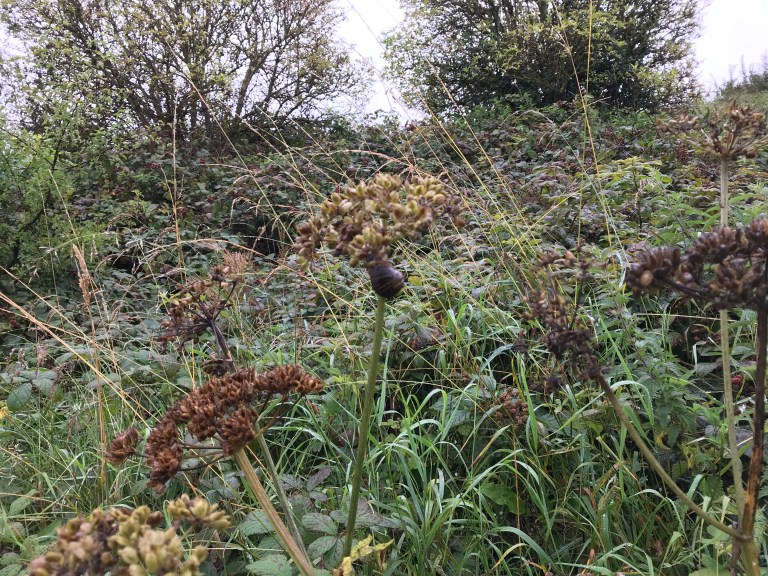
On the way back down the hill, I took a moment to contemplate how long it must have taken this snail to climb to the top of this weed (flower?).

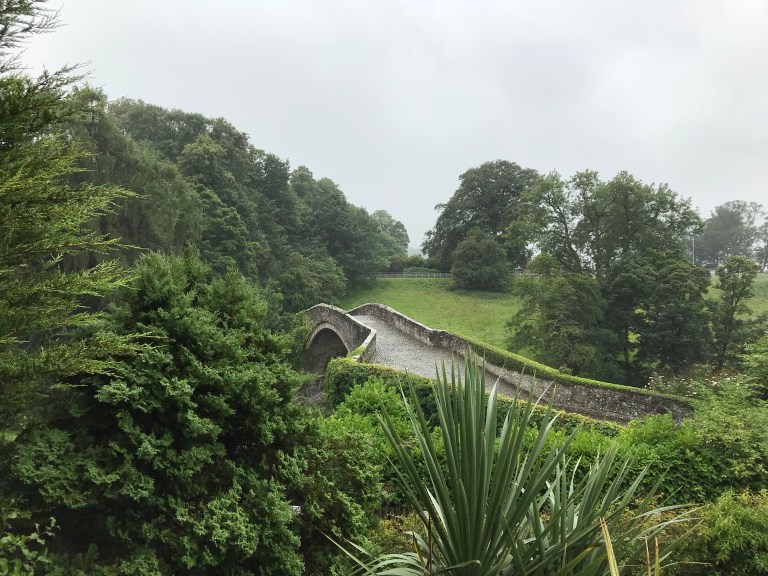
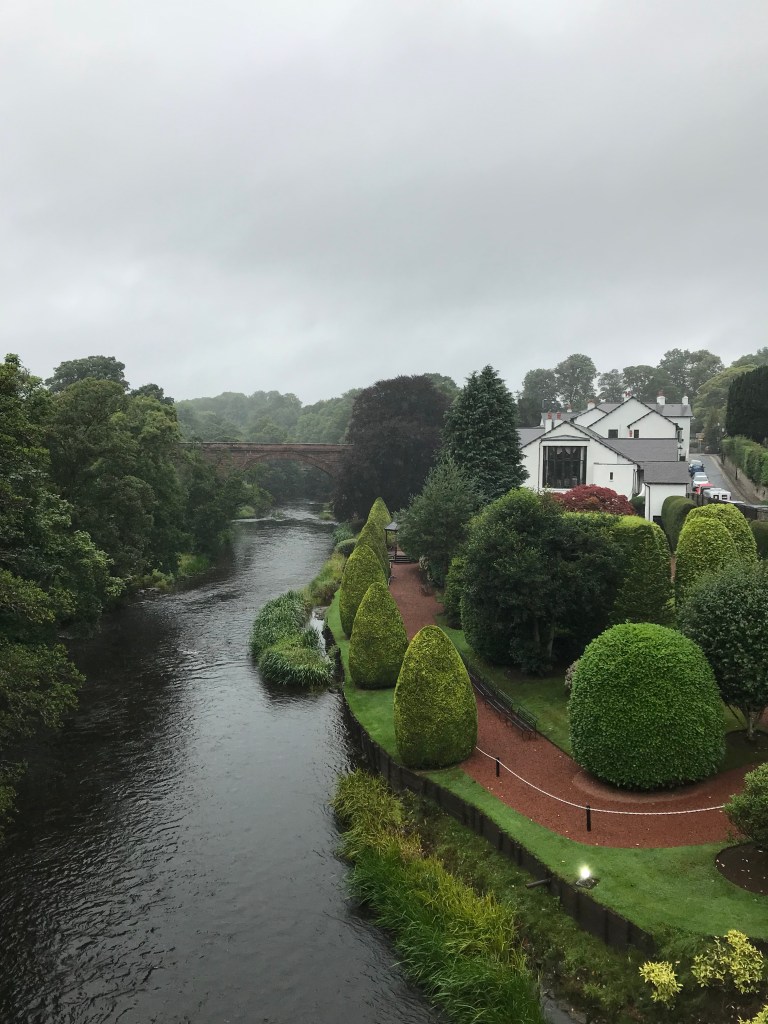
Our next stop was at the Robert Burns Museum cafe for lunch (we did not go through the museum), followed by a walk through the beautiful gardens to the Brig O’ Doon., which is mentioned in the poet’s tome “Tam O’Shanter”. I’m pretty sure he probably references the bridge in other poems or songs, but I admit to not really being familiar with Robbie Burns’ works. We did feel compelled to pick up a copy of his complete poems and songs to correct that.

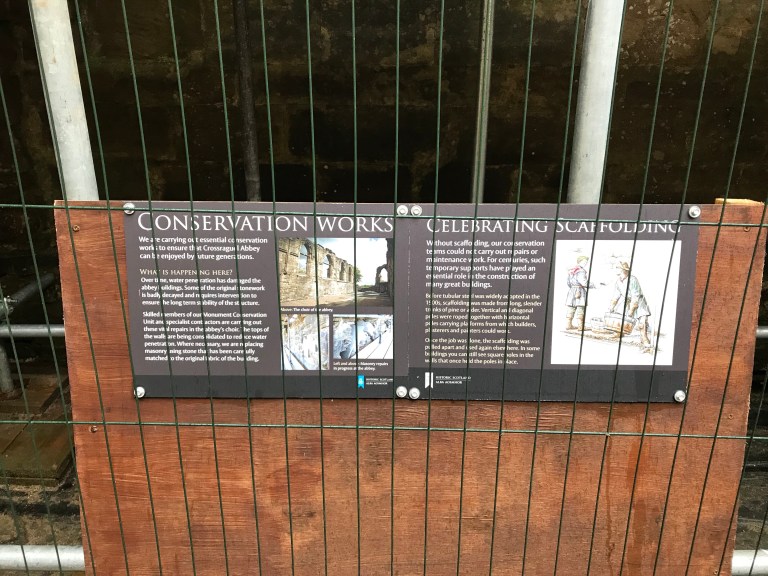
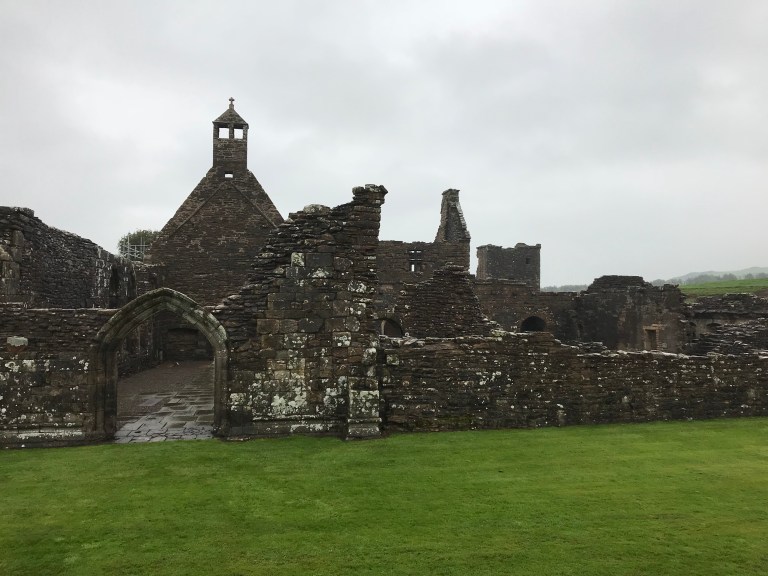
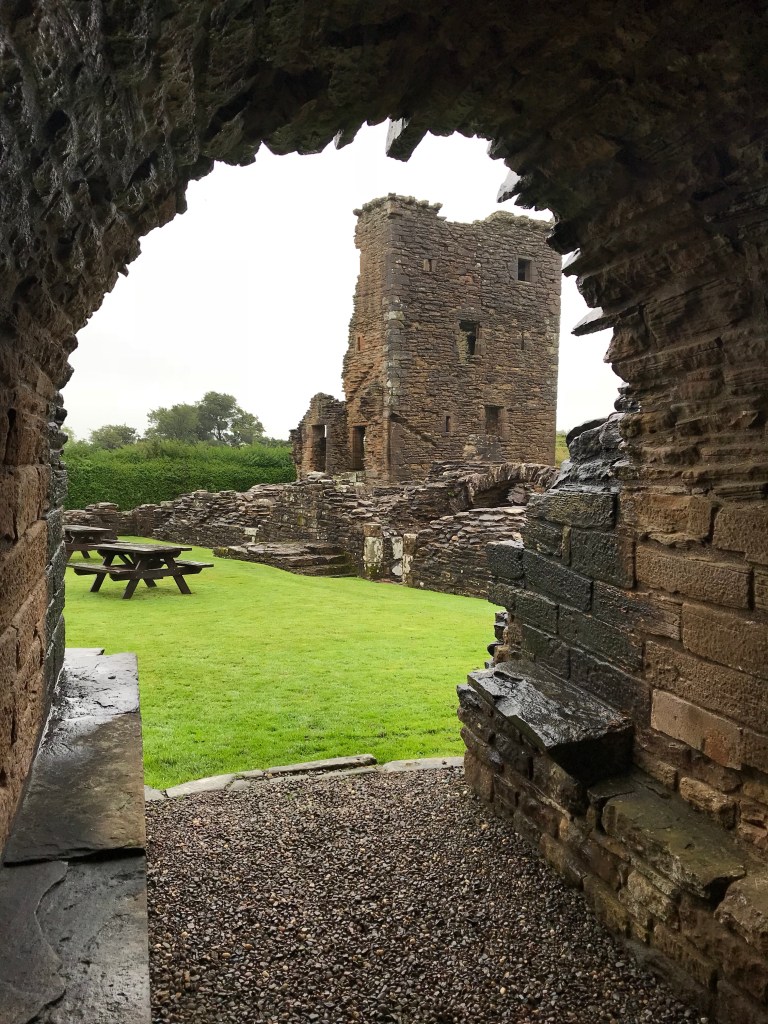
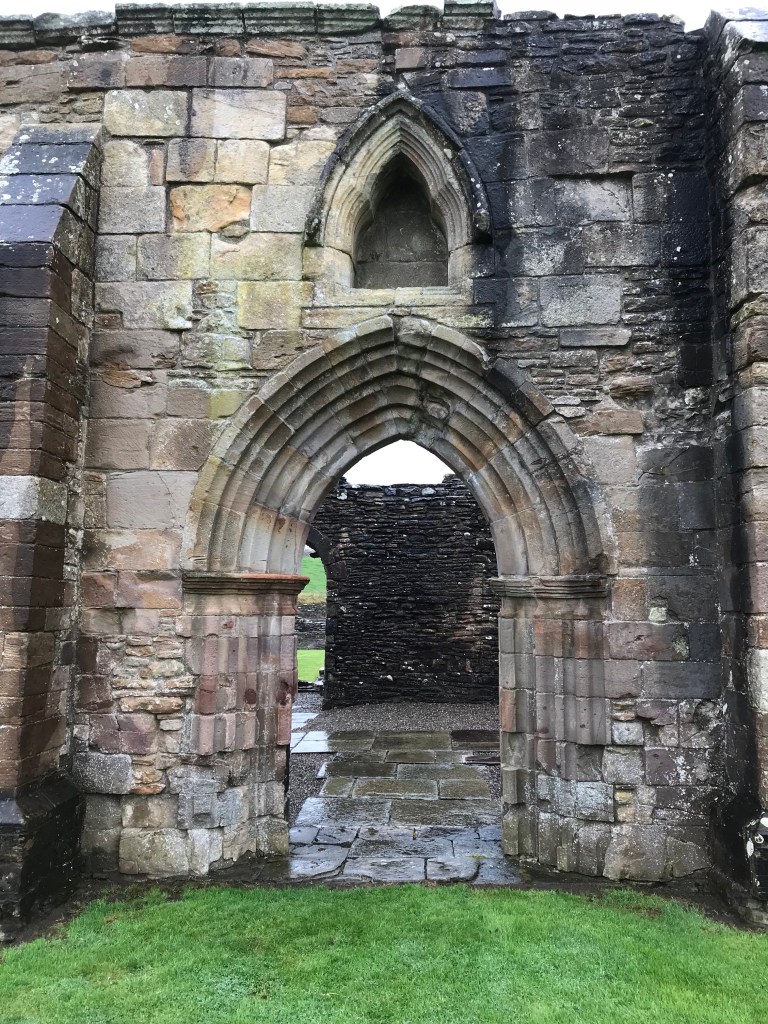
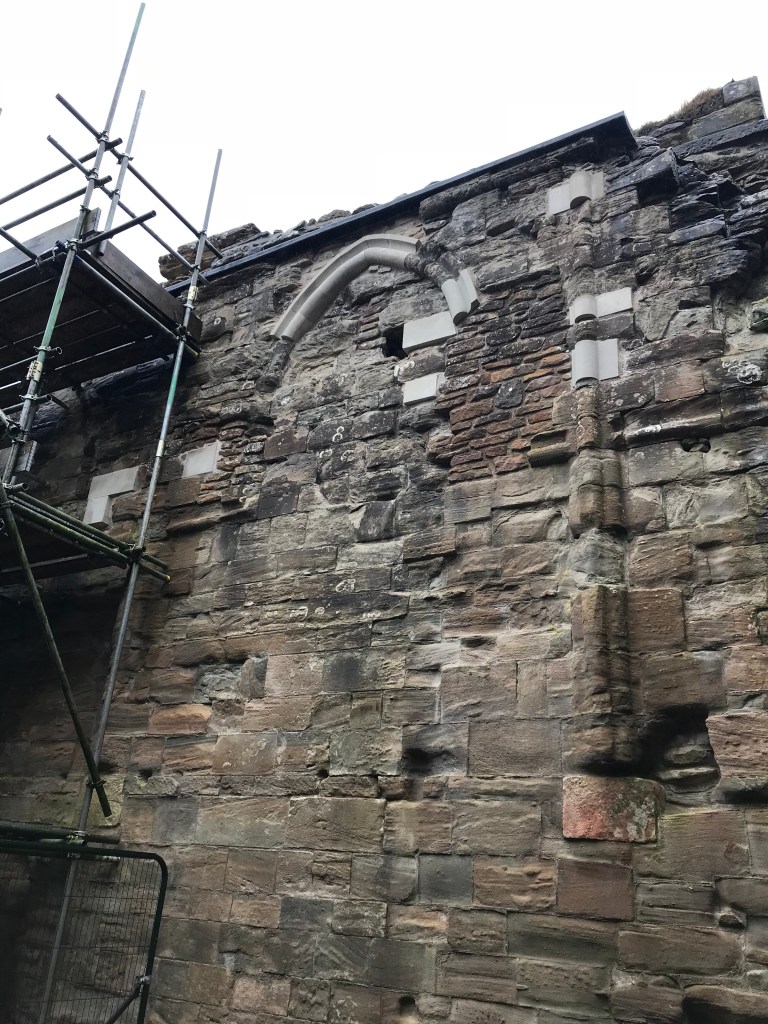
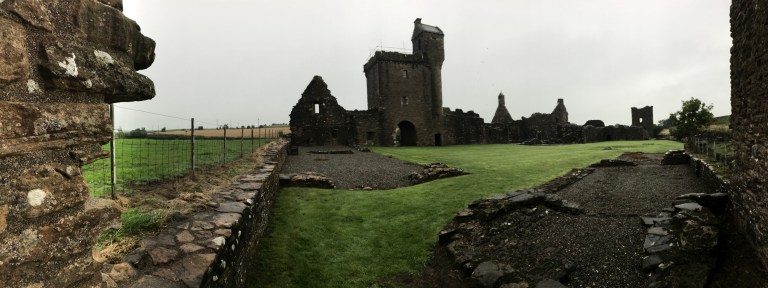
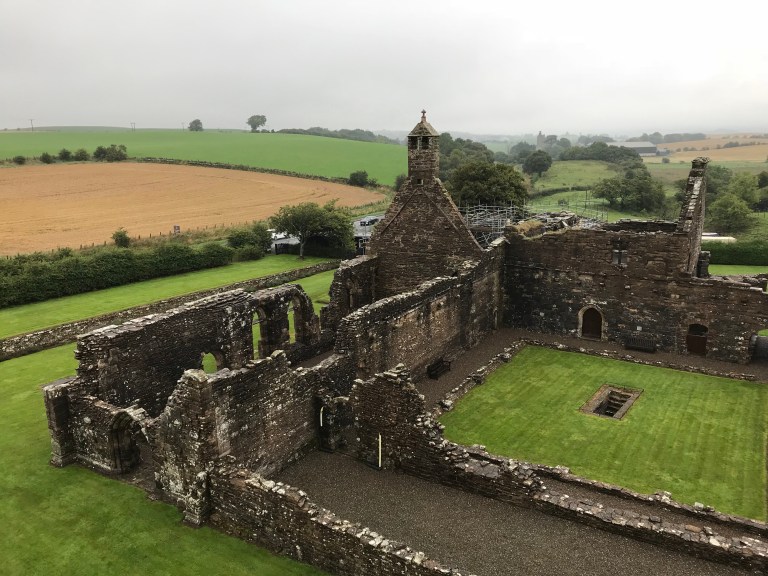
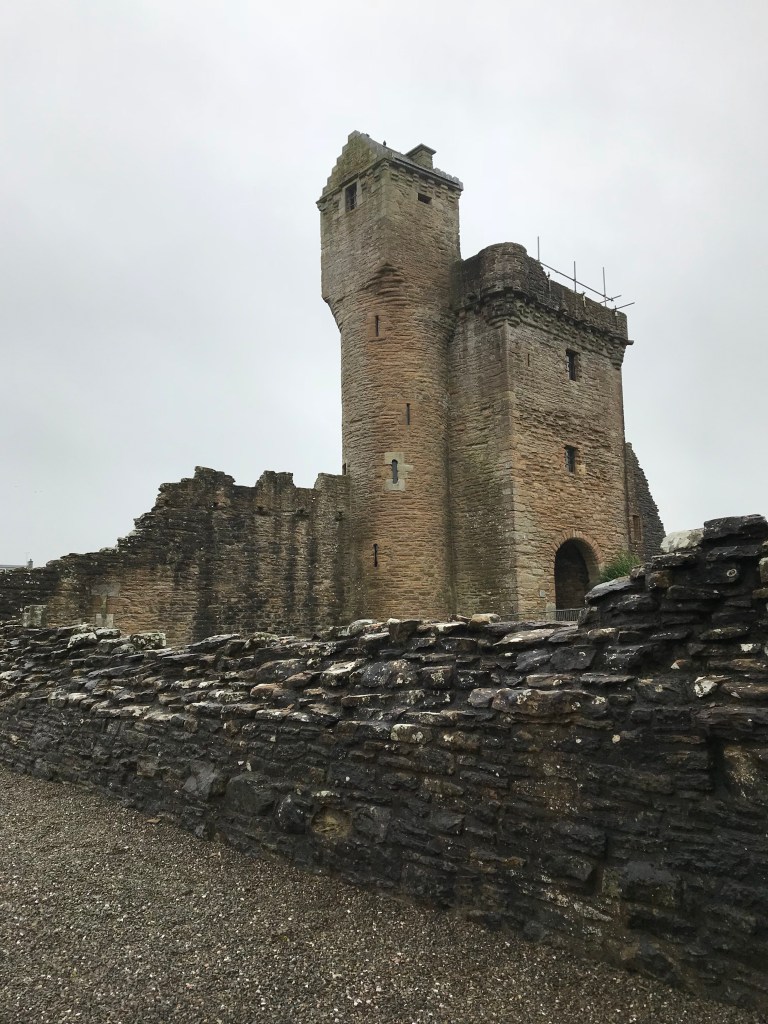
On to Crossraguel Abbey, which turned out to be the highlight of the day. Fantastic place, it just felt so right to be there. The architecture is beautiful, and the stonemasons who are currently doing conservation work on the building are being very respectful and true to the designs, endeavouring to keep the stones with stonemason’s markings in place.

“Crossraguel Abbey is one of Scotland’s most complete medieval monasteries. It was founded around 1250, as a daughter of the Cluniac Abbey at Paisley, and was still in use well after the Protestant Reformation of 1560, though in much reduced form.” [taken from Historic Scotland’s Official Souvenir Guide]

Jean, the Steward on duty while we were there, was fantastic, and so enthusiastic about the highlights and history of the Abbey.

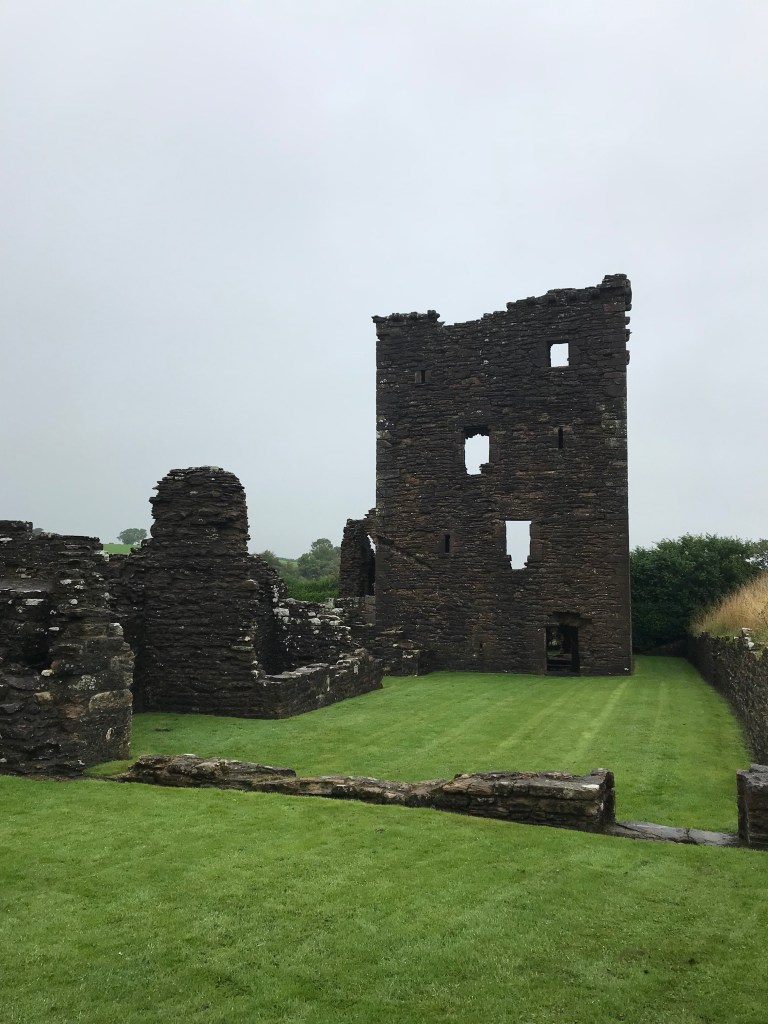
Written history documents that Robert the Bruce was baptized at this Abbey, and he made particular efforts to ensure the prosperity of the Abbey. However, local oral histories suggest that not only was he baptized there, he was also born there, in the corner tower.

There were two architectural features of particular note (among many): the sewer system and the Chapter House.

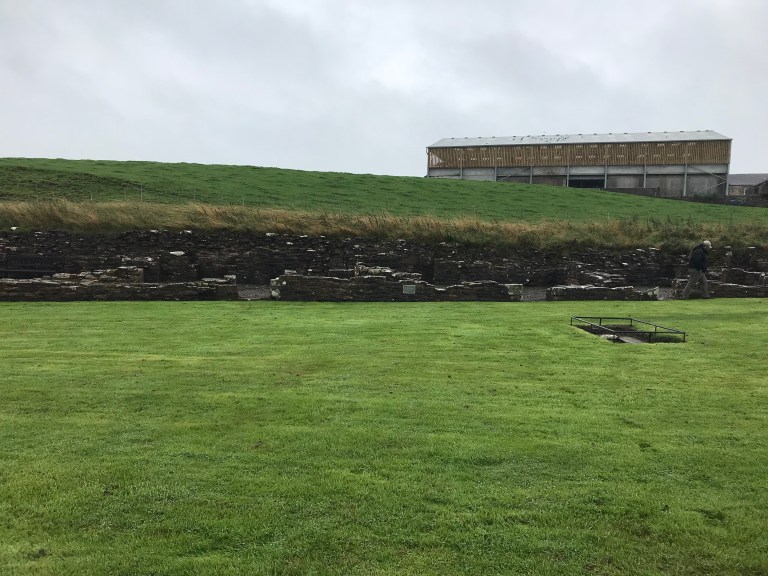
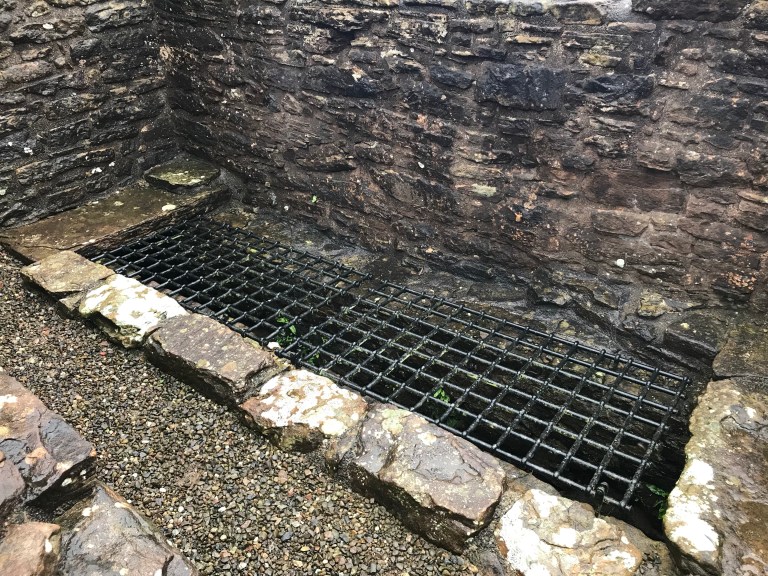
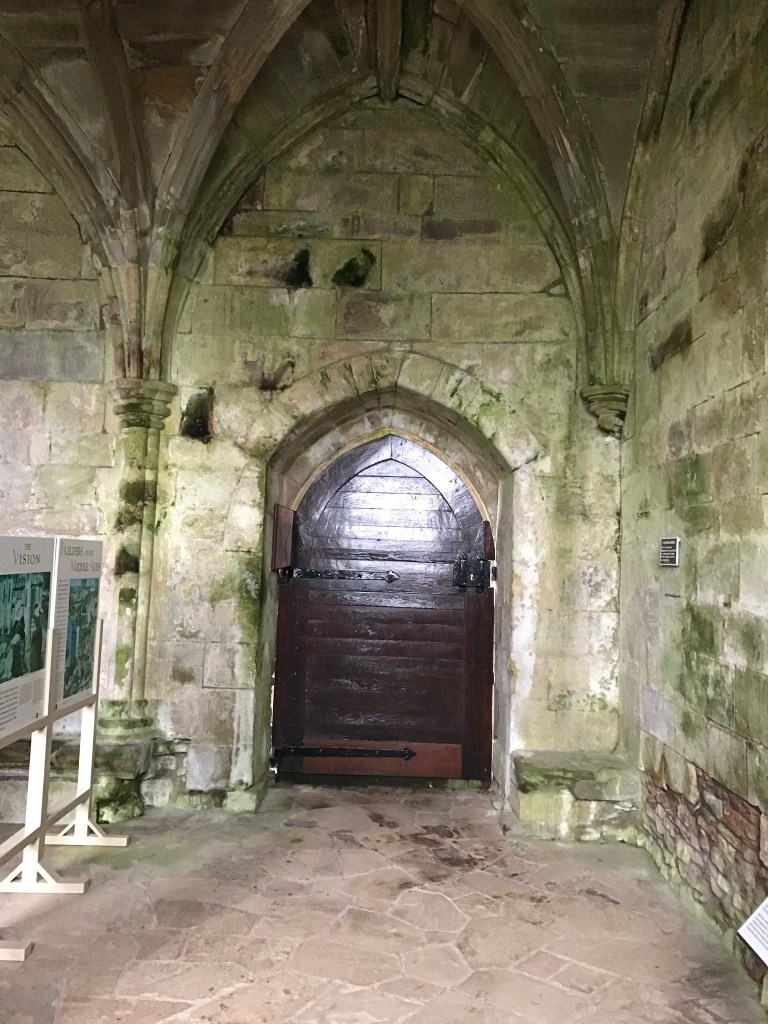
Yes, that’s right, at a time when most places were throwing their piss out the window, the architects who built this Abbey had learned from the Romans, used the surrounding features of the landscape, and included private latrines in most rooms that let out into an aqueduct of sorts which flushed the waste away. An existing stream was rerouted underneath the Abbey compound with all of the sewers emptying into the stream. Good for the Abbey dwellers, but not for the people downstream. The stream is till flowing under the Abbey today.

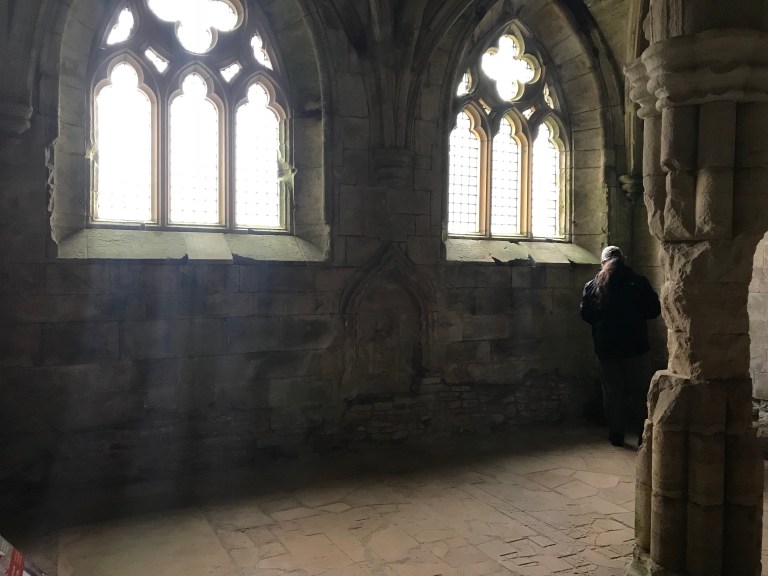
The Chapter House is amazing! It’s a relatively small room, but with the most wonderful architectural features that create fantastic acoustics. The room was used for group meetings, and the acoustics were designed to make it impossible for more than one person to speak at a time. I’ve made a short video to try and capture just how fantastic it sounds, but I’m not sure it really does it justice. (I’m pretty sure I got the words wrong…)

Here is a link to a performance on flute of “The Water is Wide”, which really gives a better sense of the sound:

The Water is Wide, on flute

As we were leaving Jean recommended we go to Dunure for supper. With a twinkle in her eye, she also suggested we might recognize some of the areas from a particular TV show. Turns out, Ms Jean not only was one of many local extras in Outlander, she also actually interviewed and met Diana Gabaldon. So jealous! Her article can be found here:

Jean Brittain’s article about Diana Gabaldon

Dunure is a sleepy little fishing town with a castle ruin all its own (which we did not take time to explore) and the best seafood restaurant ever!

Before partaking of a meal, we found the harbour backdrop used for filming the Paris dock scenes when Jaimie and Claire board the Artemis to Jamaica to go after Young Ian.

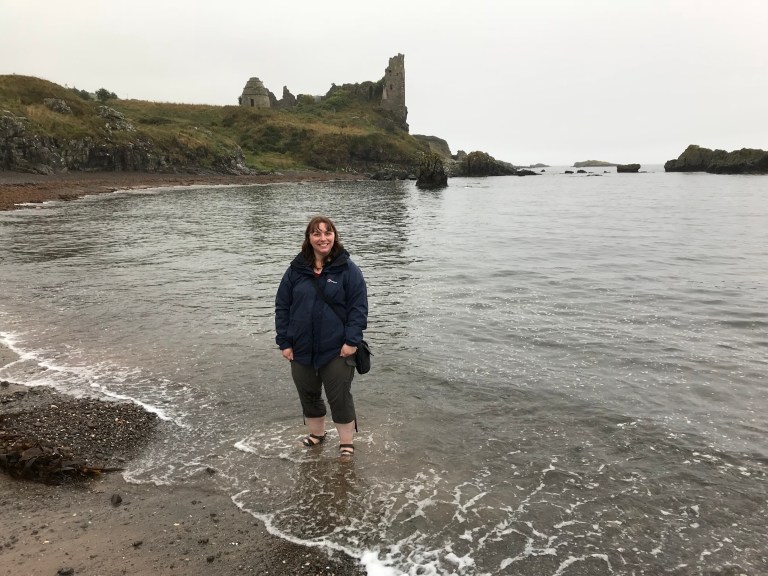
Then we walked on the beach, for which the scenes at Silkies Island were filmed, when Young Ian swims out to the island and gets taken by the pirates.

Of course I had to get my feet wet in the North Sea of the Atlantic Ocean, too…

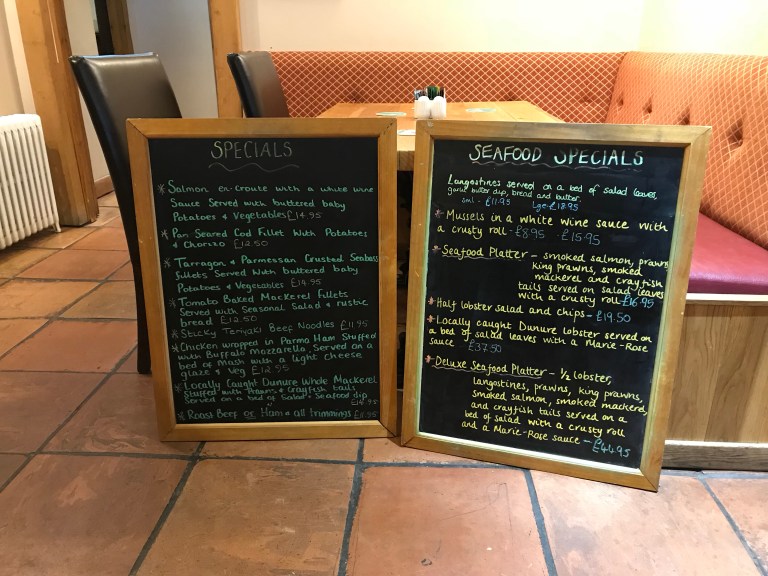
Then we were faced with the dilemma of choosing from this extensive and mouthwatering specials menu!

The hour-long drive back to the B&B through Galloway Park in the dark was worth it for the wonderful day we had today.

Adelle and Dan

Fallen Trees and Raised Spirits

Hellooooo, Lesley and Mark!

Lesley and Mark are the owners of Solway Tours, and they took us on their Cradle of Christianity day tour today.

Solway Tours

First stop was at Garliestom. This is where, in 1941-1944, the allied forces designed, built, and tested three different devices to facilitate the speedy off-loading of military equipment and vehicles on D-Day. Of the three designs, only the Mulberry Harbour was successful and actually used.

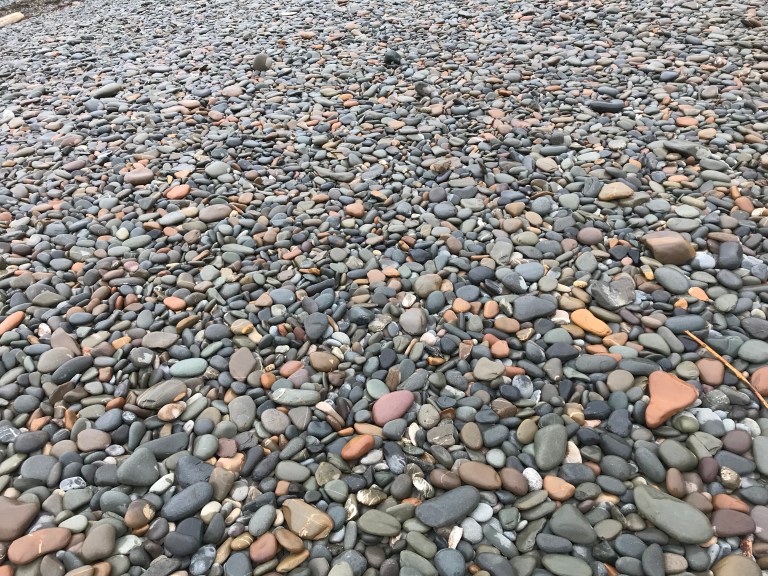
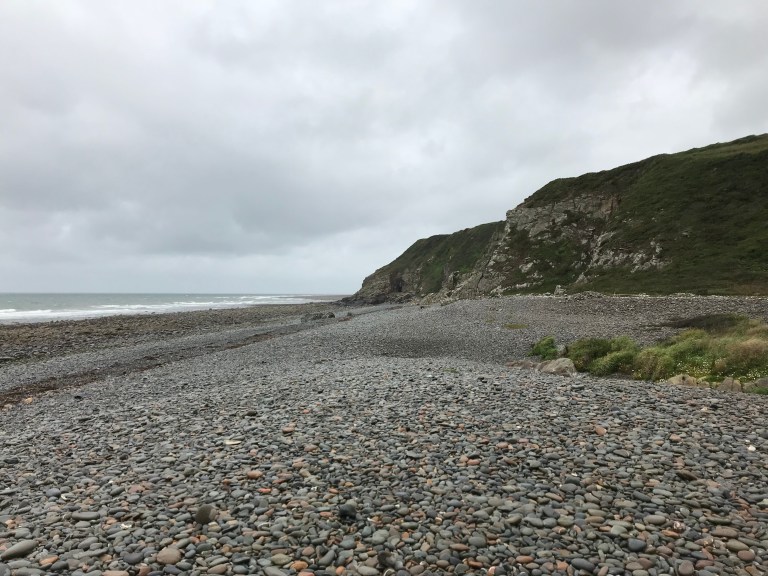
Next came St. Ninian’s Cave. We walked in from a car park less than a mile to the coast which brought us to less than a quarter mile to the cave itself. The start of the trail was edged by naturally occurring bamboo, which was kind of startling but speaks to the warm and wet climate. The beach was made of loose stones. Given that it was raining, and I didn’t want to tempt fate with a twisted ankle when we are only half way through our trip, we decided against walking across the beach to the cave itself. I regret that decision because the cave was one of my personal highlights for this tour, but safety first…

Ninian is Scotland’s first saint. He was a freshly ordained Catholic bishop from Ireland who decided to try persuading the constantly warring Celtic clans to unify under one belief system. He established his ministry in Whithorn around about 400 AD and is credited with converting the area to Christianity, or at least laying the foundations for Christianity to take hold.

The cave is where Ninian was believed to have retreated to contemplate and meditate on occasion. There are markings on the cave walls which support this belief. Ninian died in 431, and is supposedly buried at the site of his church.

St. Ninian’s cave can be seen in the distance.

There is scholarly debate on where Ninian’s church was originally built, but locals maintain it was in Whithorn beneath or near the current priory and nave. This despite never having found archeological evidence of that nearly 1,400 year old church at any of the theoretical sites.

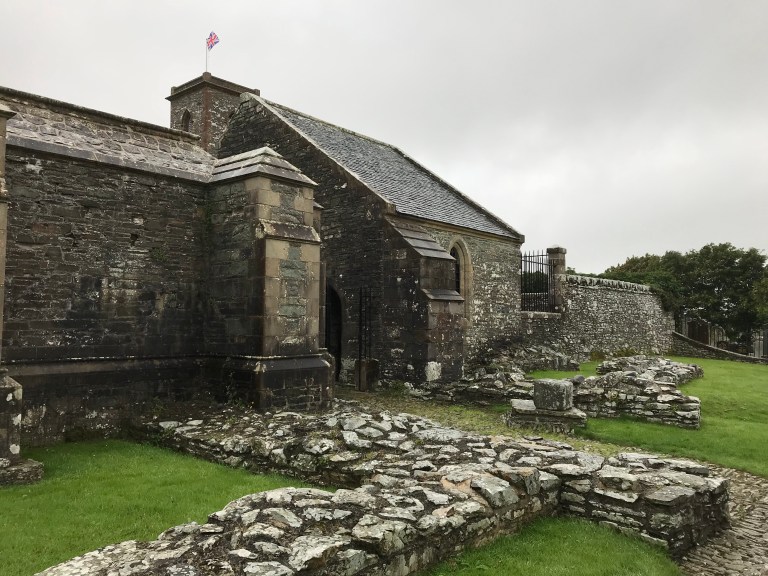
The nave is about all that’s left of a cathedral built in the 1100s.

There used to be a shrine in additional buildings where Ninian’s bones were kept. Again, the bones have not actually been located.

The Stones Museum is the access point to the shrine, and it actually houses a remarkable collection of stone crosses found at Whithorn. The Whithorn Story Visitor’s Centre has a fantastic little museum on the area.

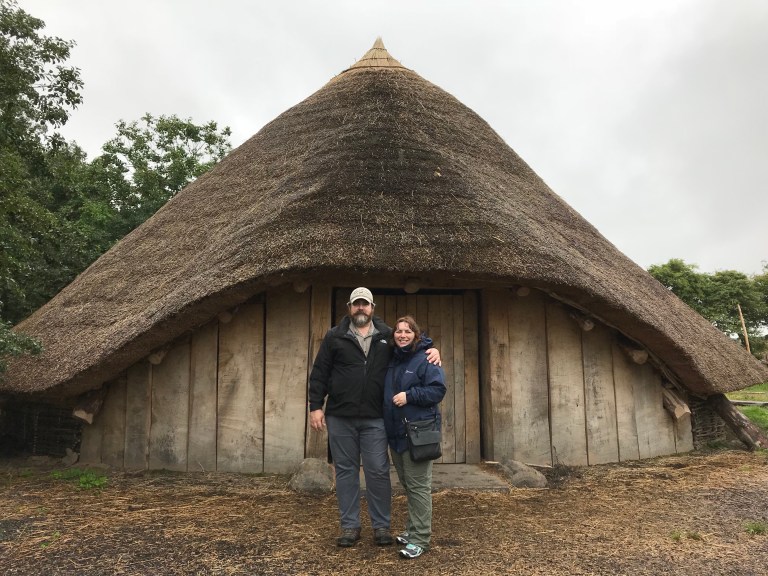
Nearby archaeological excavations uncovered very well-preserved 2500-year-old remains of Iron Age roundhouses. With the information they’ve learned, they recruited an archaeologist, an engineer, an architect, and local volunteers (including many young people) to recreate a roundhouse from scratch – literally. Nothing was manufactured; logs were cut and trimmed by hand, reeds and willows were collected from nearby, etcetera. We were privileged with a private viewing of the roundhouse, and it was so very interesting!

I am really not doing the Whithorn museums and sites justice here. Their advertising is far too understated, and they deserve far more interest than they seem to get. I highly recommend including the area in your visit to Scotland.

Our next stop was one I requested if possible. Mark was, dare I say, ecstatic to bring us to Druchtag Motte, us being the first of his clients to ask to be brought there. Mark grew up in the area and has been there often.

Mark says nobody except Historic Scotland calls this place a Motehill, so just ignore that part of the signage.

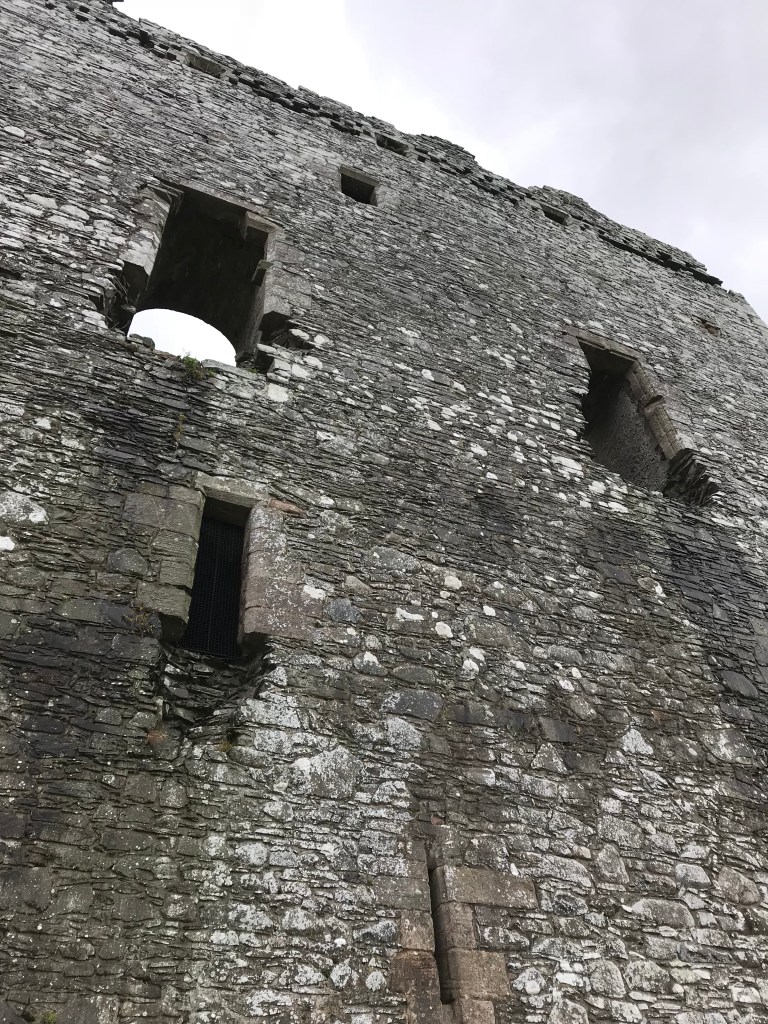
Druchtag Motte was likely built in the 12th century by a feudal lord. The motte is a massive flat-topped hill built using soil from around the motte site, on top of which would have been built a wooden tower. A ramp would have been built winding around the outside of the motte. There should have been wooden fortifications around the perimeter, and a Bailey next to the motte where the household staff would have resided and worked, but no evidence has been found of these. To be fair, though, the site has not actually been excavated to look for these things.

The top of the motte.
Where the bailey likely would have been, looking from the top of the motte.

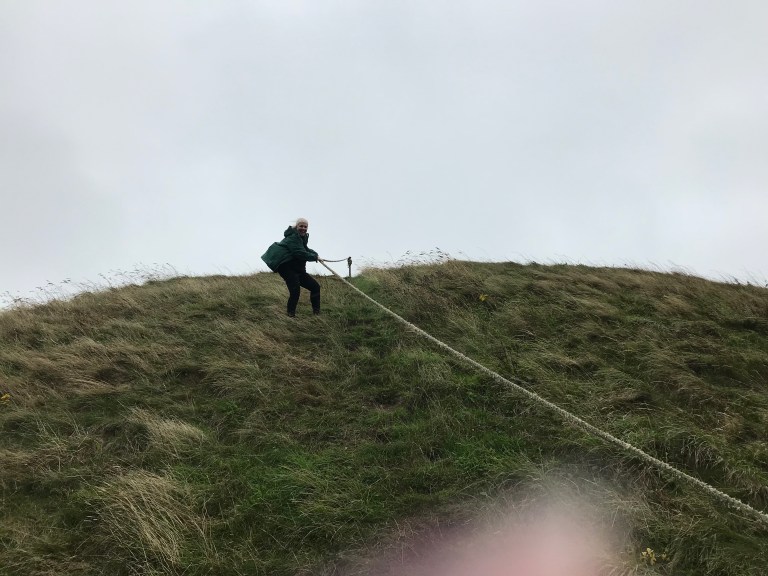
The motte is much bigger than it looks on approach, and the sides are quite steep (hence the rope rail). It was worth the effort of climbing the motte.

Looking down from the top.
Looking up from the bottom, watching Lesley navigate her way down.

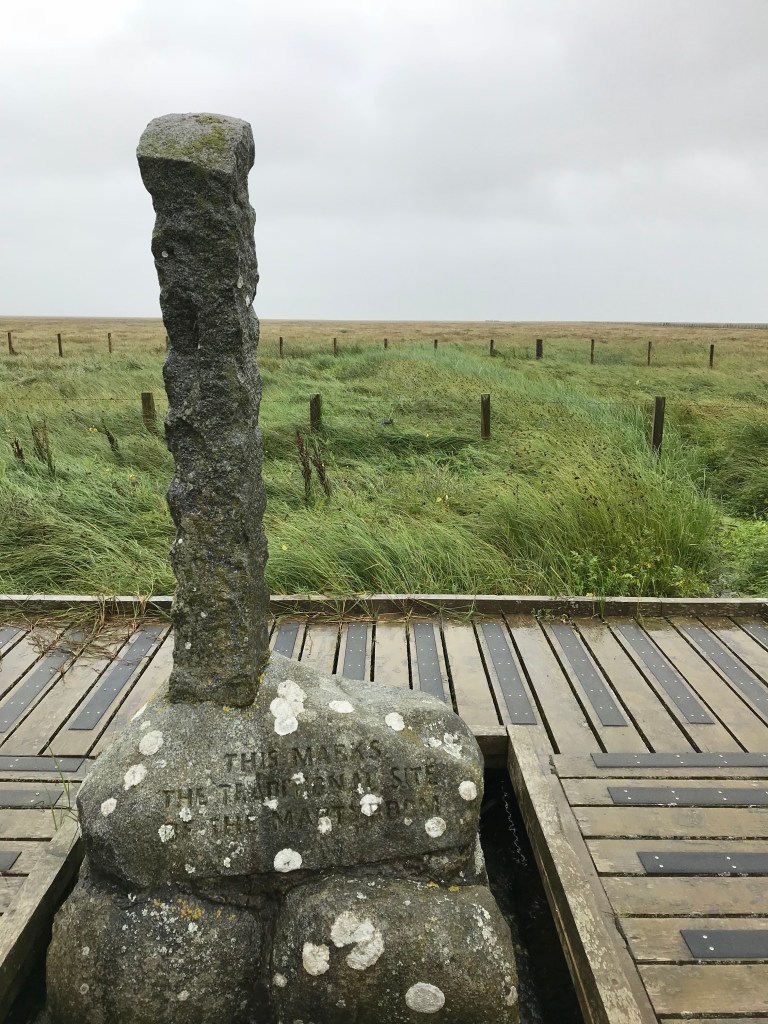
Next came Martyrs Stake in Wigtown, which memorializes the execution by drowning of two women who were caught practicing Presbyterianism in 1685. The women were 63 and 18 years old. The period called “The Killing Times” had Catholics and Presbyterians (Covenanters) killing each other over how they chose to exercise their beliefs, despite both of them being Christians. During this period it is estimated 11,000 people died.

The stone marks where the 18-year-old Margaret drowned. The 63-year-old Margaret was drowned about 300 yards further out.

Our last stop on the itinerary to Bruce’s Stone in Glentrool did not end up happening because of a tree that fell across the only access road. Mark was very disappointed with that, understandably, because it has a great story to it. Lesley related the story to us anyway. In short so as not to spoil the story for you, the site commemorates Robert the Bruce’s first victory over King Edward’s English army in 1307, after declaring himself King of Scotland.

We really had a wonderful day with Mark and Lesley, and cannot emphasize what great tour guides they are. They are very knowledgeable about the history of Scotland, and Dumfries and Galloway region specifically. And Lesley makes fantastic tablet (Scottish fudge), too!

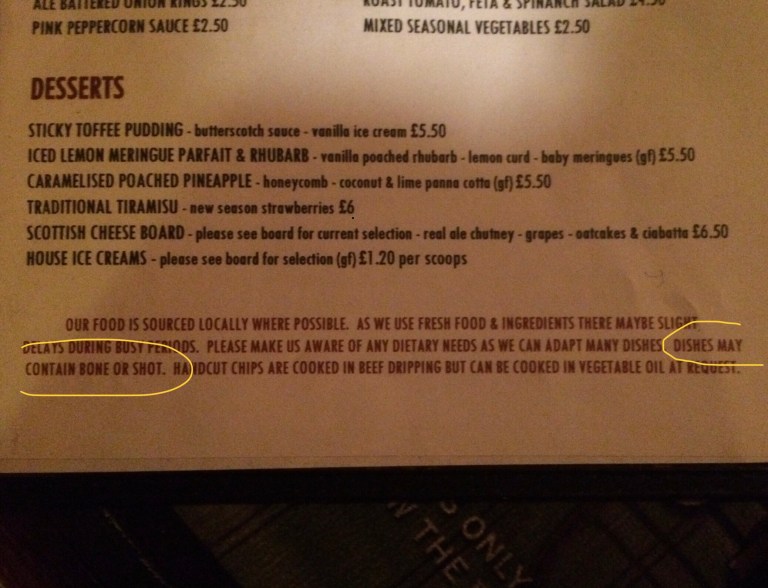
We ended the day with a late supper at Clachan Inn Restaurant. Upon reading the fine print on the menu…

…Dan thought to himself, “Challenge accepted,” and proceeded to order the venison meatballs with pasta. I went another direction and ordered the pan fried sea bream (whitefish) with chorizo and peas risotto. I can happily report that no teeth were broken on this night. The food in fact was fantastic.

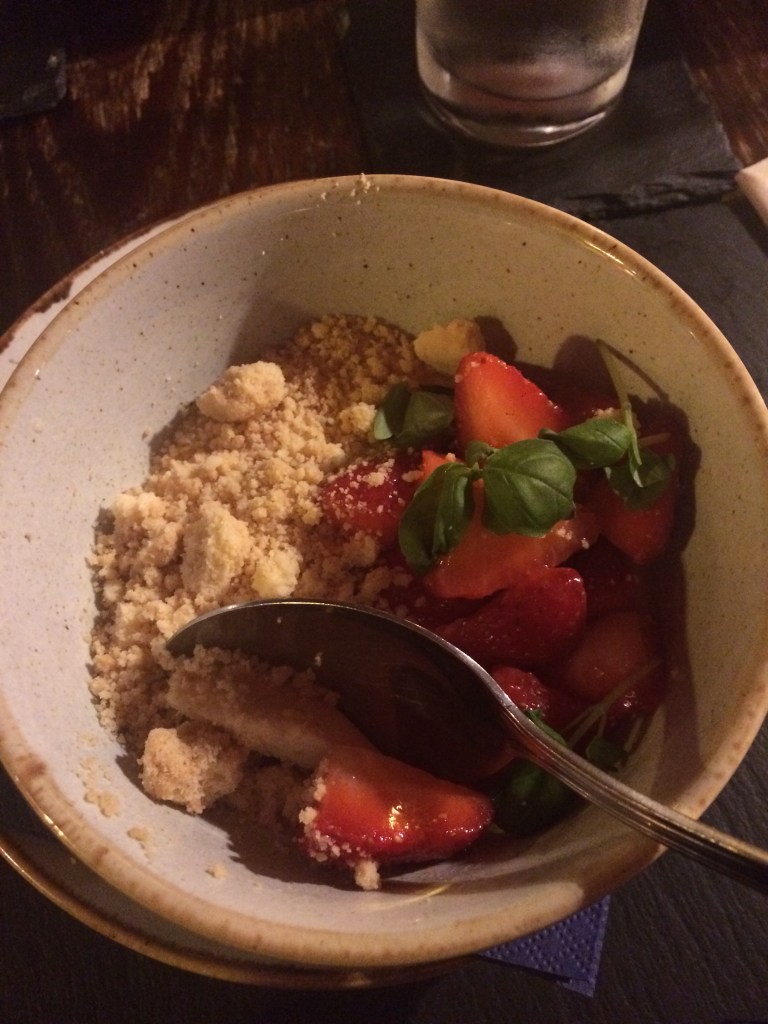
In celebration 🙄 we ordered desserts: sticky toffee pudding — which is not that sticky and is not a pudding — and vanilla pancetta — no! Not pancetta! Panacotta! Oiy — vanilla panacotta with shortbread, Scottish strawberries, and micro basil — read ‘baby basil’.

Baby basil!

Adelle and Dan

Boats and Moats

So even though we got to bed relatively early, we still managed to wake up late for breakfast. Not as big a deal here as it might be elsewhere, because another great bonus is that Ronnie and Angie do not have an end time for breakfast (woohoo!), but I still felt bad about it because we did specify our preferred time. Breakfast was fantastic, just as all the reviews said it would be.

We decided to take our time today, and rather than trying to see all seven places I had on our itinerary (oiy) we narrowed it down to two must sees, and if we had time for any of the others then they would be a bonus. We did not have time for the other five places.

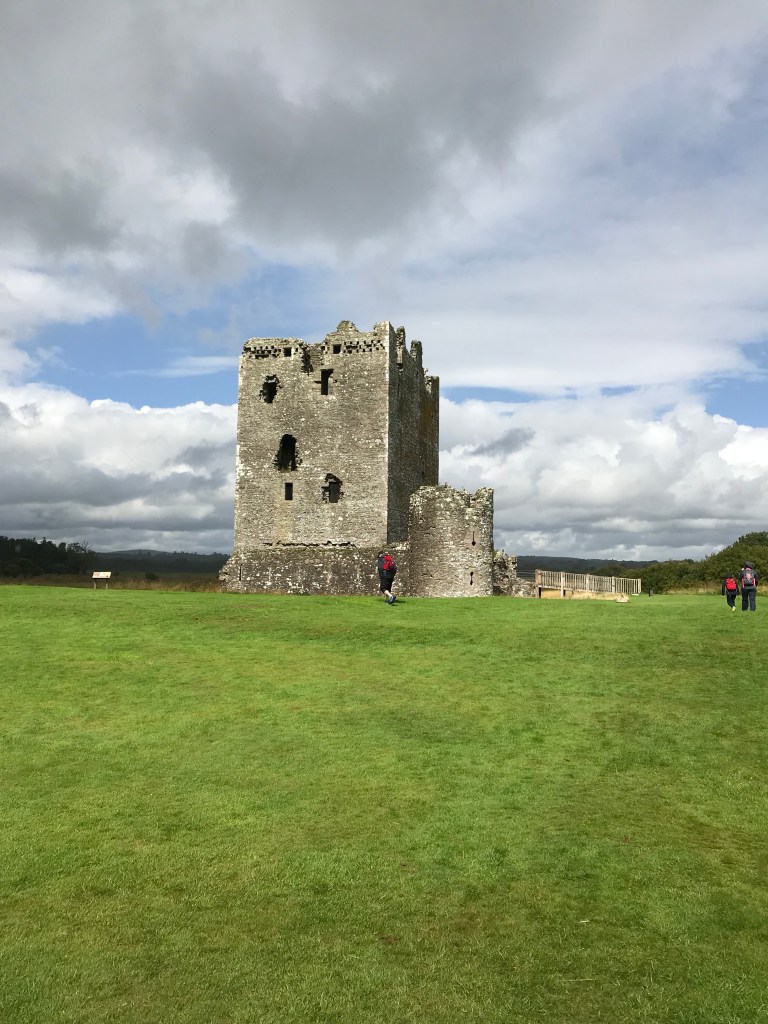
First up was Threave Castle. This site is on an island in the River Dee which can (supposedly) only be accessed by boat. So yes, we had to be ferried across on a small boat.

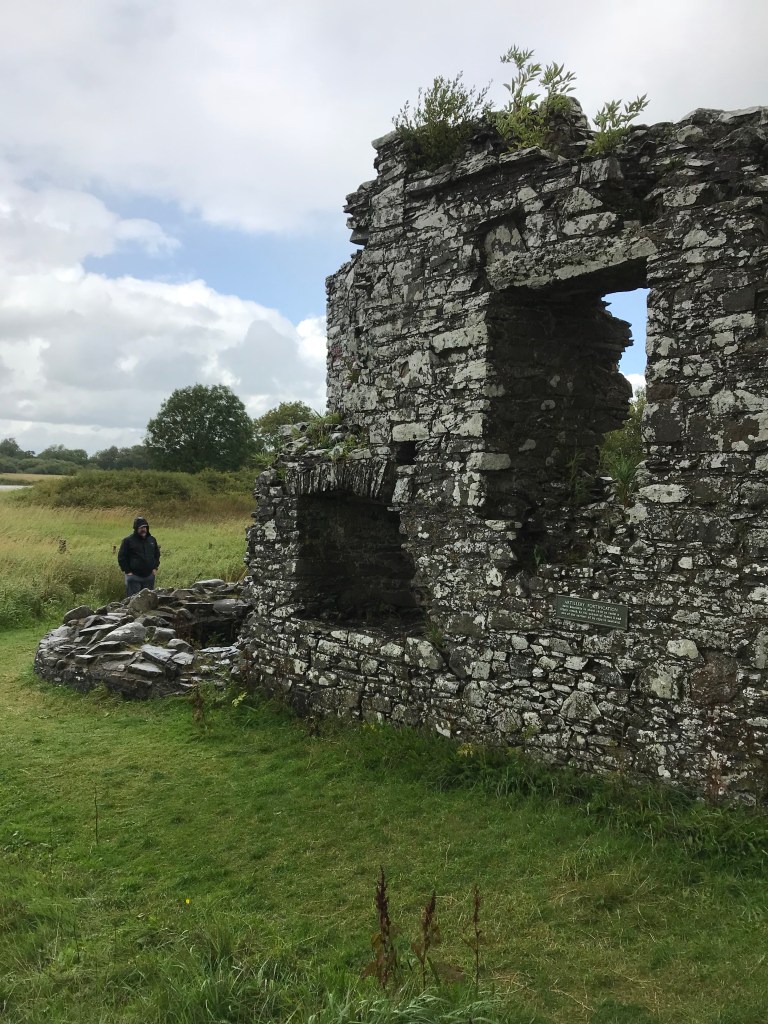
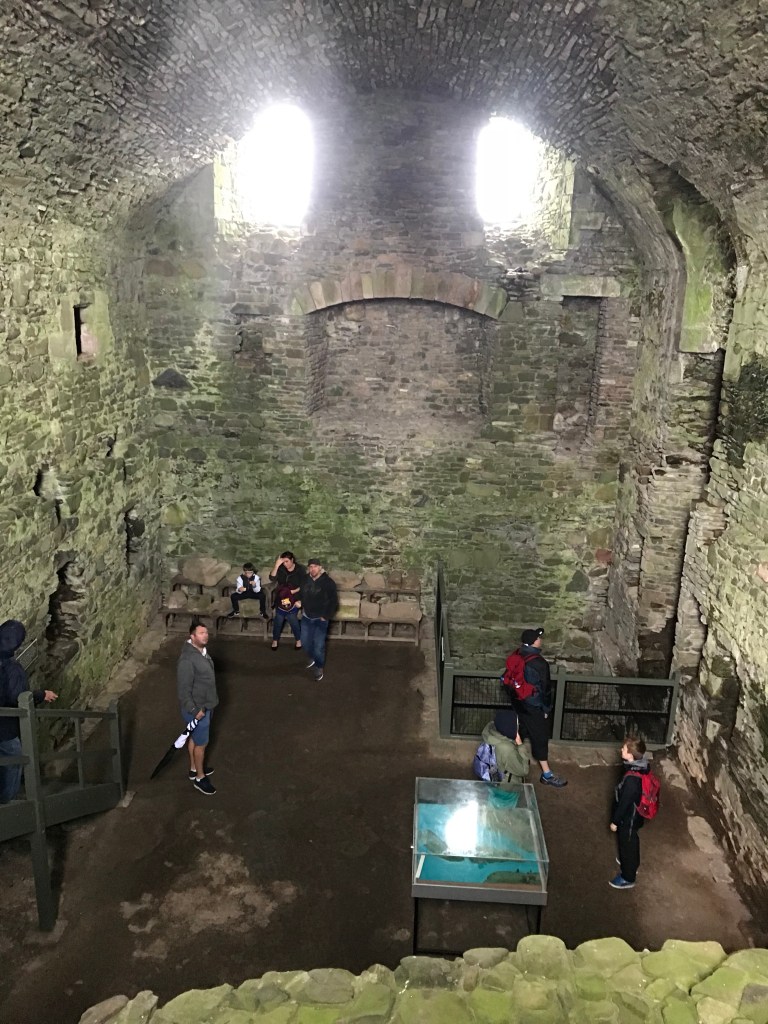
Tradition says that Ferguson, native Lord of Galloway originally resided on the island in the 11th century. It is believed to have been destroyed by Edward Bruce (Robert I’s brother) in 1308. Archibald ‘the Grim’, third earl of Douglas, later took the island for the Black Douglas’s and built the tower house and a sprawling complex over the southern third of the island in 1369. This was soon after becoming lord of Galloway. The tower house is the only part that remains today.

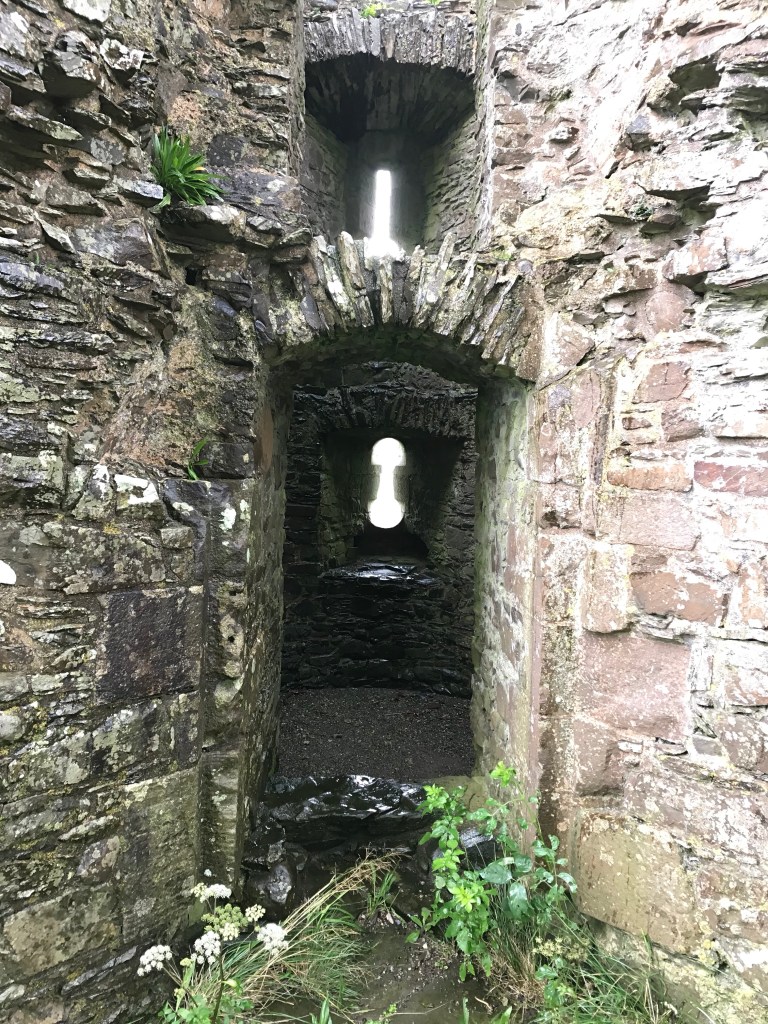
In 1455, King James II and the Black Douglases had been at loggerheads for a long time, and finally the King systemically destroyed all the major Douglas strongholds, ending with Threave. Threave was well provisioned and defended, and survived the siege for over two months before the King finally ordered a gun to be brought to the island from Linlithgow Palace. The garrison in the castle eventually surrendered, although more likely through persuasion rather than the threat of the gun. An artillery house erected around the tower in 1447 was a major contributing factor to the castle’s ability to withstand the siege.

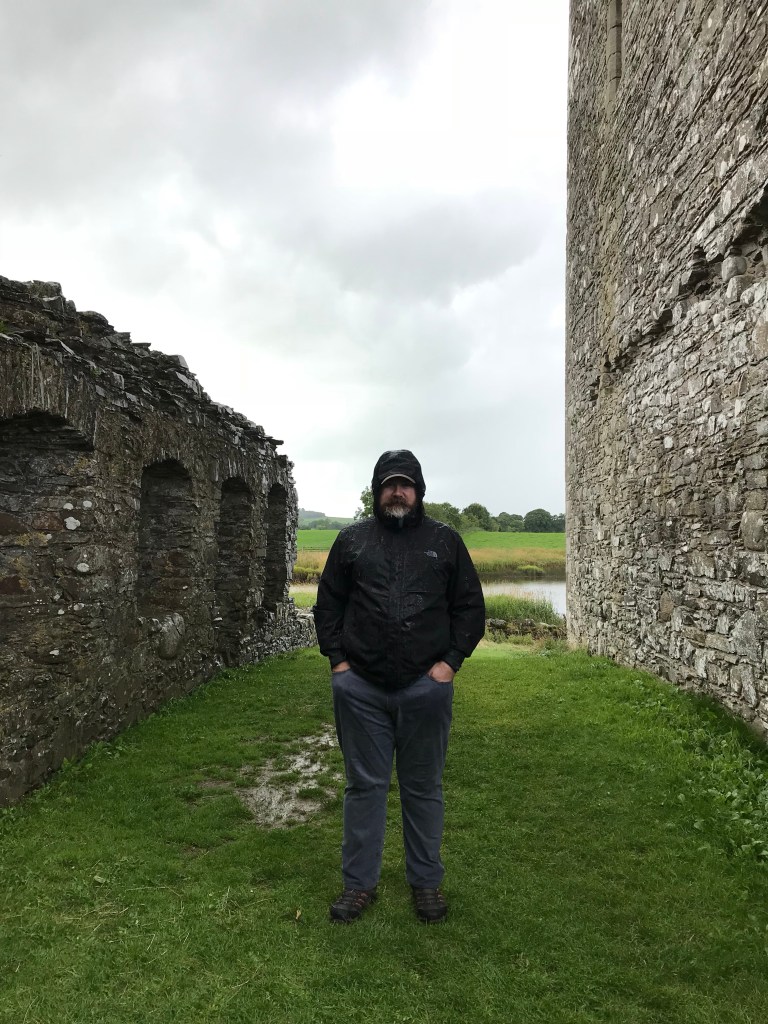
Yes, it rained again.

Various keepers stayed at the castle after that, until 1526, when Lord Maxwell was made heritable keeper. He and his family stayed there until 1640, when the castle faced its second and final siege made by the Army of the Covenant. This time they held out for 13 weeks, until King Charles I gave written authorization to Lord Maxwell to surrender. The Covenanters dismantled the castle so that it could not be used again.

The placards at the site reference a secret causeway that ‘people in the know’ could use to walk across to the island, but we didn’t find or see any evidence of that. I guess we’re not people in the know.

All that history to say that we really enjoyed our visit to Threave Castle. It was really quite fascinating.

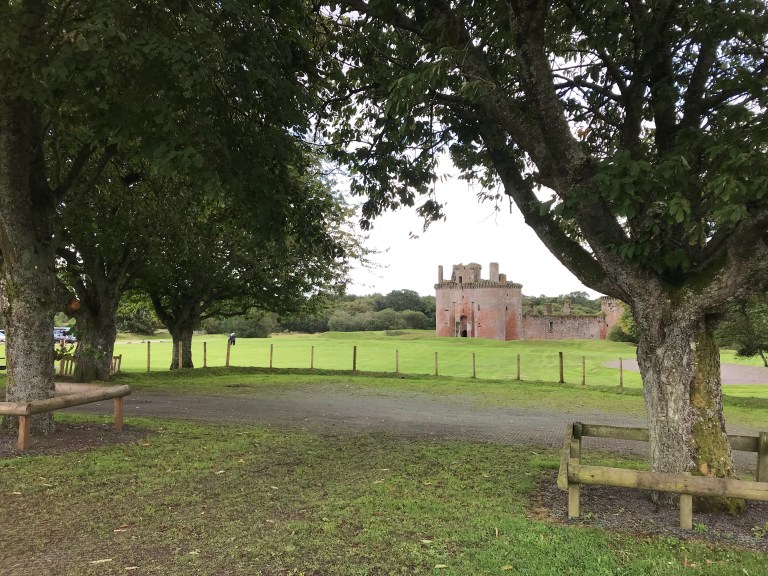
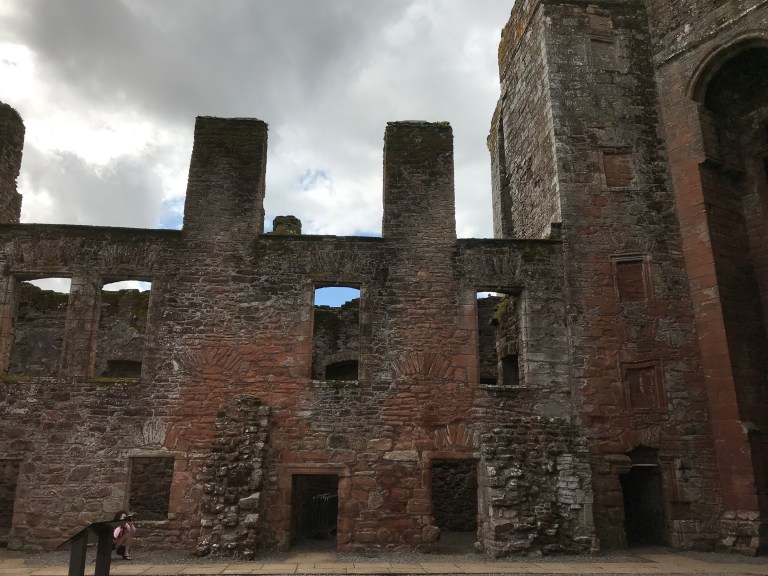
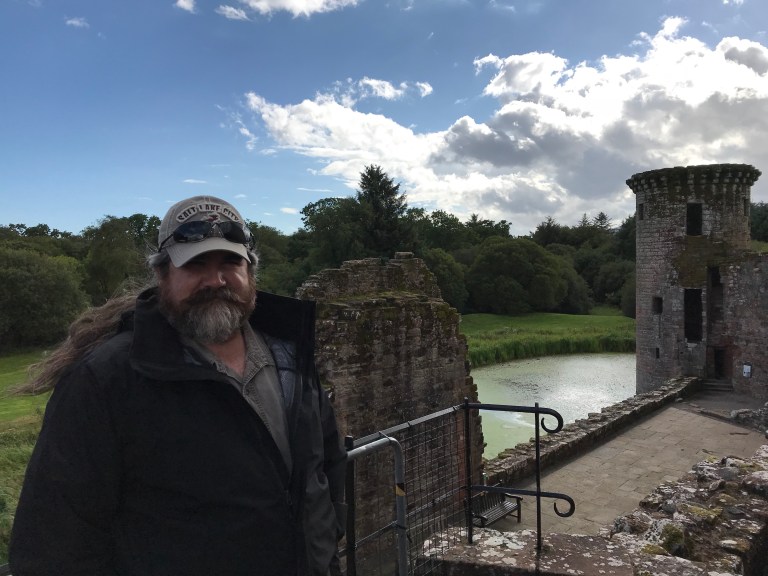
We followed this with a quick stop at Tesco for some shopping and then lunch before going to Caerlaverock Castle. This was eventually the primary seat of the Maxwell family, after the Romans abandoned southern Scotland and the British lords of Nithsdale ruled over the lands (400 AD).

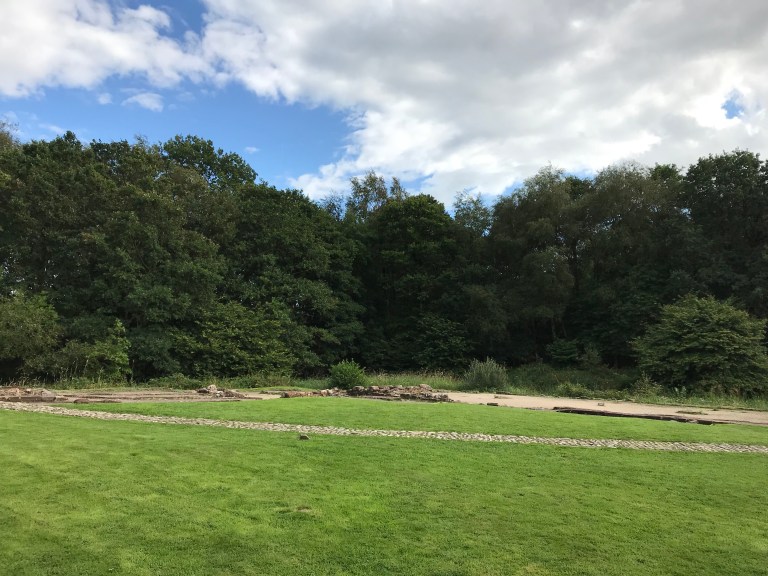
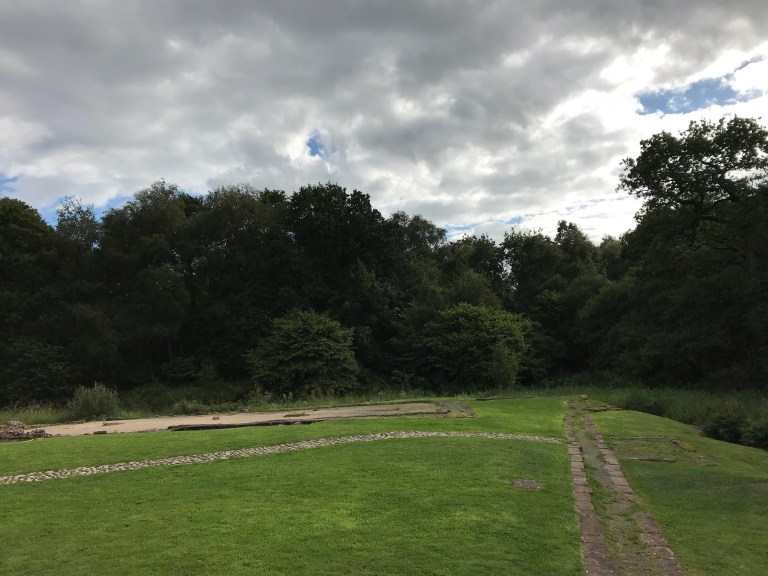
The Nithsdale lords built a fort on the site that would later accommodate the first castle in 950 AD. The lands were granted to the Maxwells in1220 by Alexander II of Scotland. They built the first castle, but it was too small, and it was built on a clay foundation where it kept flooding and the buildings were deteriorating. There is not much left of the old castle except the footprint of the main walls.

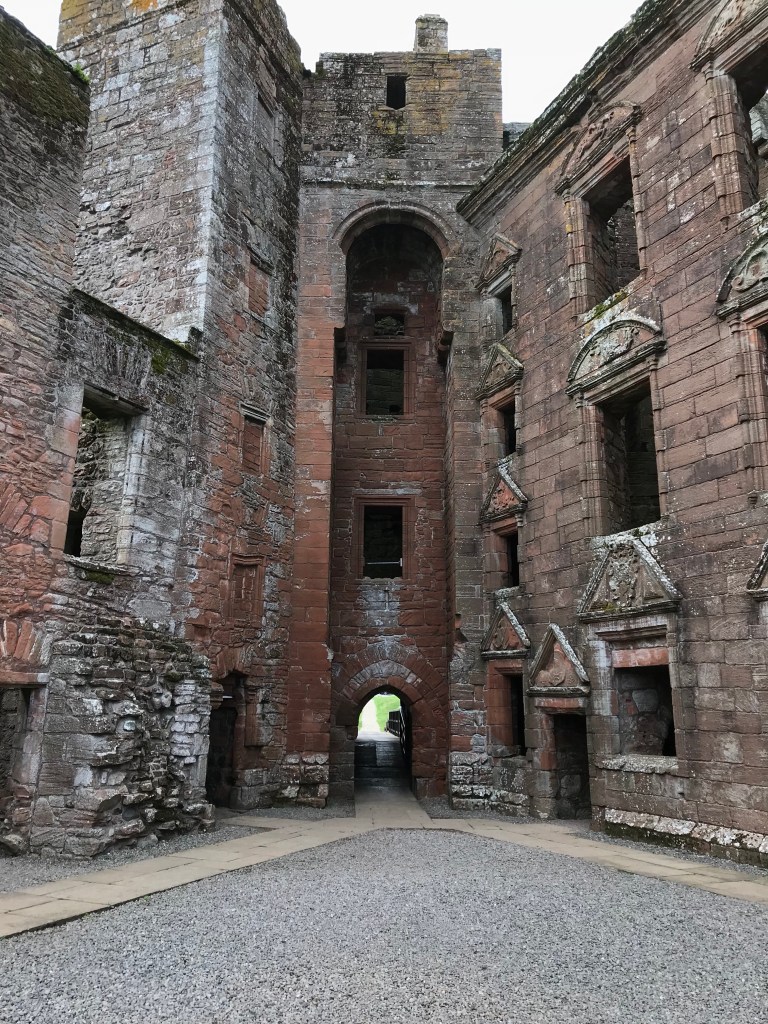
In 1270 the Maxwells built a new castle, where they remained until 1640. The new castle is considered one of Scotland’s great medieval fortresses. It is triangular shaped, with towers at each corner.

The castle faced two sieges in its time: one in 1300 by Edward I of England, the second in 1640 by the Covenanters. A herald in Edward’s army wrote an extremely detailed account of the two-day siege, which chronicled the fact that Edward’s army consisted of 87 knights, 3,000 men, and a number of siege engines against what turned out to be a garrison of just 60 men defending the castle. The Covenanter’s siege lasted 13 weeks with a castle garrison of 200 before the earl of Nithsdale surrendered.

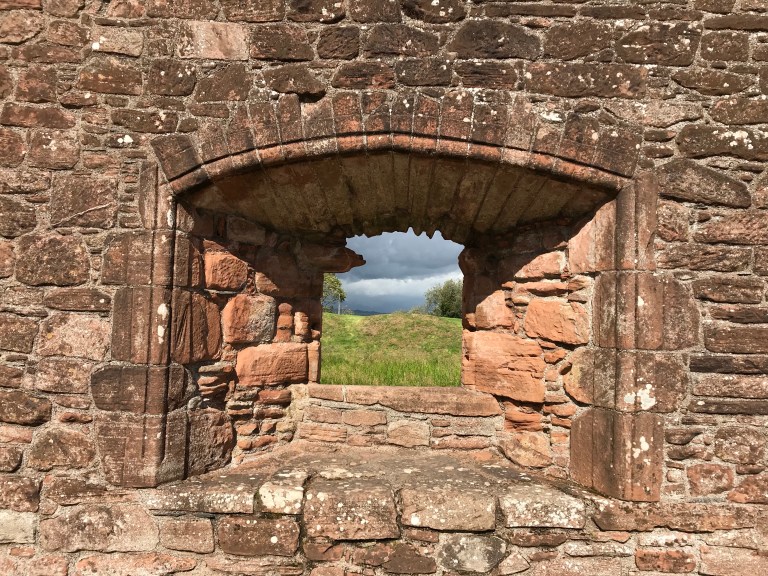
Both the old castle and the new castle had moats, and the new castle had a proper draw bridge. The new castle had substantive fortifications, cannons, and crossbow holes.

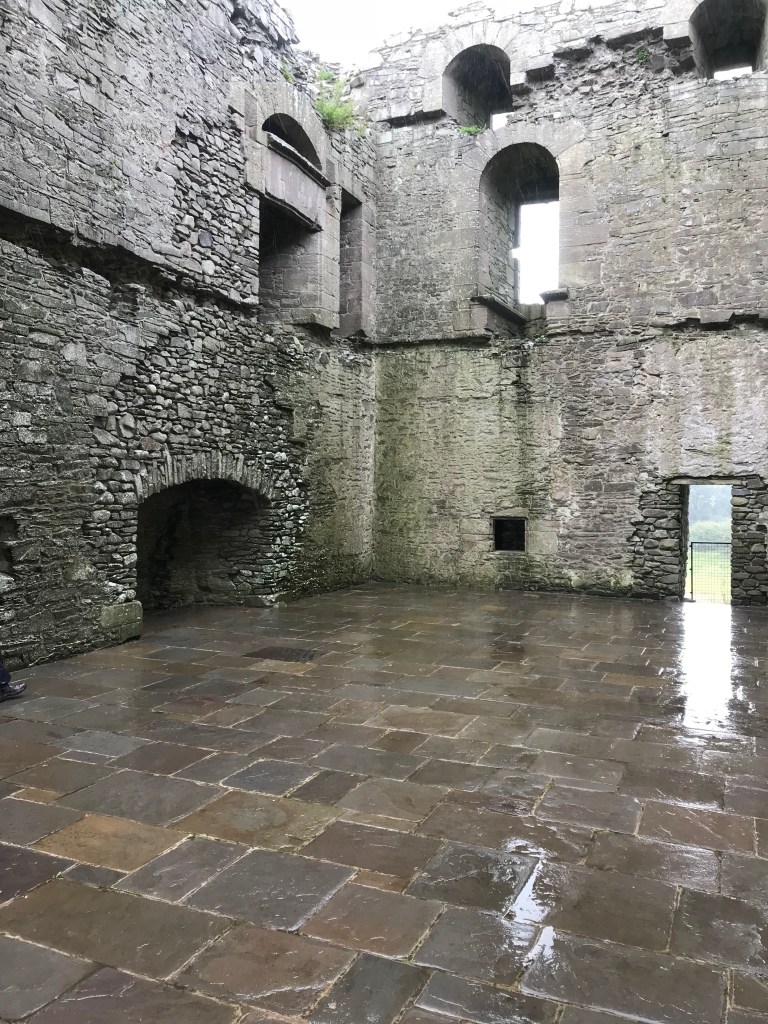
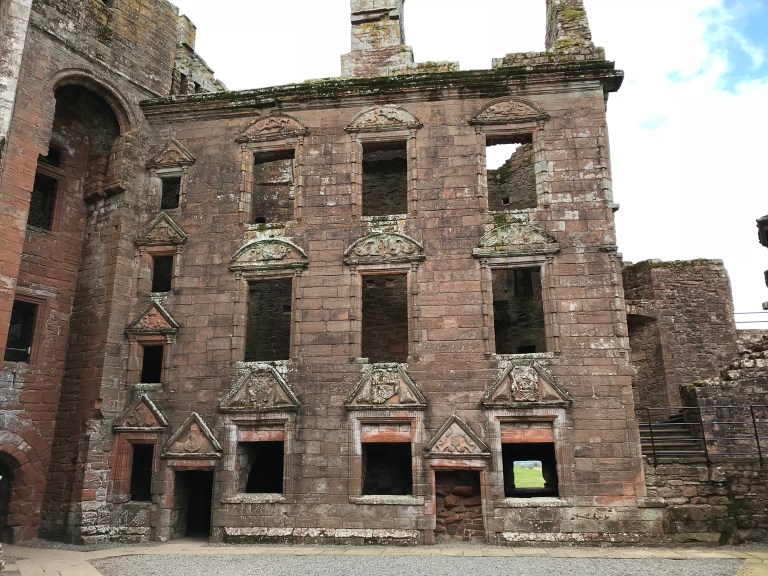
In 1634 the first earl of Nithsdale became less concerned about security and more concerned about looking the part of a nobleman, and renovated the east and south sides of the curtain wall to build what became known as the Nithsdale Lodgings. It’s pretty much what it sounds like: a three-story apartment complex within the castle, including a courtyard. Fancy decorations included.

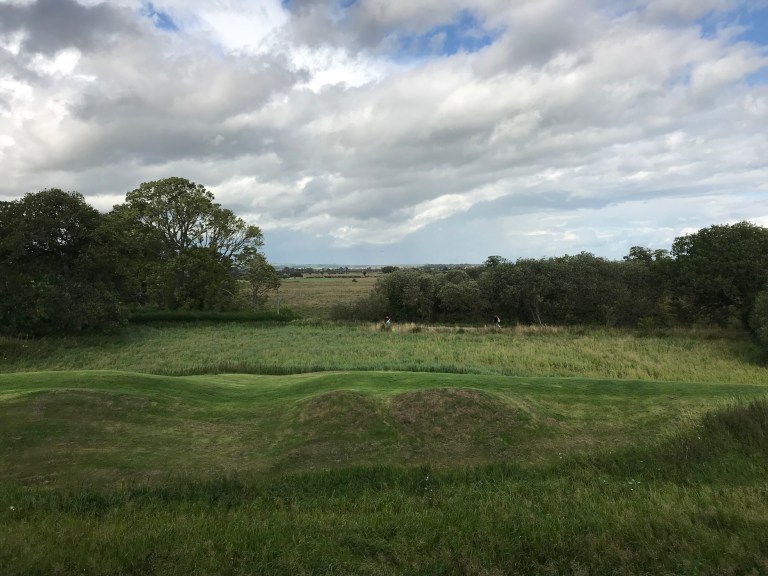
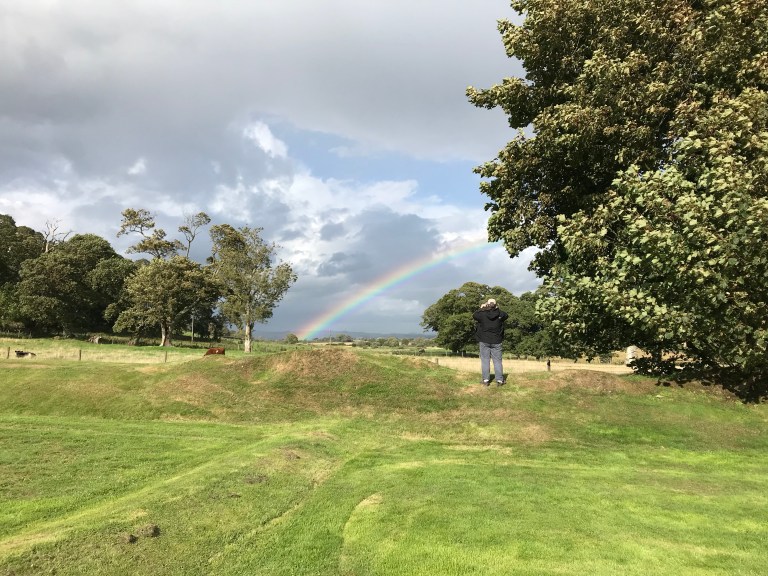
The surrounding countryside is beautiful, and in fact is now a nature preserve. I imagine during the time the castle was occupied they would not have starved, given the arable land, good hunting and fishing, and plentiful berries, mushrooms, and honey.

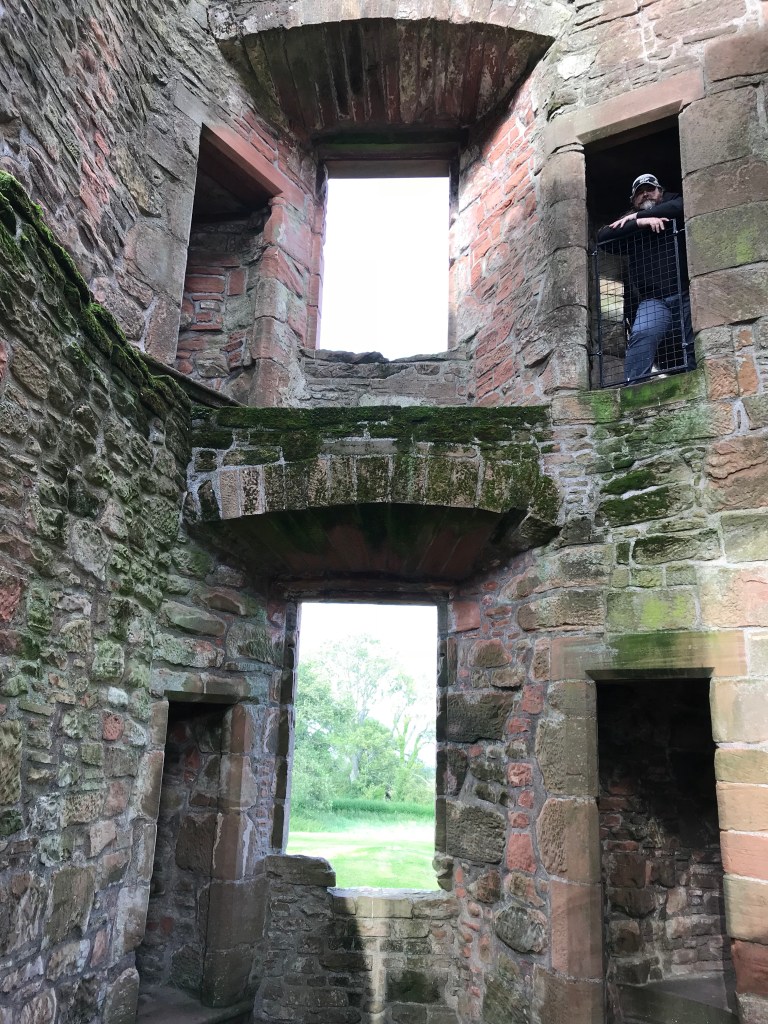
Yet another fascinating experience, although I admit to feeling more creeped out at the new castle than anywhere else. Don’t know why. Maybe it was all the pigeons living in the ruins…yeah…

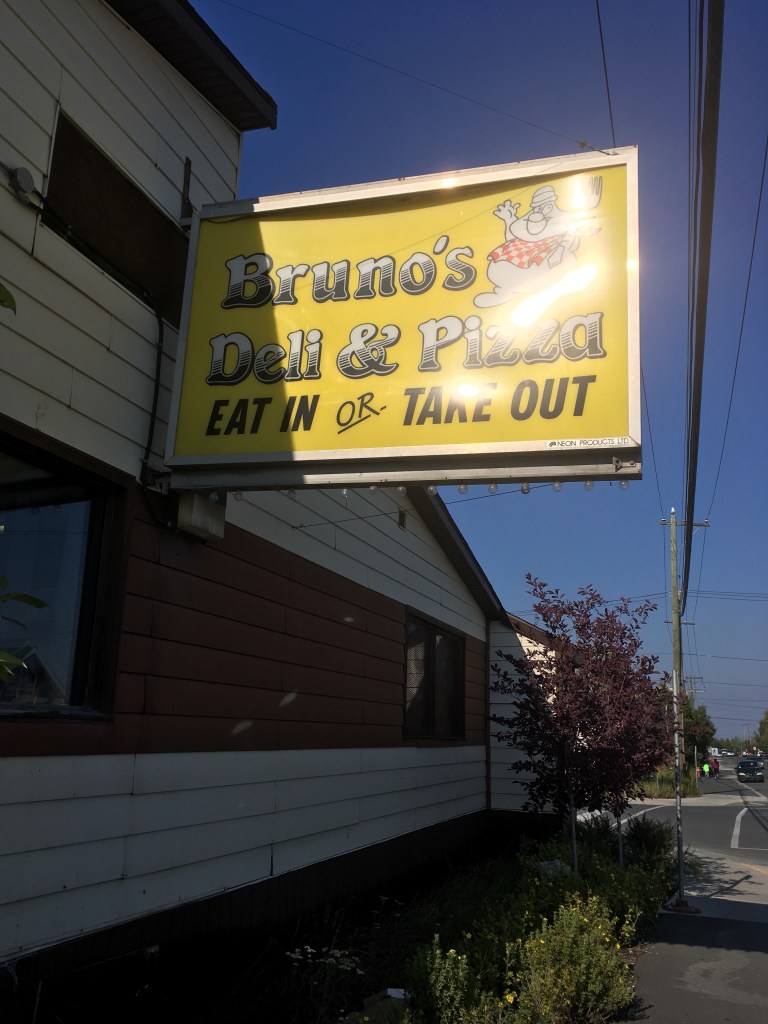
We finished the day off at Bruno’s. No, not this Bruno’s:

Although, don’t let the outside fool you; they’ve got the best pizza in Yellowknife (besides mine, of course).

We ate at this Bruno’s:

Bruno’s Italian Restaurant in Dumfries is another place that deserves all the great reviews it has. The meal was phenomenal, the service was great, the servings were just the right size to not feel overfed. Highly recommended!

Adelle and Dan
Walking a Mile on Their Hobnails

We said farewell to our lovely hosts at Kingsway Guest House, Lizzie and Gary, and their adorable son. I highly recommend staying with them if you’re ever in Edinburgh.

Kingsway Guest House

We hit the road today for our next destination being Brookford B&B in St. John’s Town of Dalry, near Castle Douglas in the Dumfries and Galloway region (south west corner). Now if we had gone straight there it would have only taken us a couple of hours. Do you really think we went straight there? Of course not! Don’t be silly…

No, we drove due south for a couple hours first. Now, when I did my research planning this itinerary I failed to recognize that Hadrian’s Wall is actually well south of the Scottish border. I had it in my head that Hadrian’s Wall effectively WAS the Scottish Border. My sincere apologies to Scotland. Yet another unintentional deviation from the Everything Scotland theme of our trips to Scotland. Unless you look at it from the perspective that Hadrian’s Wall was built to keep the hoards of ancestors of Scotland out of Britannia. Yes! Let’s go with that. And at least now Dan can say he’s been to England.

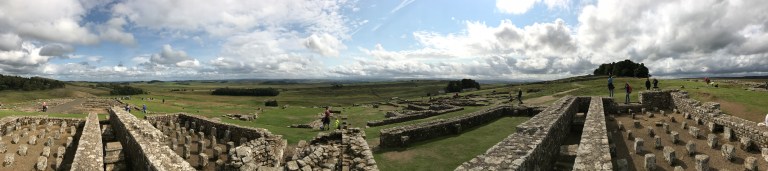
We visited Housesteads Roman Fort along Hadrian’s Wall, near Bardon Mill. What a fascinating place! It’s a short half-mile walk from the main entry to the site, where a small museum and gift shop are located. The museum is really well done, and very interesting.

Housesteads Fort, Museum, and Giftshop

The remains are the most complete of the Roman forts along the Wall. You can see where each of the military buildings were placed throughout.

Panorama facing south, standing on one of the building walls.

Of particular fascination are the latrines – they also are the most intact Roman latrines in the United Kingdom.

The Roman latrines.

It is remarkable to walk along the walls and contemplate just how much effort was put into building it, how the different parts were strategically placed to make best use of the existing landscape. For example, the granaries were placed near the top of the hill, the stables and bathhouse were midway down to facilitate water flowing down the hill to fill the troughs and baths, and the aforementioned latrines were at the lowest corner of the entire thing. The barracks were at the east end, up the hill from the latrines, while the baking ovens were at the far west end to avoid fires burning down the barracks.

The ovens.

The outside walls, including the north wall itself, were easily three feet thick. The guard wall along the north Wall has long since fallen (or been pushed over to reuse the stones for other purposes).

The Walls – my foot is there for scale.

Needless to say, we ended up staying there a good two hours longer than I planned for. We ended up dropping planned visits to Gretna Green (sorry Chelsea, no surprise vow renewal photos) and the Twelve Apostles Standing Stones.

We did very briefly stop at Bonshaw Tower in Kirtlebridge, though, which was more or less on the way to the B&B. This is where my Auntie Janice should really start paying attention, because Bonshaw Tower is the seat of the Irving family. It is a four-story tower built in 1570 as a power base for the Irving family, but it is believed that the Irving family have lived at the site since at least the 1300s. The property remains the private family home on a beautiful piece of land, but the tower is now available to book weddings. We did not realize we were supposed to pre-arrange a visit, which it turns out we didn’t have time to really do anyway, but we’re pretty sure we technically trespassed to get this quick photo of the tower…Our sincere apologies to the resident Irving family…

Bonshaw Tower

Bonshaw Tower – Seat of the Irving Family

When I looked for a place to stay in Dumfries and Galloway I wanted something central, that we could do day trips from to any of the corners of the region. What I did not realize when I chose Brookford was just how central it was; that being, pretty well off the beaten path. The drive from Castle Douglas was all on narrow roads with plenty of curves and hills, and the ridiculous 60-miles-per-hour speed limit. I did not go 60 miles per hour. That’s insane. And I should have taken Gravol. But the place is worth it! A lovely little town nestled in the hills, and Brookford is perfect. Ronnie made us supper of Haggis stuffed chicken breast with peppercorn cream, garden fresh potatoes, Scottish carrots, and something like eggplant that I don’t remember what he called it, followed by sticky toffee pudding with vanilla ice cream. Sigh. So good!

We are exhausted now, but at least we can have an early night. Plenty to do tomorrow, but we probably won’t get to everything again. Good night.

Adelle and Dan
P.S. I forgot to mention, the Roman soldiers wore leather shoes with hobnails attached to the bottoms for traction. They look sort of like baseball or soccer cleats. Hence the reference in the title of today’s blog. …traction, or perhaps an additional weapon? Imagine kicking someone in the face with nail studded shoes. Just saying.

The Ditch Isn’t Funny If You Have To Explain It

Well, we planned to go to at least five different places today. We ended up going to two (with one more to come). We missed out on going to Audible Presents podcast recording, and to the Scottish Photo Experience. Don’t worry, Martin, I’m sure we’ll find another opportunity for the photo experience while we’re here.

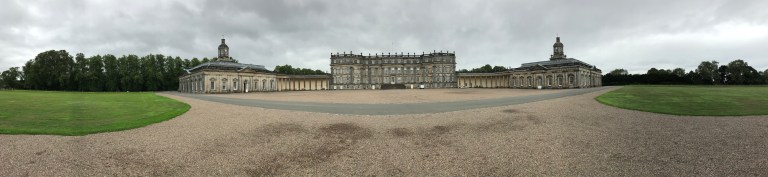
The reason we missed those things was totally worth it! We visited Hopetoun House and Midhope Castle. Both are owned and managed by a trust created by the Hope family.

Lord Hopetoun and his family still live in a wing of the House. The rest of the House is open to the public, and is magnificent! The House is considered Scotland’s finest stately home, and displays throughout it the history of the House and Hope Family.

They have converted the attached stables into a wonderful restaurant. They have a ballroom that is available for booking events. The original part of the House was built in the late 1600s and was designed by William Bruce. It was later altered and extended by William Adam. Both men were noted architects of their times, and have designed multiple buildings throughout Scotland.

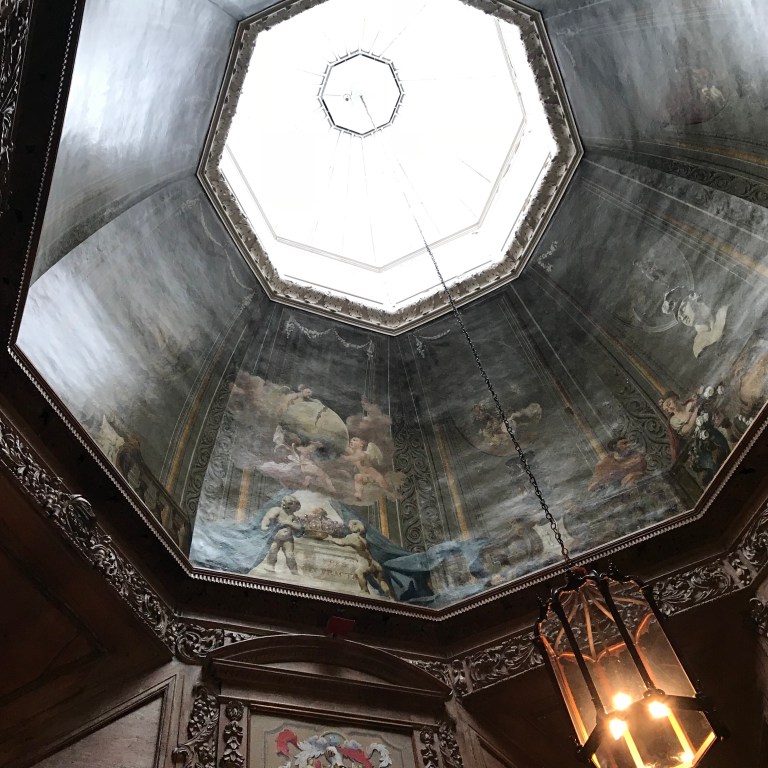
The paintings in the dome are original to when the old house was built, but nobody knows who the artist was because they were painted over in white at some point and completely forgotten about. It wasn’t until they were preparing for renovations in the 1980s that the original art work was discovered. Professional restorers were brought in, and it took them eight months to uncover the work.
This is my kind of den.
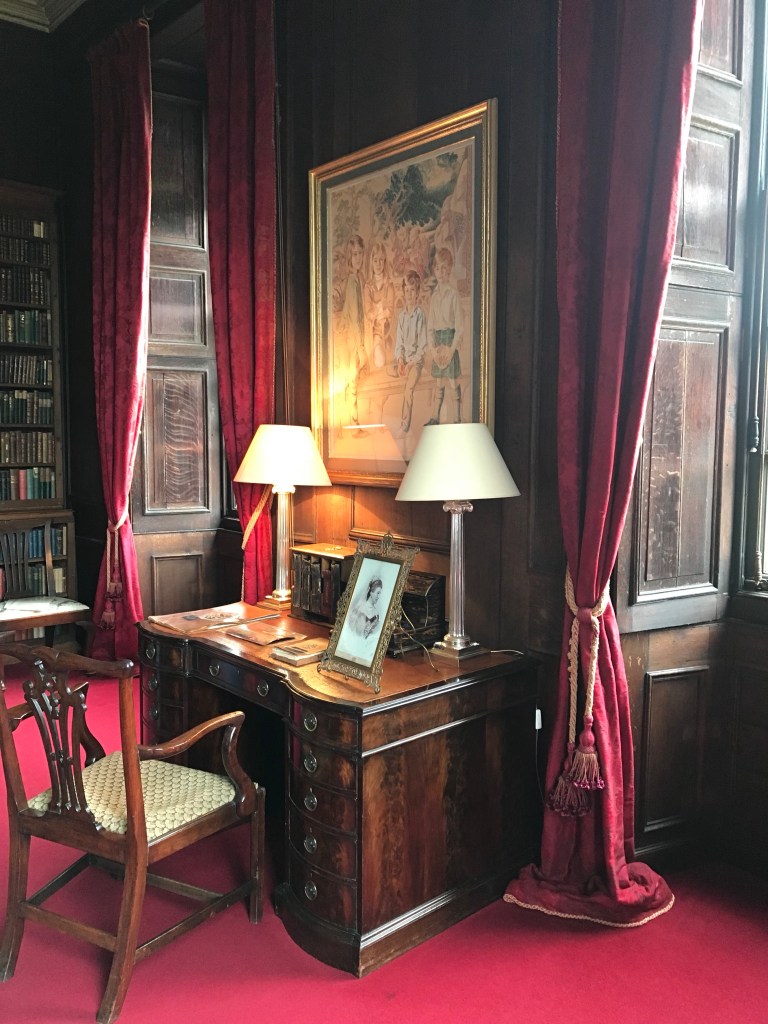
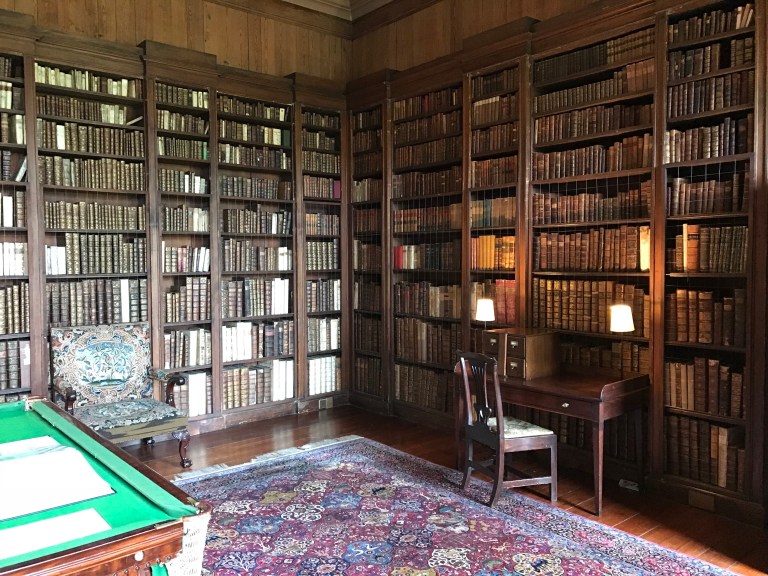
This is my kind of library. The oldest book they have is from 1619. Oh, to have time to go through all the books they have here!
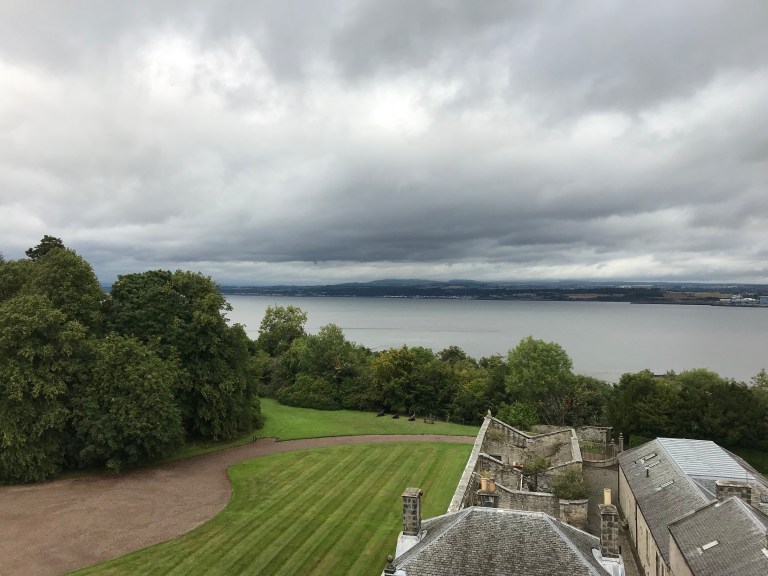
You can see a village across the Firth of Forth, and in the foreground you can see the old stables that were used for some Paris scenes in Outlander.
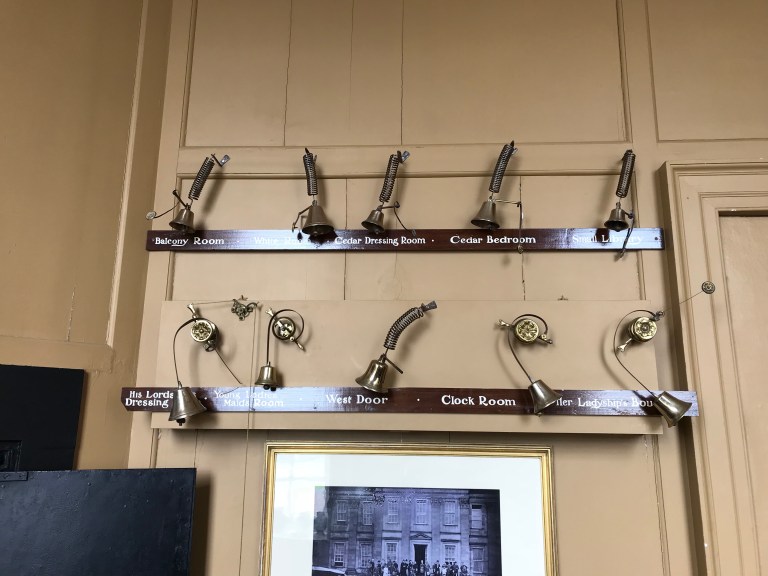
We had a Downton Abbey moment when we saw these.
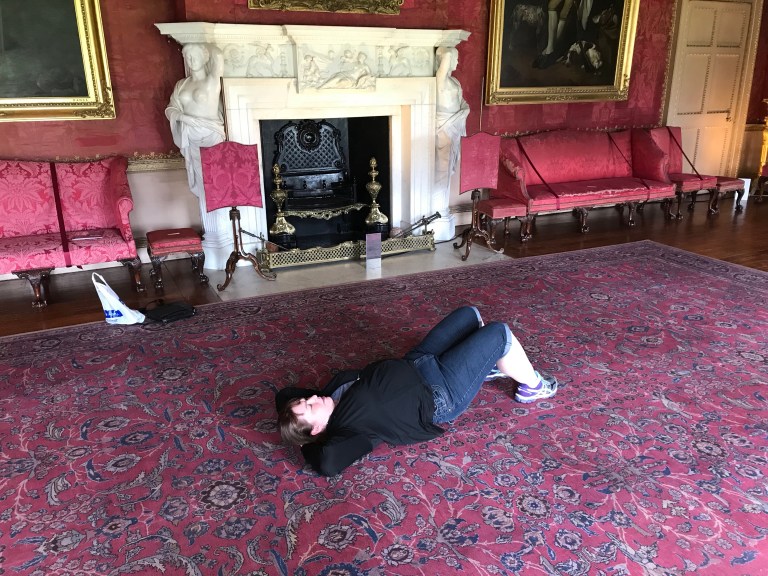
This is me, lying on the floor in the room used as the Duke of Sandringham’s in Outlander, looking for…
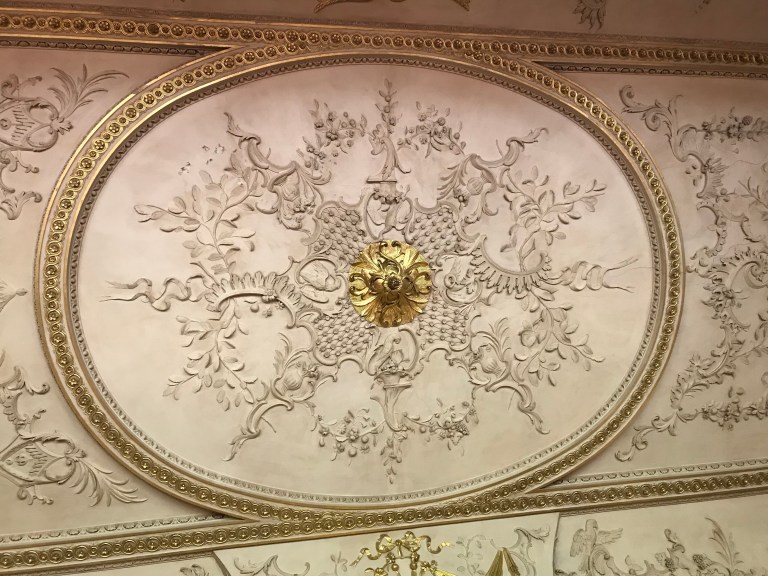
…the hidden faces in the ceiling.
The ballroom. It was supposed to house the Lord’s library, but ended up being used to exercise the horses, before being made into the ballroom.
This also made us think of Downton Abbey.

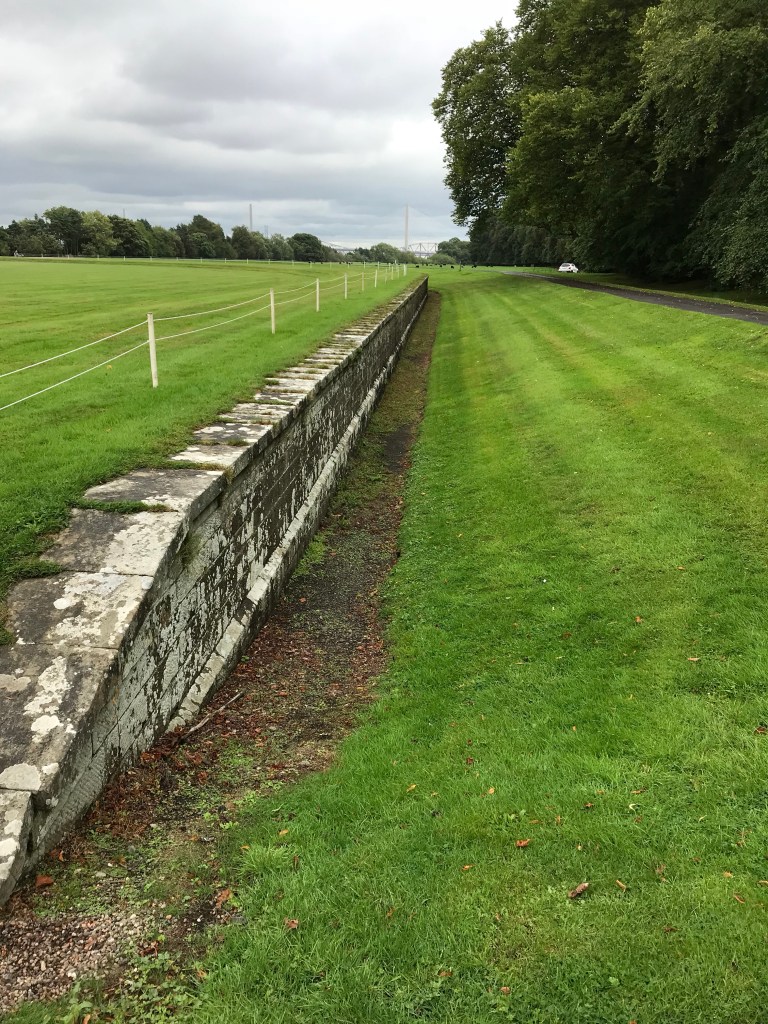
The lawn appeared to be well-groomed primarily by the goats, which were kept in check by the Ha-Ha. Good luck Googling that. The Ha-Ha is what they call the stone-walled ditch separating the grounds from the access road. We got a kicked out of it.

The Ha-Ha.

Before I forget to mention, we did have lunch at the Stables Restaurant and enjoyed our first bowl of Cullen Skink. We’re old hats at haggis, now, but hadn’t gotten around to Cullen Skink. Turns out it’s just fish chowder. Really good fish chowder, but fish chowder nonetheless.

Outlander reference: the Paris street scene where Claire and Mary get in trouble, the room Mary is brought to at Claire and Jamie’s, the duelling scene, and the Duke of Sandringham’s room were filmed there, and the outside rear view of the house was used to represent the Duke’s residence. Oh, yeah, the existing stables were used for the Edinburgh brothel, the bowling green was where Jamie and Lord John Gray played chess, and the path where Geneva Dunsanay fell off her horse into a mud puddle was filmed on one of the paths of the forested grounds.

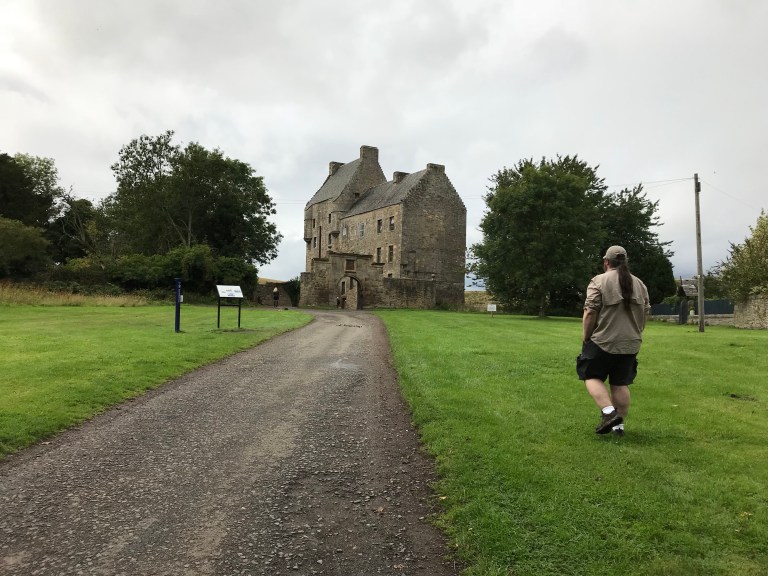
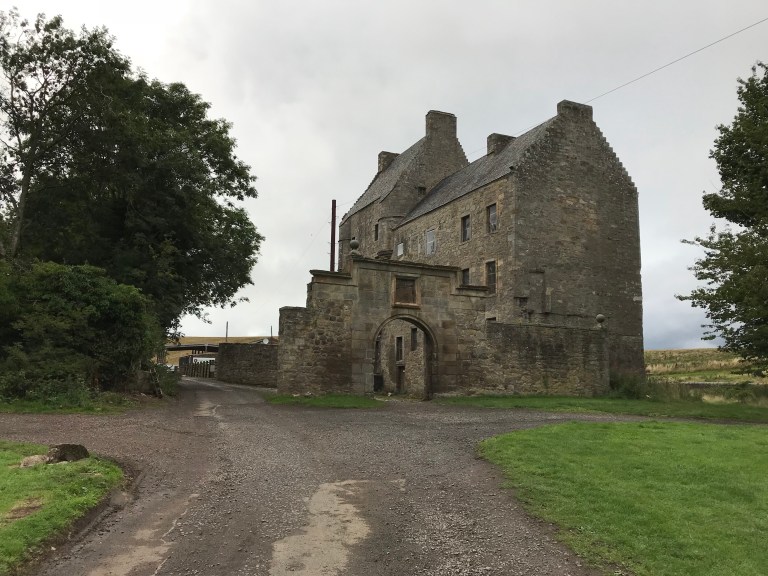
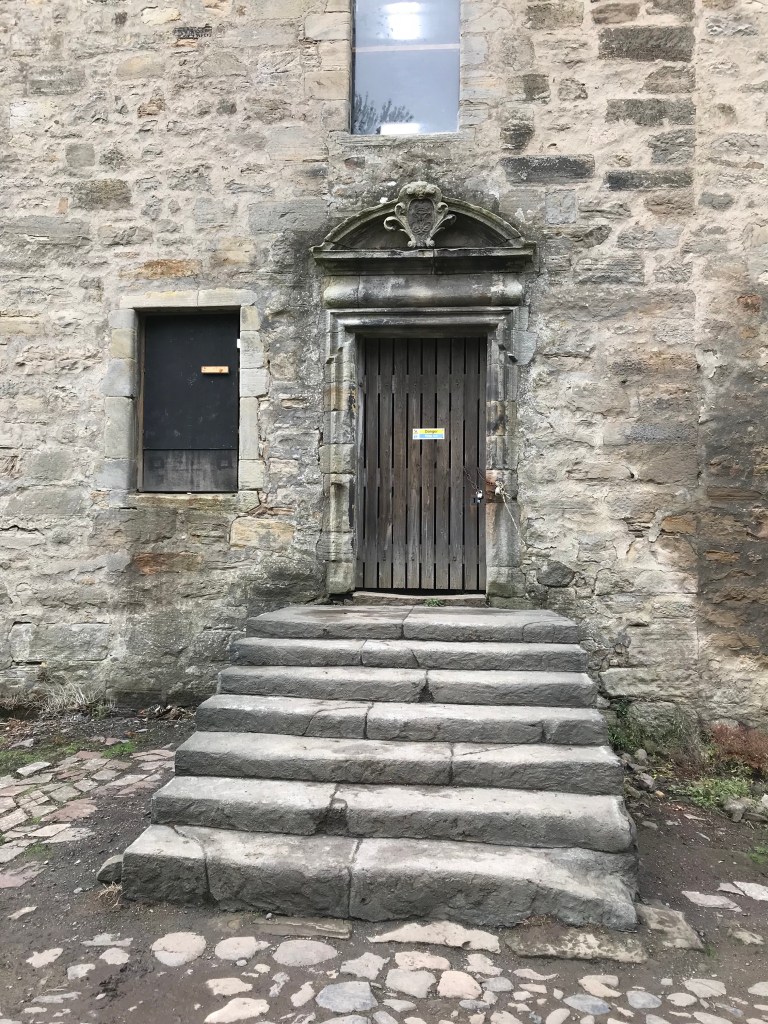
Midhope Castle was a shorter visit as we could not explore inside. The interior of the building is in a dangerous state of disrepair, although the outside still looks solid. It’s really too bad it wasn’t kept up, because it looks like it would have been a fine home. We certainly understand the attraction for the Outlander producers to use the site to represent Lallybroch. As Dan has mentioned at least three times today, this is the first site we’ve seen that you knew where you were the moment you saw the building. I wonder if Dan is going senile…?

There it is!
Lallybroch…
I mean, Midhope.

About five hours later we returned to Edinburgh. You know that point when you’re so hungry you don’t know what you want to eat and therefore cannot decide on what to eat? Yeah, here, that resulted in eating Mexican food in Scotland. The Mexican food was really good, despite not exactly fitting into our Scotland theme.

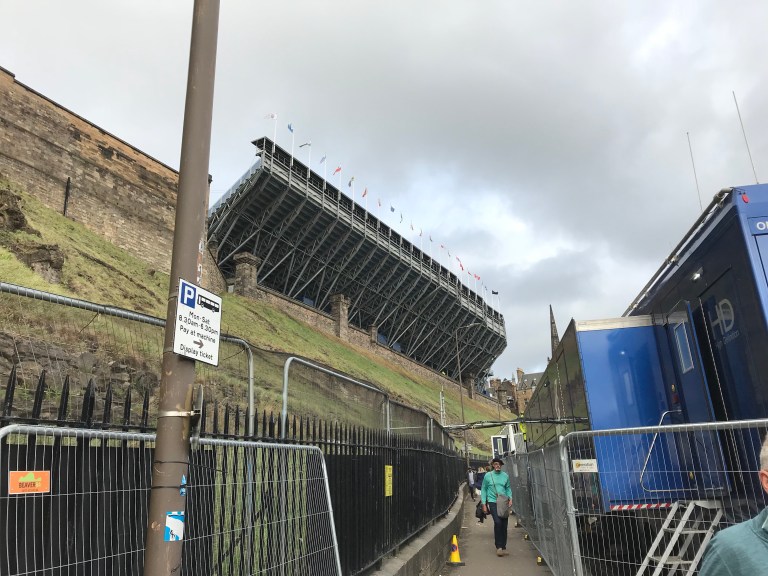
On our way to find food, we happened to walk up alongside the Edinburgh Castle terrace. You know, the one surrounding the esplanade where the Tattoo is performed? Yes, that one. You can’t really appreciate the engineering of the bleacher support structures until you see them hanging over the rock face. Dan’s comments: “Last night whilst everybody in the audience was swaying in unison while singing Auld Lang Syn (sp), I was gauging the deflection in the floor to see if a resonant structural failure was imminent, while simultaneously looking for an exit route, be it over or through women, children or old people. And there were LOTS of old people.”

Now we have an few hours before our next show (Rachel Parris’ A Musical Comedy), so thought it best to take the opportunity to write this blog. Especially appropriate since we won’t get out of the show until Midnight, and we drive all day to our next destination tomorrow.

We promise not to have any more noteworthy adventures today. But if we do, I’ll tell you about it tomorrow.

Adelle and Dan
“Boss! Da plane! Da Plane”

It rained again today. But it’s okay, because we started the day spending money on two new rain jackets, so we didn’t get quite as wet as we could have. Despite taking a boat ride.

Yes, a boat ride. And we even stood on the top deck for the outward sailing. In the rain. Where we couldn’t see half the points of interest referenced by the guide due to the fog. Stupid Canadian northerners, you’re probably thinking. But you’d be wrong! Because in this case it was the destination that was worth the journey. We went to Inchcolm Island and explored Inchcolm Abbey. Or what’s left of it. Which is actually quite a lot. It is the best preserved medieval abbey in Scotland. The Abbey was built by King David I on behalf of his late brother King Alexander I. Alexander went and got himself stranded on Inchcolm Island in 1123, where he and his retinue were helped by a hermit living on the island until they could be rescued. Alexander was so grateful to the hermit, he promised to build the abbey there as a thank you. Now, as I type that, I find myself wondering how appreciative a hermit would actually be to suddenly have a bunch of monks sharing the small island with him…

Dan doing his Kal Drogo impression.

Anyway, we had a great time exploring, we saw some grey seals, and Inchgnome Island.

Our next stop was supposed to be to see Frankie Boyle’s show, but I underestimated when we’d be back to shore from Inchcolm Island, so we missed the show. Instead we took a leisurely stroll up The Royal Mile, I got me some dark chocolate fudge, and we made our way (in more rain – good thing we have proper rain coats now) to The Scottish Cafe and Restaurant. Why there? Because I splurged and got us the Piper’s Package to see the Royal Edinburgh Military Tattoo, that’s why! The package included a light supper at the aforementioned restaurant, with a piper’s escort to Edinburgh Castle, and reserved seating at the event.

So we sit at our designated table at the restaurant and an older couple sits down with us, so we start talking. You know, where are you from, what do you do, that kind of thing. The couple, it turns out, are originally from England, but have been living in Australia for the last 50 years. I’m helping the lady put her hospitality wristband on and she makes a comment about her husband being an engineer. I look at her and comment that so is mine. Her husband says he’s a mine engineer. In my head I’m like, seriously? A mine engineer from Australia? I look at him and Dan and say, you two need to talk. So you say you work at a mine? Yes. Which one? Rio Tinto. Really? Yes. So does he, I say, referring to Dan. So, yeah, they talked. What are the odds? We had a lovely conversation over supper.

After supper, as mentioned, we walked up to the castle for the tattoo. Which was a great show. The theme this year celebrated the 100th anniversary of the Royal Air Force and young people. There were performers from all over the world. And my favourite thing of all: Switzerland’s Top Secret Drum Corps was there! Don’t get me wrong, everyone was great, but Top Secret is just phenomenal! Precision drumming at its finest. YouTube them! Right now! Go on…

Adelle and Dan
P.S. Bonus points to anyone who gets the title reference.