Go Boil Your Bottoms, You Sons of a Silly Person

March 13th – Day 9 – Heidelberg Stroll

We arrived in Mannheim this morning around 3:00 a.m. — yeah, we didn’t notice until we got up. Our tour was scheduled to leave at 9:00 a.m., so again we had to get up earlier than I’d like during a vacation, but there was always that ridiculously good buffet breakfast waiting for us. Honestly, it’s the breakfast that’s going to kick me in the butt when we get home because I usually skip breakfast.

Off we went on our walking tour of Heidelberg. Our tour did not take us to Heidelberg Castle, but it brought us by it. There was another tour that would have included the castle, but we were warned that there was a steep hill involved. We later learned that it ended up not being a big deal because they managed to arrange for a shuttle to bring the guests up that hill instead of walking it. So that was a little disappointing for us. But the stroll was lovely nonetheless.

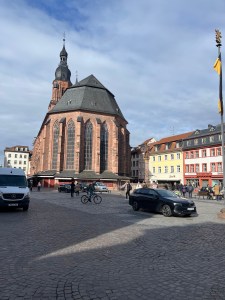
We strolled through the Markplatz where the Church of the Holy Spirit overlooks. It was constructed between 1398 and 1515, and those red doors you can just see below awnings under the long windows were where various market sellers would set up shop every day, and still do (they were open later in the morning today). There are carvings on the walls beside some of them, indicators of what the shops would sell. At the bakery stall the carvings were of different sized bretzels (pretzels, but bigger and softer products than the sticks we get in North America). If the customer questioned whether they got the size of bretzel they were paying for they could hold it up against the carvings to confirm.

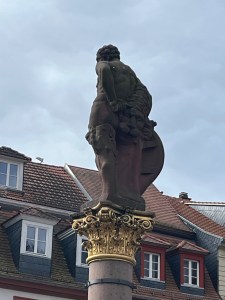
The Hercules Fountain in the Marktplatz was completed around 1706, commemorating the reconstruction of the city after the Nine Year’s War. The “official” description suggests Hercules is holding a lion skin symbolizing strength and resilience. Our guide told us the generally accepted subtext was that Hercules was sculpted to hold the lion’s head against his butt in yet another Rhineland insult to the French.
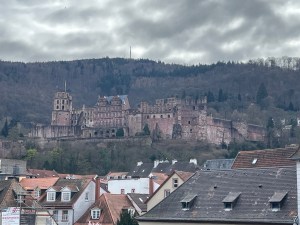
Heidelberg Castle
Church of Our Lady at Marktplatz
Hercules Fountain
Bruckentor

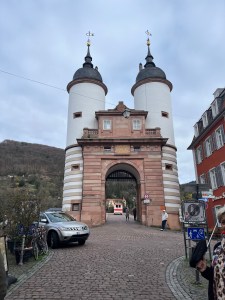
The Bruckentor (Bridge Gate) leads to the Old Bridge spanning the Neckar River. There’s a sculpture of a monkey (baboon, actually) at the base of the gate called the Bruckenaffe. This one is made of bronze and replaces a 15th-century stone version, and there are a pair of small bronze mice right next to it. Apparently the baboon represented mockery and points its butt towards the city’s border to show the Elector’s power over the passing bishops, and it holds a mirror that is meant to encourage self-reflection or remember where you come from. Similar to the Tunnes und Schal statues, the baboon and mice have good luck rituals, too: rubbing the mirror will bring you money or wealth; rubbing the baboon’s fingers will ensure you return to Heidelberg, and rubbing the mice will bring you fertility. The bronze version of this baboon’s face is actually hollow, which tends to unintentionally (?) invite people to stick there head in it like a mask. Our guide did not recommend actually doing this as you do run the risk of getting stuck… and then there’s of course the unhygienic part of it. I thought I took photos of the monkey and mice, but apparently I did not. Oops.
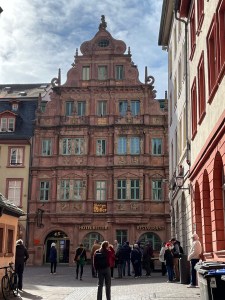
We had some free time here, so Dan and I wandered back down the Hauptstraße (main street), which is one of the longest pedestrian shopping streets in Europe. Lots of modern recognizable chain stores, but also lots of cobblestones, cafes, and boutiques. During the tour we passed by our guide’s favourite little cafe, so we returned to Chocolaterie Yilliy and ordered (at her recommendation) Spanish hot chocolate — which of course was just melted chocolate, thick almost like pudding but drinkable. They even provide a wooden spoon with the drink. We took our pudding drinks and walked back along the river boardwalk towards the bus pick up location.
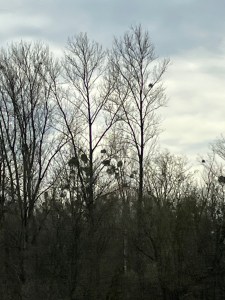
The bus ride back to the ship did not return us to the same place we disembarked. It had moved on down the river and picked us up in Germersheim. Along the drive many of us noticed these odd balls on many of the trees that looked like nests. But there were so many of them we agreed they couldn’t possibly be nests. A little Google searching as we drove and we learned that they are actually European Mistletoe, which is a hemiparasitic plant that draws water and nutrients from the tree it grows on. There you go; your horticultural lesson for the day.
We spent the afternoon shipboard having lunch, partaking in another trivia game, watching a World of SCENIC presentation, trying to finish the Day 2 Sudoku, and engaging in the Daily Port Talk with Cathy.

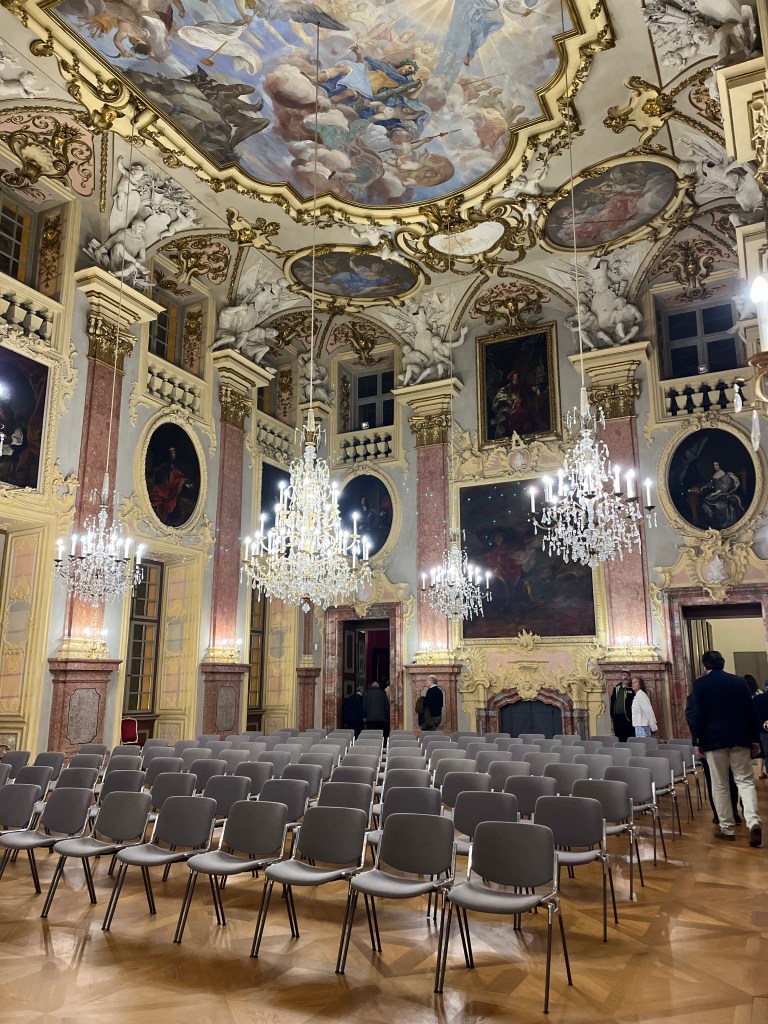
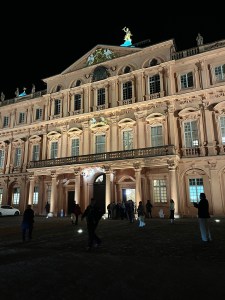
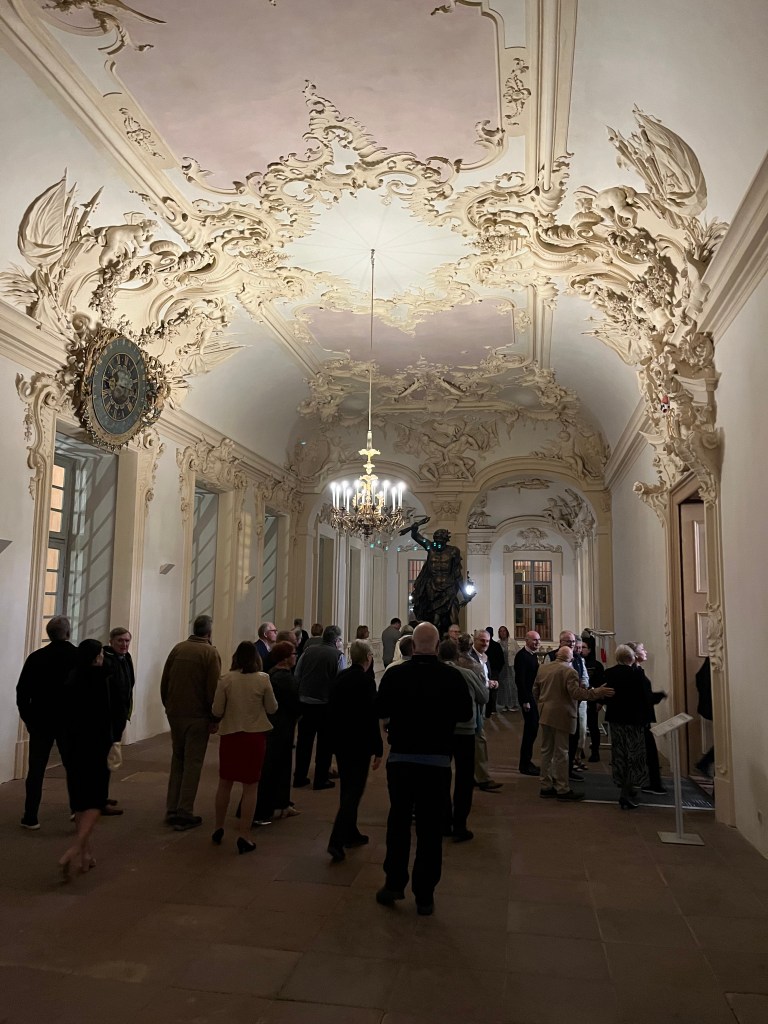
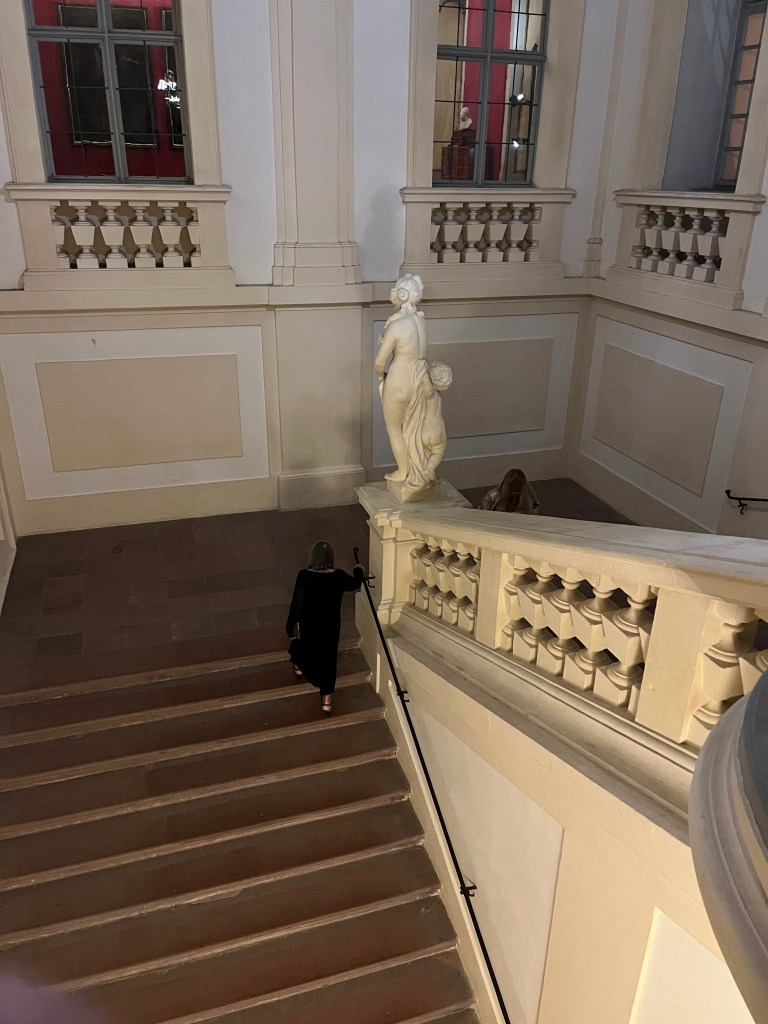
Shortly after arriving in Rastatt we all got as gussied up as we wished (honestly, Dan and I were moderately dressed up, but I did wear my Scottish shawl). Why? Oh, nothing special, just a classical concert with opera singers and a pianist at Rastatt Palace. It was wonderful! We arrived by bus, were escorted into the palace, served champagne, toured around some of the restored rooms, and then enjoyed the performance.

Rastatt Palace was yet another building meant to one-up Versaille. It was the first Baroque residence on the Upper Rhine, built between 1700 and 1707 for the Margrave of Baden-Baden and his wife. It is one of the only palaces that was not damaged during WWII.
Gute Nacht!

Adelle and Dan
If the River Starts to Rise, Head for the Beer Hall

NOTE: I have done extensive editing and additions to the previous posts for this trip. I wasn’t happy with what I had produced while travelling, so I suggest it may be worthwhile to revisit those posts.

Day 8 – Walking Tour of Koblenz

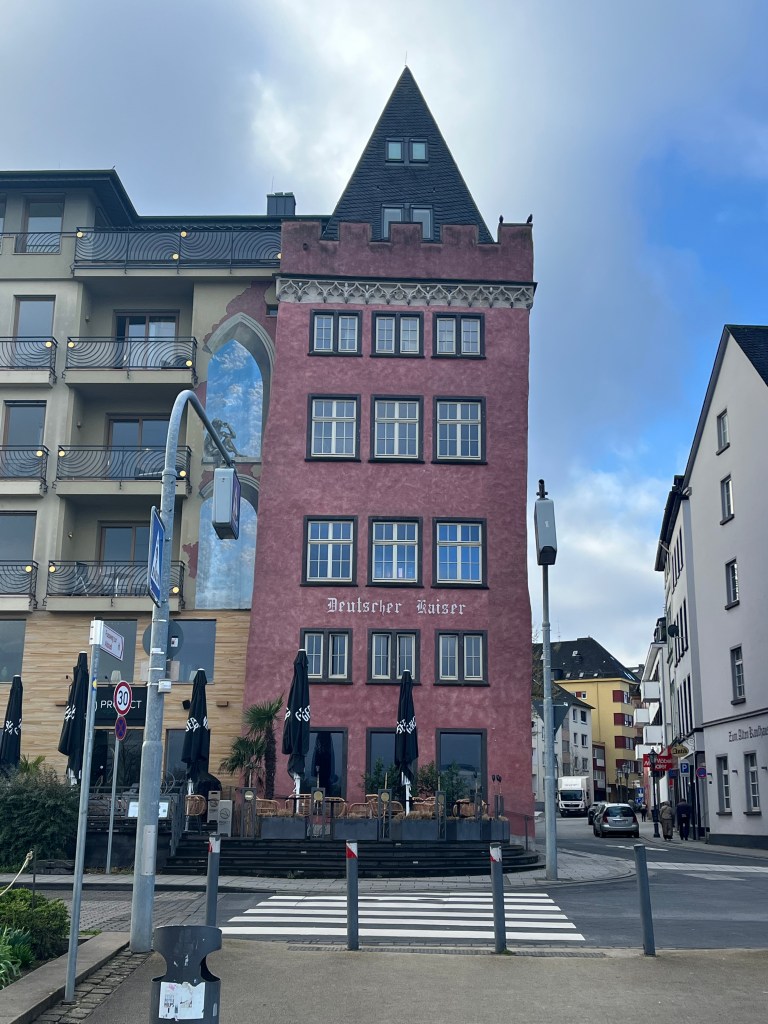
After breaking our fast at the wonderous buffet too early for my personal liking, we left the ship at 9:00 a.m. for the Koblenz walking tour. Our walking tour took us around the main historical town of Koblenz. We started with identifying the oldest remaining building (in pink) after the last time the entire town was destroyed by Allied forces, against which a new building was directly attached (in yellow). This was designated as our landmark if we got separated, given it was near where our ship was docked.

Ehrenbreitstein Fortress

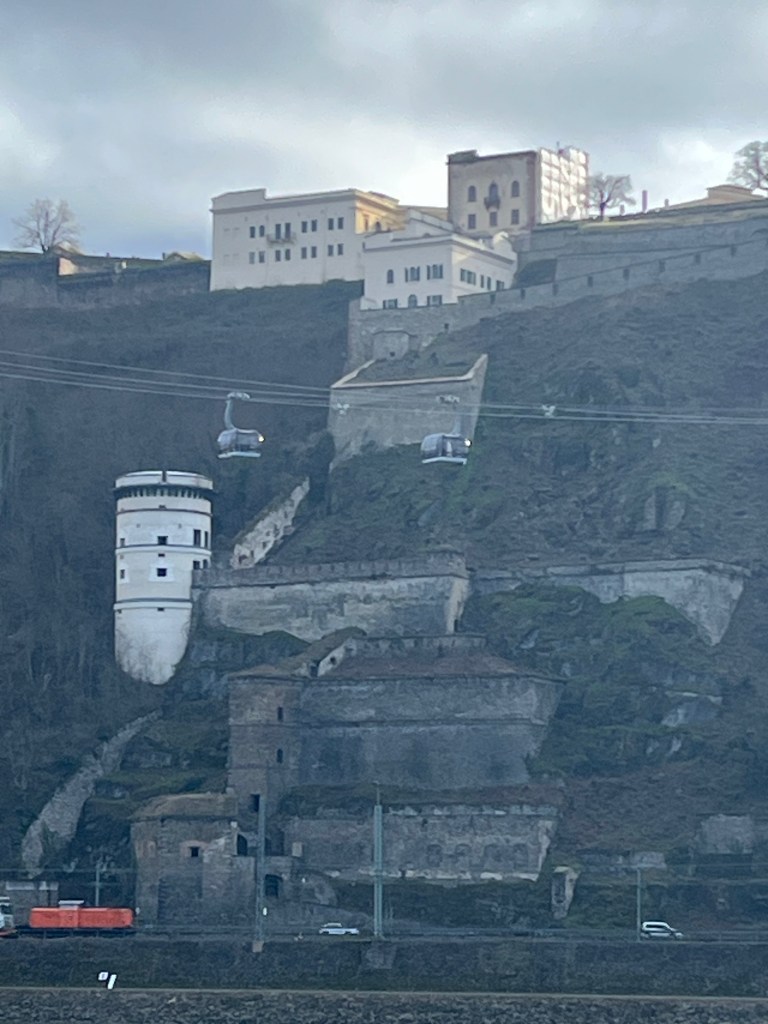
As we walked away from our ship, towards the triangle point that marks where the Mosel River meets the Rhine River, you can see across the Rhine a fortress sprawled up high on the hill. This is the Ehrhenbreitstein Fortress. It was built over the remains of an earlier fortress destroyed by France in 1801, and now houses a state museum. There’s a modern gondola that connects the west side of the river up to the east side where the fortress is. Most of the locals aren’t very happy with the design of the gondola station given its modern look placed in the heart of the historical district, and the potential impact it could have on their UNESCO funding. We did not actually go up to that fortress.

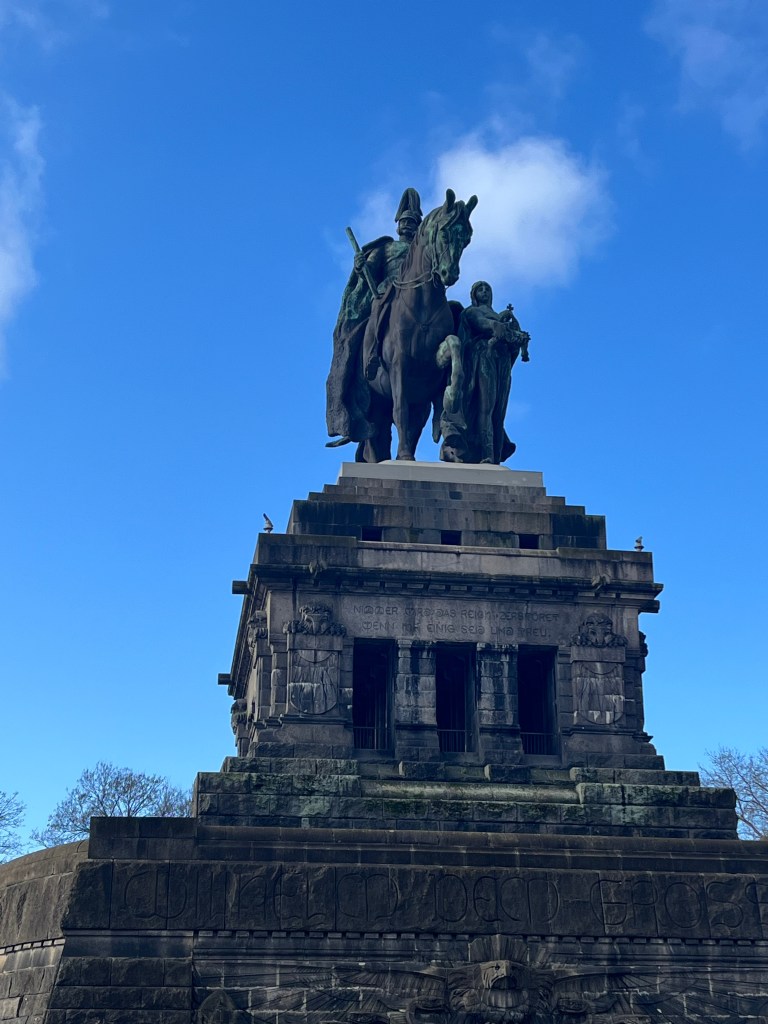
Emperor Wilhem I with the winged female genius loci

Emperor (Kaiser) Wilhelm I was honoured with this statue placed at the “German Corner” for unifying Germany. It was placed three years after his death, and inaugurated by his grandson Kaiser Wilhelm II. There is a winged female genius loci standing next to the Emperor’s horse, representing the spirit or guardian of the place.

The Teutonic Knights’ House was the first branch of the Teutonic order in the Rhineland, in 1216. The grounds were given to this branch and included a hospital for the poor. The Teutonic Order is still active in Koblenz today, although the house itself now contains a museum.

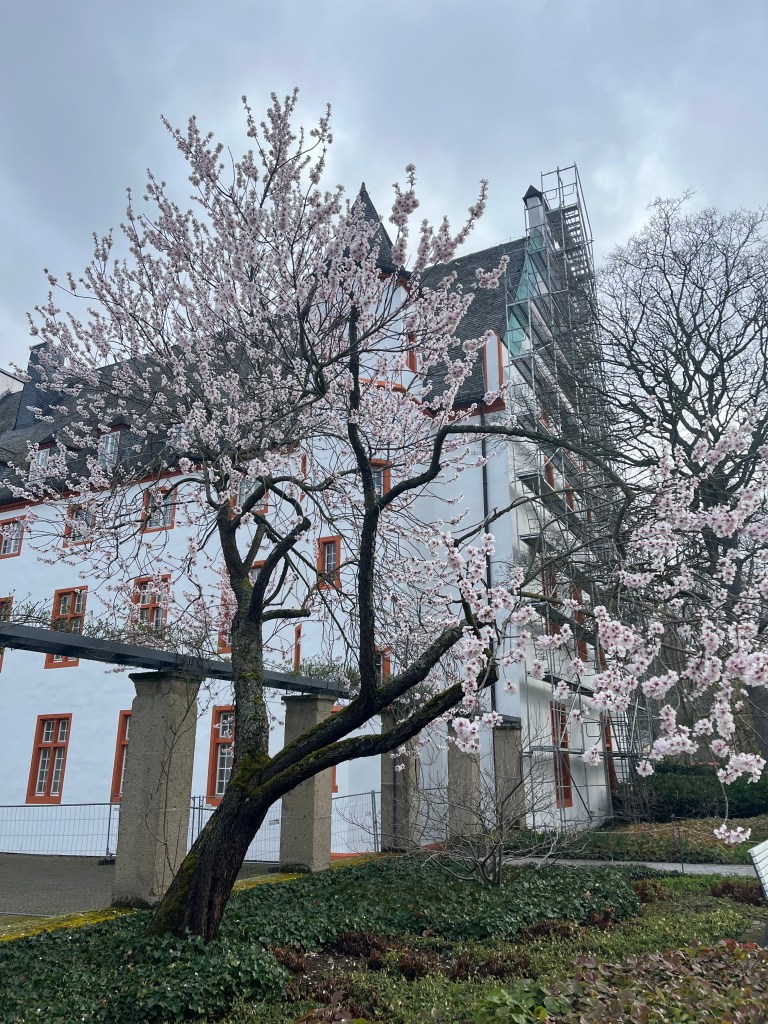
The cherry blossoms were amazing throughout this trip. This one was on the beautiful grounds of St. Castor Basilica.

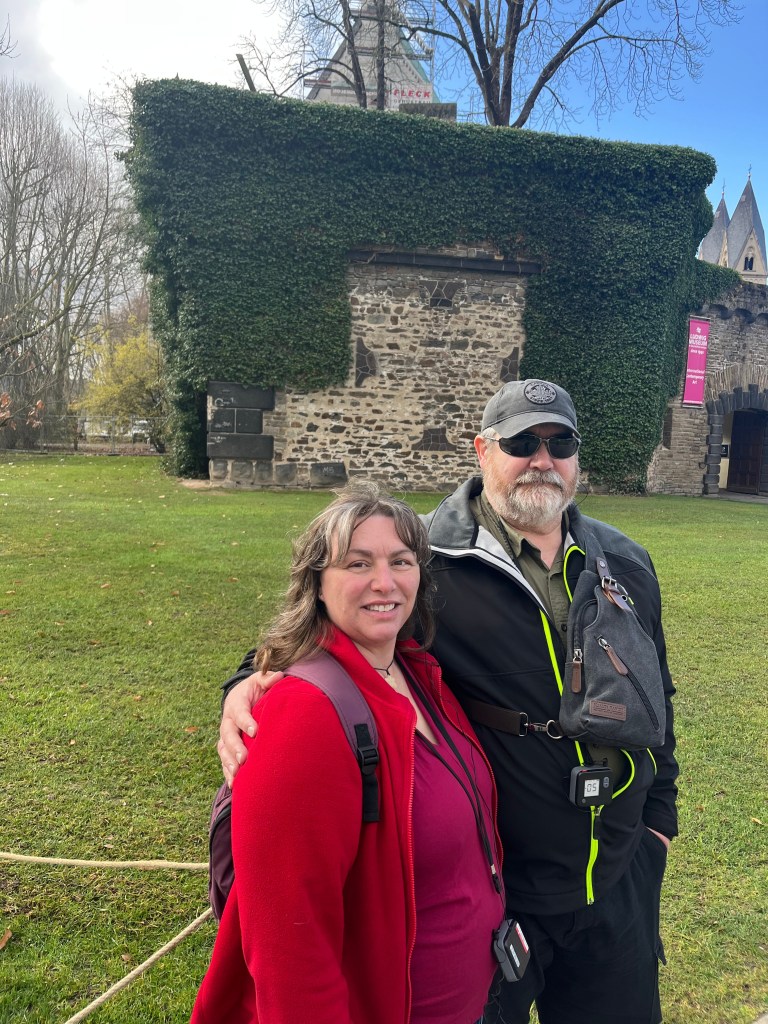
In front of the Teutonic House.
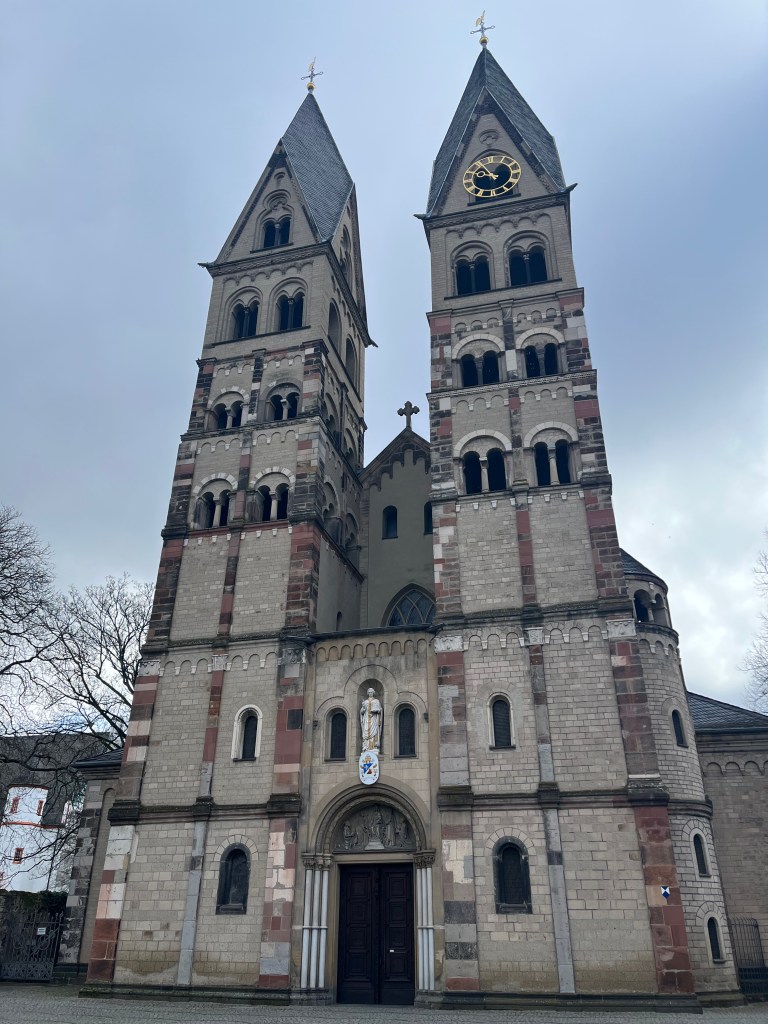
St. Castor’s Basilica
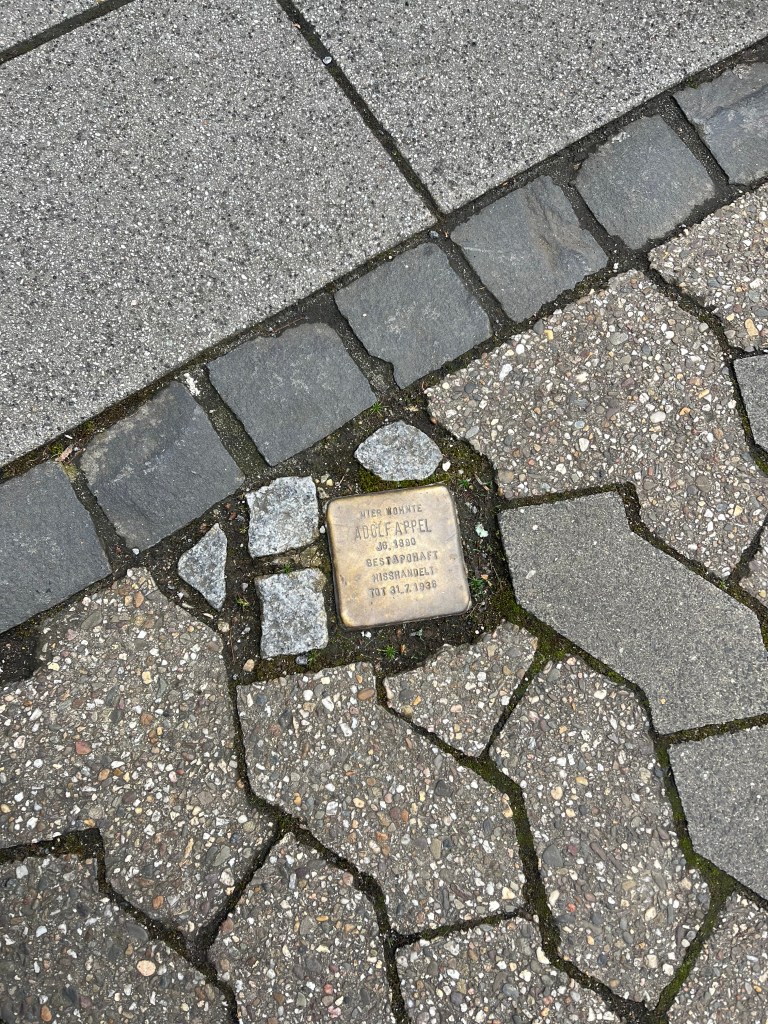
A Stumbling Stone

These are called Stumbling Stones, and they’re in places throughout Europe identifying the homes of people who were taken by the Nazis. These do not just recognize and remember Jewish people, they also remember other peoples from other cultures who were also taken. The stones are purposely placed slightly off from the surrounding cobblestones so they are tripped on (stumbled over) and noticed. We found them to be very sobering reminders to never let such atrocities happen again.

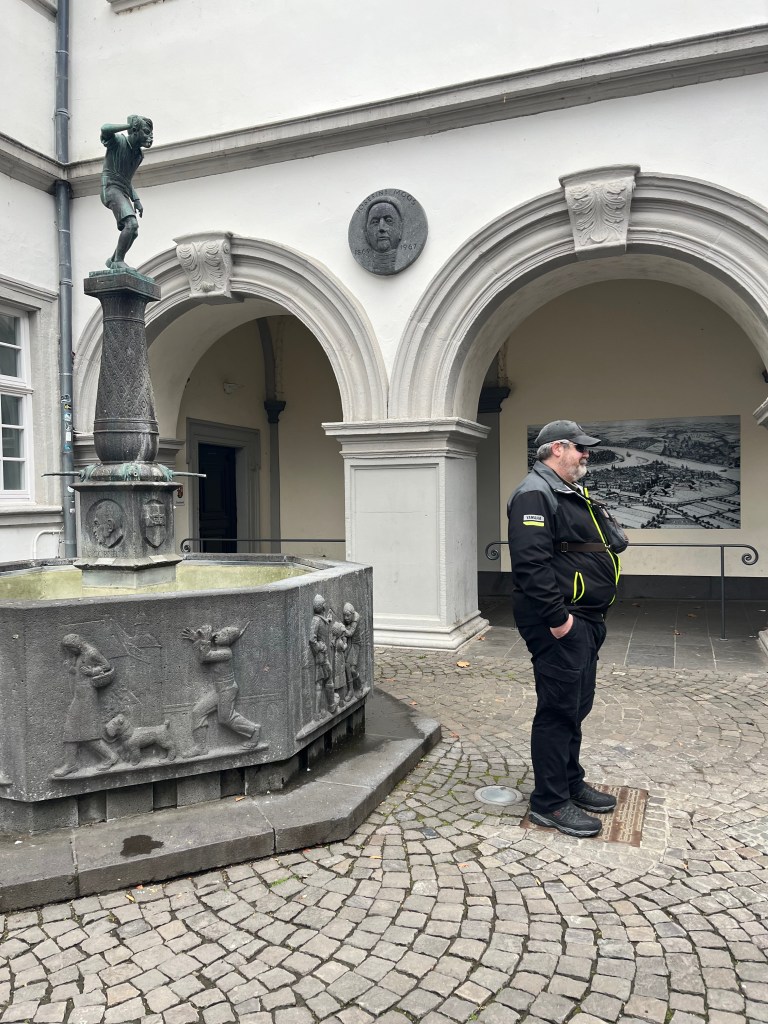
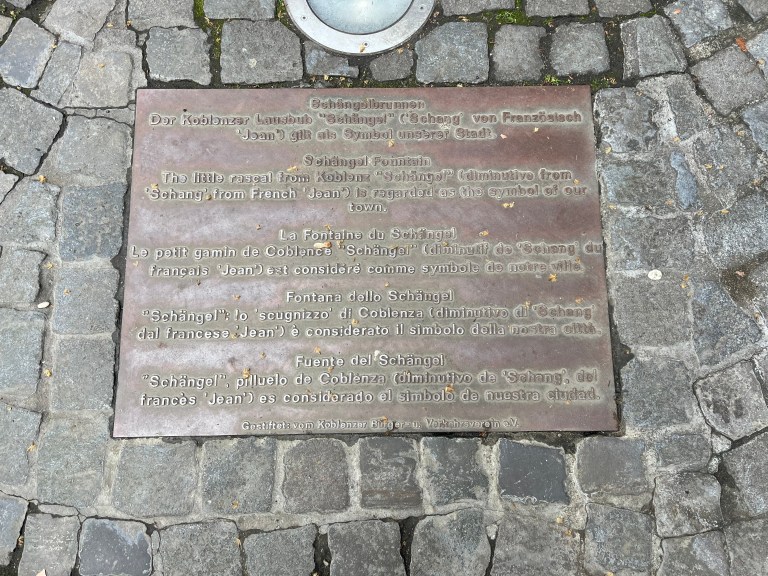
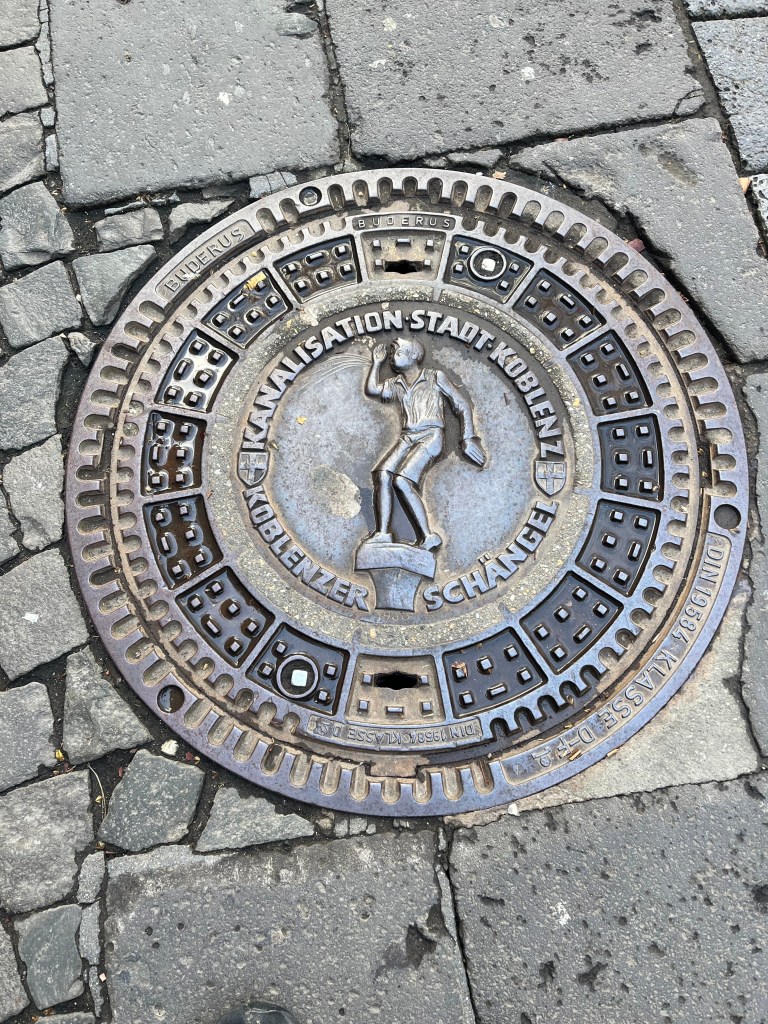
For about 20 years in the late 18th and early 19th centuries Koblenz was affiliated with France. During this time the French soldiers who occupied the town had children with the German women, often naming them Jean (Johann or Hans). When the French released Koblenz back to Germany, the French soldiers left the German women and their children behind. Over time the name Jean became Schang and eventually Schangel, referring to the German-French children. Those children grew up without fathers, and often were considered “rascals”. They apparently would go around spitting playfully at passersby and running away. Eventually, all native Koblenzers considered themselves Schangel, and being spit on by the Schangel children was a right of passage for newcomers to be accepted into the community as natives. In 1940, this fountain with a spitting child was built and dedicated to the poet who wrote the lyrics to the Koblenz anthem, Schangellied. There’s a plaque on the ground in front of the fountain where people can stand, and every few minutes the statue will spit a jet of water splashing you and effectively making you a Koblenzer. It wasn’t actually working while we were there, so Dan did not get to become a Koblenzer. The manhole covers throughout the community also depict the Schangel.

The Schangel Fountain
The Schengal Fountain Plaque
The Schengal Manhole Covers
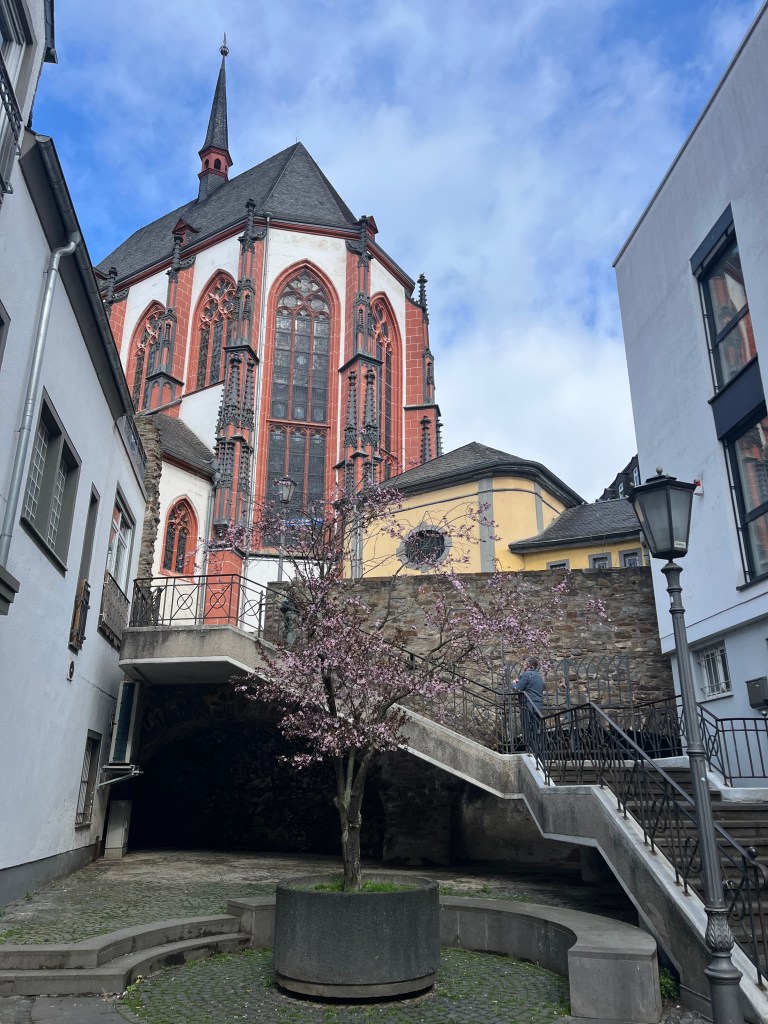
The Liebfrauenkirche (Church of Our Lady)

The Liebfrauenkirche (Church of Our Lady) has its beginnings on this highest point of the city dating back to the 5th century. The Franks built a place of worship in a previous Roman building, and it was rebuilt several times using the original foundations. This photo shows architectural elements from at least four eras, starting at the bottom: Romanesque from the 12th and 13th Centuries; Late Gothic from the 15th Century; Baroque from the 17th Century; and Reconstruction from the 20th Century (after severe damage during WWII). I just love this image. I should really consider printing and framing it…

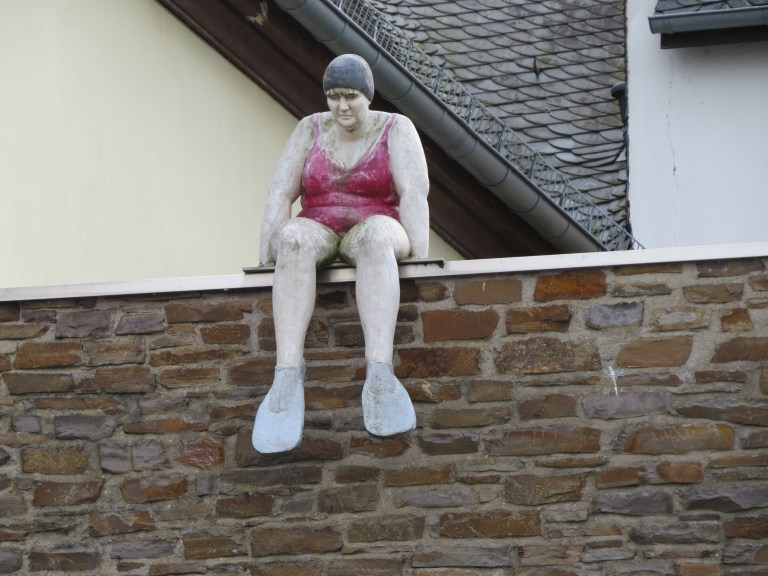
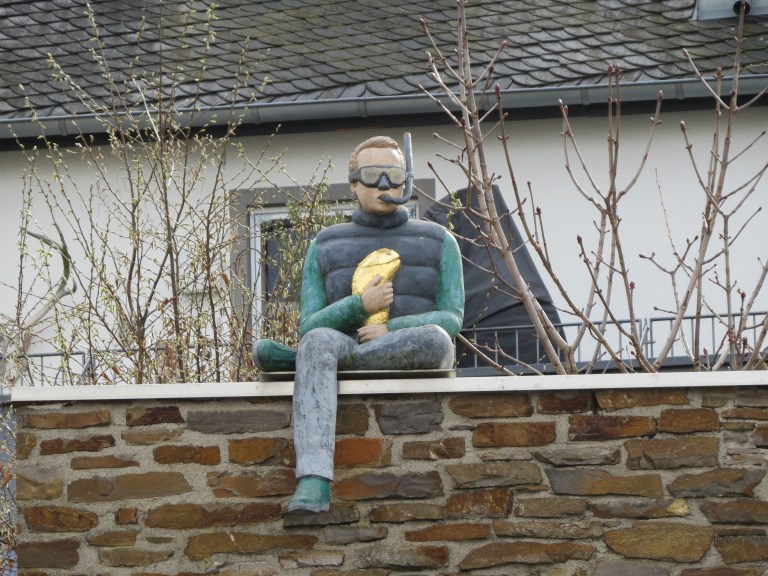
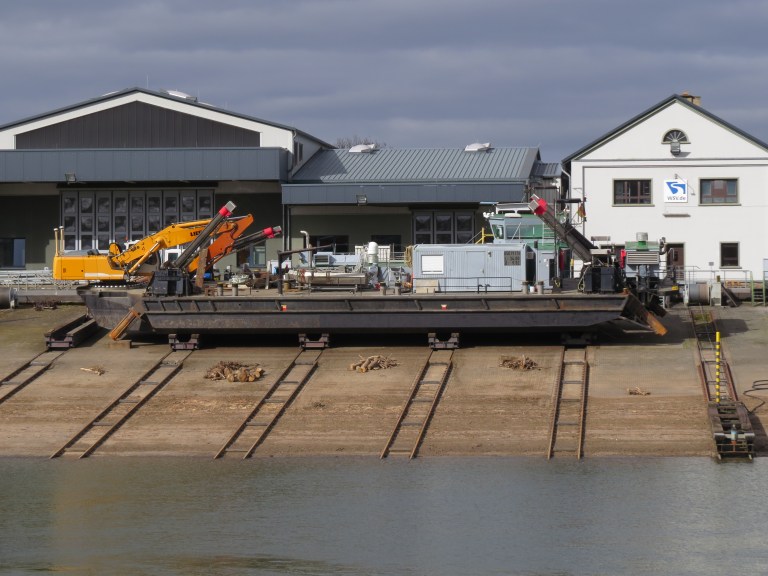
At the shore where our ship was docked there were these statues placed high on the stone wall. They were rather disconcerting at first glance because they’re just good enough that you might think they were real people. Across from the Mosel from the dock they shored the dredging ships for repairs and probably storage. It looks like they would winch them up the rails, and then release them to slide back into the water when needed.

We had a little bit of time to ourselves before we had to head back to the ship, which left the port at 1:45 p.m. heading for Mannheim. Our “tour” wasn’t over this day, though, given the next several hours would take us through the Rhine Gorge. This is where the majority of the castles and other sites would be seen. The Gorge is generally well protected from the worst weather, with high hills on both sides and several curves. One side would get sunny and warm enough that there were several vineyards planted on the hills. Today was a bit cool and windy, but we parked ourselves on the sundeck recliners at the front of the ship to watch the show. My Scottish shawl came in handy today for this. Dan used his real camera and got some amazing shots, a few of the best follow with captions.

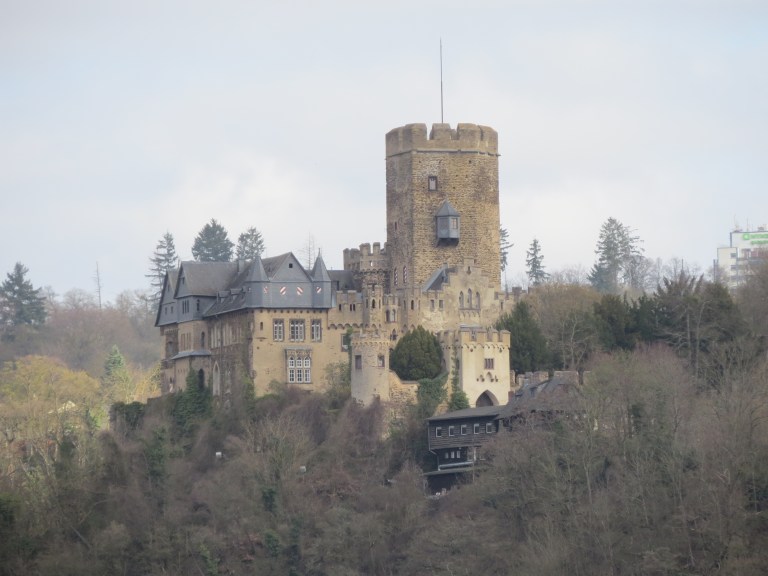
Lahneck Castle (Burg Lahneck)
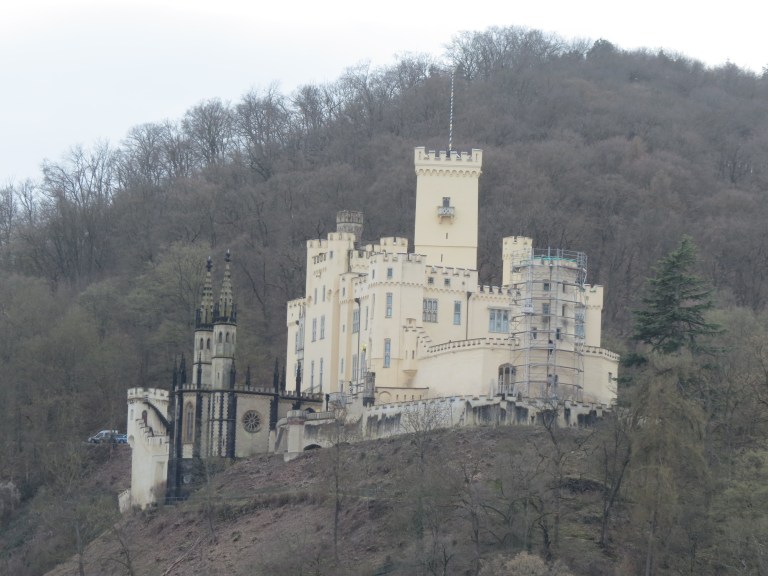
Stolzenfels Castle – Rebuilt in the 19th century for the Prussian Crown Prince
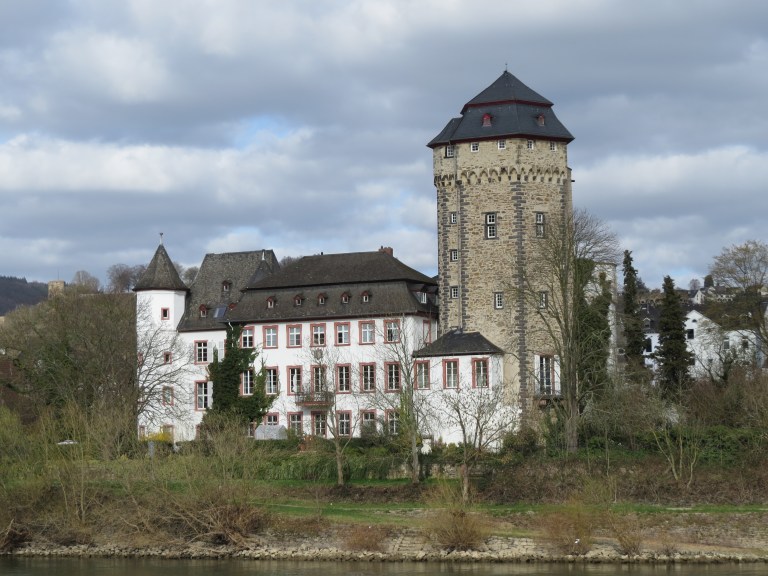
Schloss Martinsburg

Lahneck Castle – Tragedy of Idilia Dubb: A famous tale tells of a 17-year-old Scottish tourist who allegedly died of thirst in the castle’s tower in 1851 after the wooden stairs collapsed behind her. Apparently her remains were not found until 10 years later by construction workers doing renovations.

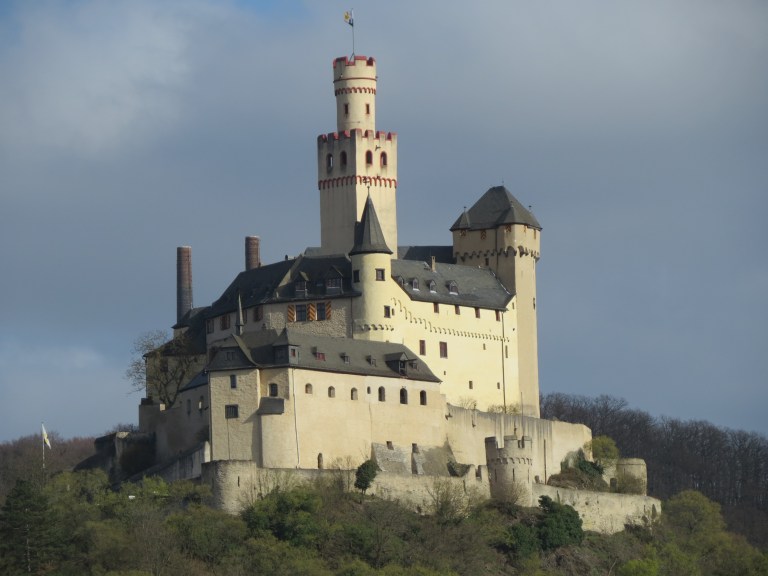
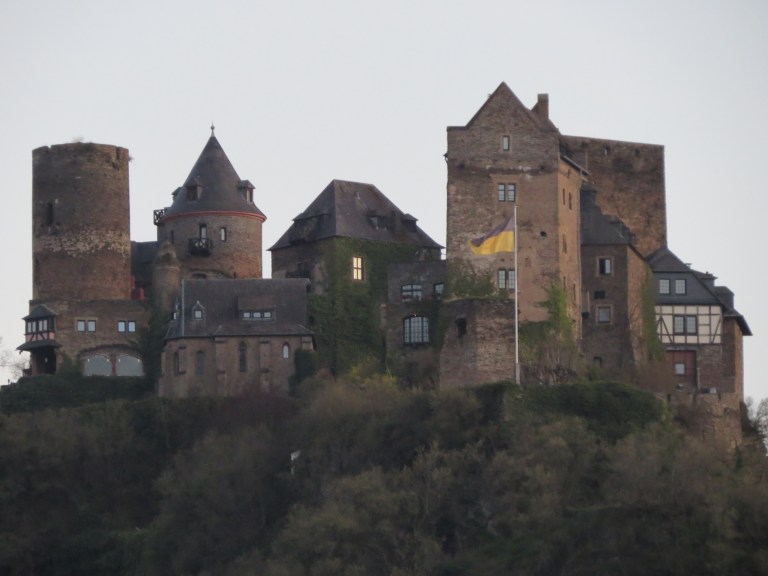
Marksburg Castle is unique among Rhine castles for never having been destroyed in its 600-year history.
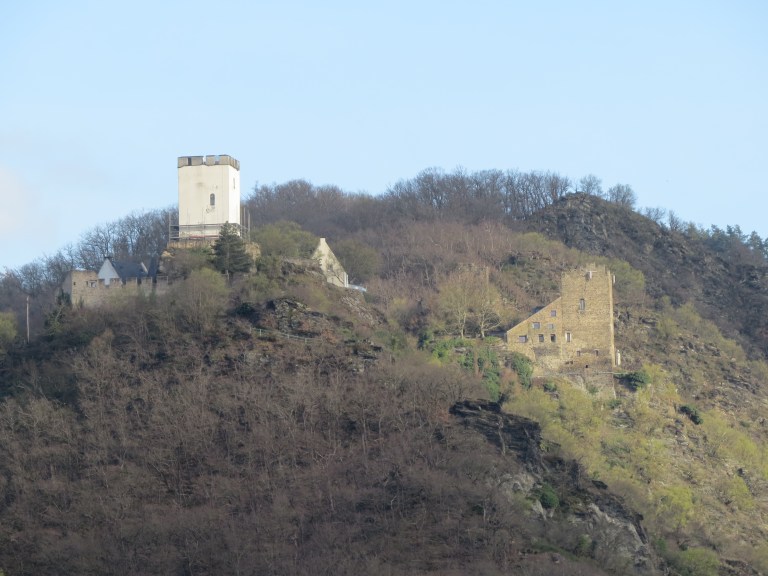
Sterrenberg Castle and Liebenstein Castle, known as the Hostile Brothers Castles

The legend of the Sterrenberg Castle and Liebenstein Castle is that in the 13th Century two brothers inherited the land from their father, circumventing their blind sister’s interest. They got into a feud and built each their own castles in proximity to each other, building a wall between them ever higher. By the time they finally reconciled somewhat, they ended up only having a few years together before one of them died.

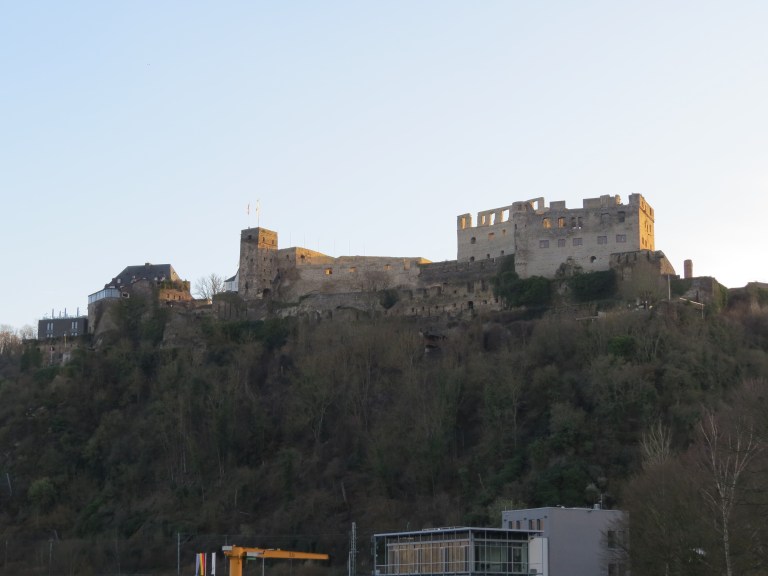
Rheinfels Castle (Burg Rheinfels) was once the largest and most powerful fortress along the Middle Rhine Valley
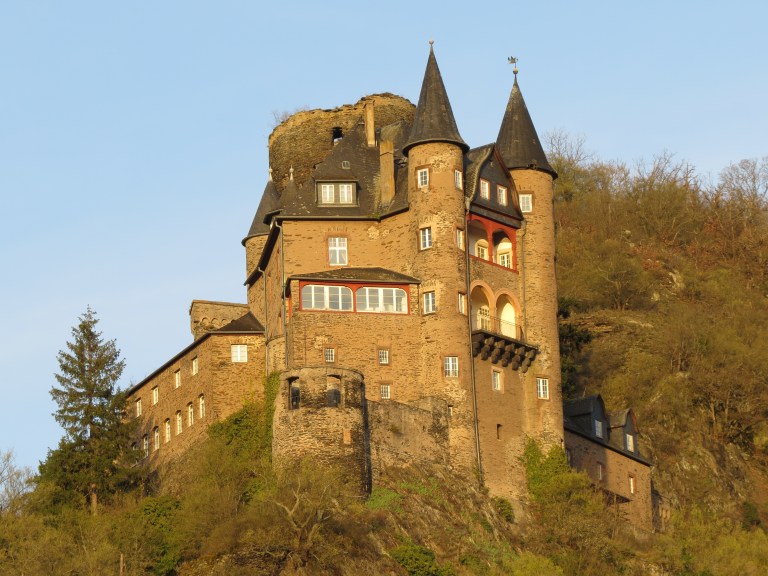
Katz Castle (Burg Katz) was built around 1371, destroyed in the 18th Century, and then completely rebuilt in the late 19th Century. It is now a private residence – can you believe that???
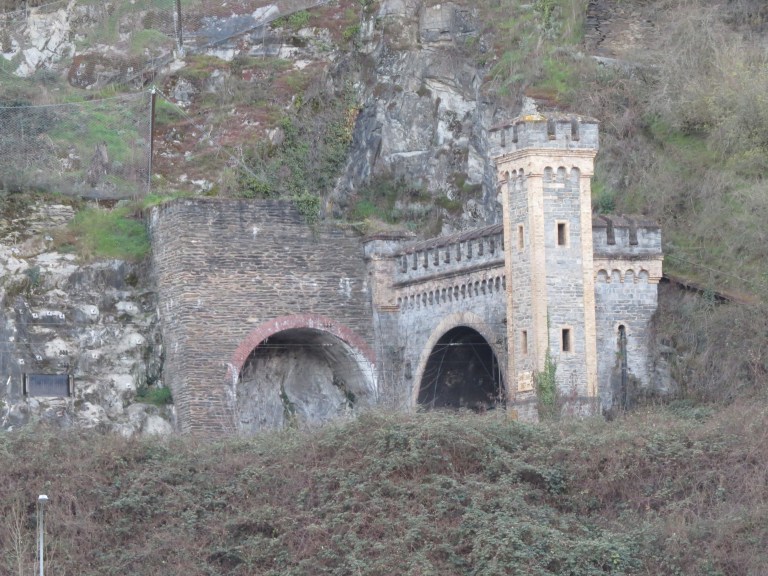
A historic railway tunnel portal built in the mid-19th Century, but designed to resemble a medieval castle tower. During WWII the design helped disguise the tunnels from Allied bombing raids, which often tried to avoid destroying historic monuments.

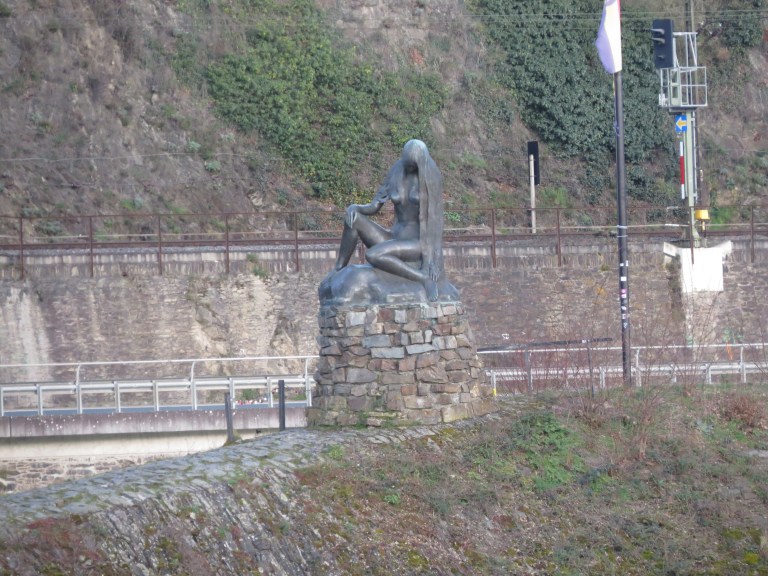
The Lorelei Statue is situated near the Lorelei Rock, which is a 132-metre-high slate cliff in a stretch of the river known for treacherous currents. The legend is that a maiden from German folklore sits on a rock in this area and lures sailors to their doom with her song. I figure Dan’s tinnitus saved him from this particular fate.

The Lorelei Statue
Schonburg Castle was originally built in the 12th century and served as a royal castle and then a toll station.

All that watching for castles and such caused me to completely forget about the Corn Hole tournament that was held on the aft side of the sundeck, well behind where I was sitting in the fore. Ah, well. After the Daily Port Talk and supper, we participated in “Name That Tune” with Hannah. Yes, that’s right, you heard me: WE participated in yet another social gathering!

Gute Nachte!

Adelle and Dan
P.S. You’re probably wondering about the title of this post. Well, the Rhine and Mosel are known historically to flood on occasion and in Koblenz along the German Corner they have several places where you can see the high water marks and where they’ve specifically marked how high the floods have gotten. We could have sworn that the guide said something about one of the historical beer halls we passed was designed to be lifted above the high water when it floods, and that it would be a safe place for the residents to go. I’m not sure we heard the guide correctly though, because nowhere in my post-trip research can I find any references to such a thing. So either he was pulling our collective legs or we misunderstood what he was telling us. Anywho.